
Area of a Circle as a Parallelogram – Demonstrating the Half‑Circumference Base
Loading the math board and drawing, please wait…
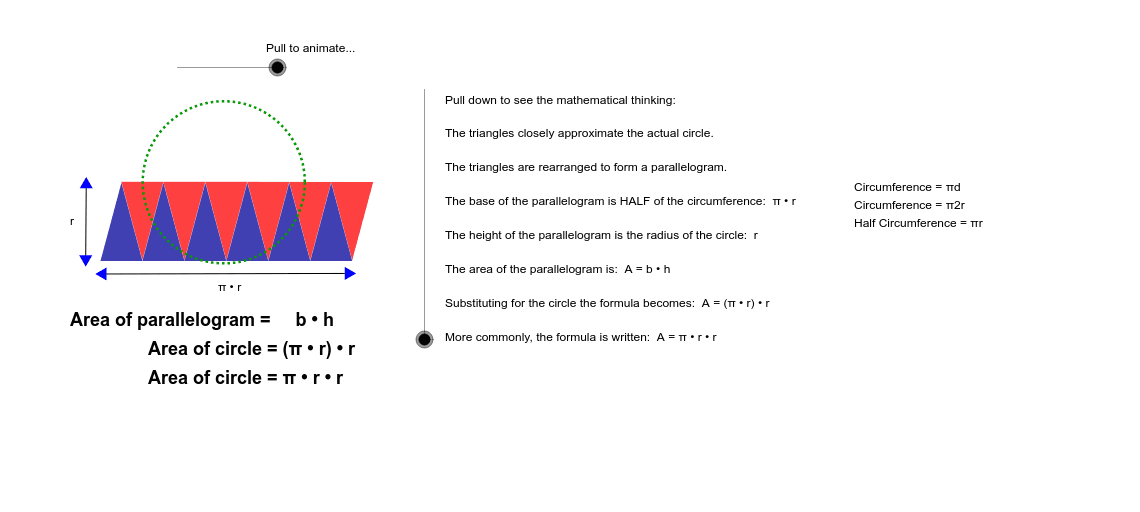
This GeoGebra example visualizes the classic proof that the area of a circle equals the area of a parallelogram whose base is half the circumference and height equals the radius. The construction uses the Circle command to draw the original circle, Point objects for the center and key vertices, Vector to create radius vectors, Translate and Rotate to reposition these vectors into a parallelogram shape, and Polygon to form the resulting quadrilateral. Additional commands such as Line, Angle, Mirror, OrthogonalLine, and Segment are employed to draw auxiliary lines and verify perpendicular relationships. The interactive applet is ideal for high‑school geometry classes, helping students grasp the concept of similarity transformations, vector addition, and area derivation through dynamic manipulation.
GeoGebra Commands & Parameters
Circle(A, a) → cPoint(c) → BVector(B, A) → uTranslate(C, Vector[(-u)]) → C'_2Rotate(C'_2, ((g / 100 * 15))°, C'_2) → C''_2Line(B, A) → bRotate(B, 30*°, A) → B'Angle(B, A, B') → αLine(B', A) → dCircle(C, a) → eVector(A, B') → vVector(B, B') → wTranslate(C, v) → C'_1Rotate(C'_2, 60*°, C) → C''_1Rotate(C'_1, 60*°, C) → DLine(C'_2, C) → fMirror(C'_1, f) → EMirror(C''_1, f) → C'''Mirror(D, f) → D'Polygon(E, C'_2, C) → poly1, c_1, e_1, c'Rotate(E, ((g / 100 * 15))°, C'_2) → E'_1Rotate(C, ((g / 100 * 15))°, C'_2) → C'_3Polygon(E'_1, C''_2, C'_3) → poly1', c'_1, e', c''Polygon(C''', E, C) → poly2, c_2, c''', e_2Rotate(C''', (g / 100 * β), F) → GRotate(E, (g / 100 * β), F) → E'Rotate(C, (g / 100 * β), F) → C'_4Polygon(G, E', C'_4) → poly2', c'_2, g_1, e'_1Polygon(C, D', C''') → poly3, c'''_1, c_3, d'Rotate(C, (g / 100 * γ), H) → C'Rotate(D', (g / 100 * γ), H) → D''Rotate(C''', (g / 100 * γ), H) → IPolygon(C', D'', I) → poly3', i, c'_3, d''Mirror(C', f) → C''_3Mirror(D'', f) → D'''_1Mirror(I, f) → I'_1Polygon(C''_3, D'''_1, I'_1) → poly3''_1, i', c''_1, d'''Mirror(G, f) → G'_1Mirror(E', f) → E''_1Mirror(C'_4, f) → JPolygon(G'_1, E''_1, J) → poly2''_1, j, g', e''Mirror(E'_1, f) → KMirror(C''_2, f) → LMirror(C'_3, f) → MPolygon(K, L, M) → poly1''_1, m, k, lOrthogonalLine(C, f) → hMirror(C', h) → C''Mirror(D'', h) → D'''Mirror(I, h) → I'Polygon(C'', D''', I') → poly3'', i'_1, c''_2, d'''_1Mirror(G, h) → G'Mirror(E', h) → E''Mirror(C'_4, h) → NPolygon(G', E'', N) → poly2'', n, g'_1, e''_1Mirror(E'_1, h) → OMirror(C''_2, h) → PMirror(C'_3, h) → QPolygon(O, P, Q) → poly1'', q, o, pMirror(K, h) → K'Mirror(L, h) → L'Mirror(M, h) → M'Polygon(K', L', M') → poly4, m', k', l'Mirror(G'_1, h) → RMirror(E''_1, h) → SMirror(J, h) → J'Polygon(R, S, J') → poly5, j', r, sMirror(C''_3, h) → TMirror(D'''_1, h) → UMirror(I'_1, h) → VPolygon(T, U, V) → poly6, v_1, t, u_1Vector((0, 0), (-3.27, 2.09)) → offsetvectorPoint(c) → WRotate(W, 30*°, A) → W'Angle(W, A, W') → δVector(W', W) → zVector(W', A) → w_1Polygon(TestPoint, E_1, D_1, J_1, TestB, Z, F_1, A_1, G_1, B_1, H_1, C_1, I_1) → poly7, testpoint, i_1, d_1, j_1, testb, e_3, z_1, f_1, a_1, g_2, b_1, h_1, c_4Translate(TestPoint, Vector[((g - 100) / 100 * w_1)]) → TestPoint'_1Translate(E_1, Vector[((g - 100) / 100 * w_1)]) → K_1Translate(Z, Vector[((g - 100) / 100 * w_1)]) → Z'_1Translate(F_1, Vector[((g - 100) / 100 * w_1)]) → L_1Translate(A_1, Vector[((g - 100) / 100 * w_1)]) → M_1Translate(G_1, Vector[((g - 100) / 100 * w_1)]) → N_1Translate(B_1, Vector[((g - 100) / 100 * w_1)]) → O_1Translate(H_1, Vector[((g - 100) / 100 * w_1)]) → P_1Translate(C_1, Vector[((g - 100) / 100 * w_1)]) → Q_1Translate(I_1, Vector[((g - 100) / 100 * w_1)]) → R_1Translate(D_1, Vector[((g - 100) / 100 * w_1)]) → S_1Translate(J_1, Vector[((g - 100) / 100 * w_1)]) → T_1Translate(TestB, Vector[((g - 100) / 100 * w_1)]) → TestB'_1Polygon(TestPoint'_1, K_1, S_1, T_1, TestB'_1, Z'_1, L_1, M_1, N_1, O_1, P_1, Q_1, R_1) → poly7'_1, testpoint', r_1, s_1, t_1, testb', k_1, z', l_1, m_1, n_1, o_1, p_1, q_1Mirror(TestPoint, h) → TestPoint'Mirror(E_1, h) → U_1Mirror(Z, h) → Z'Mirror(F_1, h) → V_1Mirror(A_1, h) → W_1Mirror(G_1, h) → Z_1Mirror(B_1, h) → A_2Mirror(H_1, h) → B_2Mirror(C_1, h) → C_2Mirror(I_1, h) → D_2Mirror(D_1, h) → E_2Mirror(J_1, h) → F_2Mirror(TestB, h) → TestB'Polygon(TestPoint', U_1, E_2, F_2, TestB', Z', V_1, W_1, Z_1, A_2, B_2, C_2, D_2) → poly7', testpoint'_1, d_2, e_4, f_2, testb'_1, u_2, z'_1, v_2, w_2, z_2, a_2, b_2, c_5Segment(G_2, H_2) → h_2Segment(I_2, J_2) → i_2