
Area Dissection of a Parallelogram
Loading the math board and drawing, please wait…
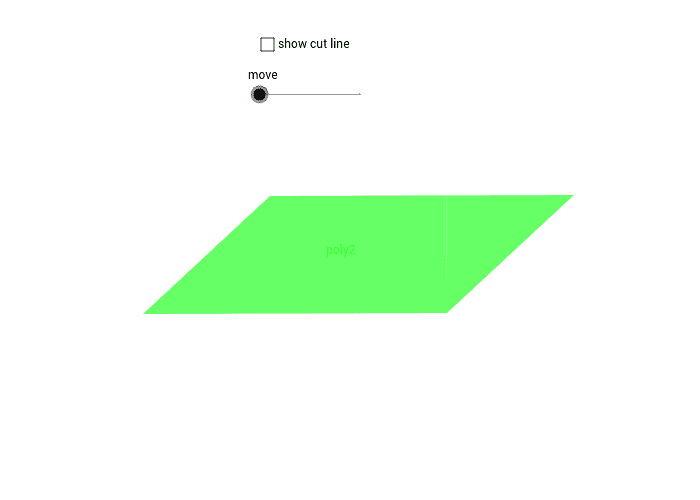
This example demonstrates the dissection of a parallelogram into a rectangle, showing how the two shapes have equal area through a geometric transformation. The core mathematics includes the area formula for a parallelogram (base × height), the rectangle area concept, vector representation of translations, and the principle that shear transformations preserve area. In GeoGebra the construction uses commands such as Segment, Line, Intersect, OrthogonalLine, Polygon, Vector, and Translate. Points A, B, C, D define the original parallelogram poly1, while vectors a, b are employed to translate and create an auxiliary polygon poly2, allowing an animated cut‑and‑reassemble process. The interactive model is ideal for high‑school geometry classes or university‑level courses on vectors and transformations, helping students visualize area equivalence and practice dynamic geometry software skills.
GeoGebra Commands & Parameters
Segment(A, B) → aSegment(A, C) → bLine(C, a) → cLine(B, b) → dIntersect(c, d) → DSegment(C, D) → eSegment(D, B) → fOrthogonalLine(B, e) → gIntersect(g, e) → ESegment(B, E) → hPolygon(B, E, D) → poly1, d_1, b_1, e_1Vector(D, C) → uTranslate(B, u) → B'Translate(D, u) → D'Translate(B, Vector[u * move]) → B'_1Translate(E, Vector[u * move]) → E'_1Translate(D, Vector[u * move]) → D'_1Polygon(B'_1, E'_1, D'_1) → poly1'_1, d'_1, b'_1, e'_1Polygon(E, C, A, B) → poly2, e_2, c_1, a_1, b_2Segment(E'_1, B'_1) → j
AI Drawing Prompt Reference
Draw a parallelogram ABCD, then dissect and reassemble it into a rectangle using translation vectors. First, draw the two sides AB and AC of the parallelogram, then draw the auxiliary lines and find the intersection point D. Next, draw the other two sides CD and DB of the parallelogram. Then, draw the diagonal DE of the parallelogram and use translation vectors to dissect the parallelogram into two parts, and finally reassemble these two parts into a rectangle.
The prompt above was compiled from the original drawing commands and is for reference only.