
Arc Hex Fractal 1
Loading the math board and drawing, please wait…
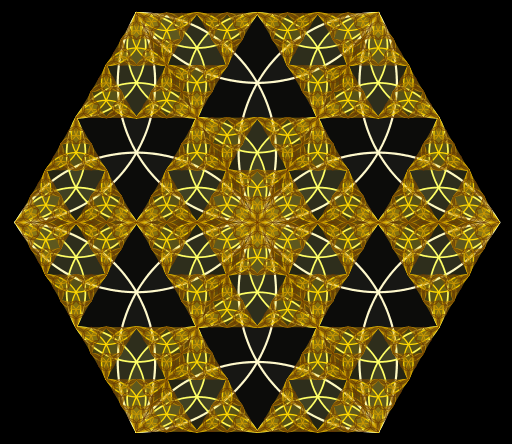
This example demonstrates the construction of a hexagonal fractal pattern using arcs. It involves core mathematical concepts such as fractal geometry, trigonometric functions, rhombus, and polygon construction. The construction process utilizes GeoGebra commands and objects like Zip, Join, butDelete, butCreate, R3, L1, L2, L3, L4, L5, R6, A1, A2, A3, A4, A5. It is suitable for high school and above students to understand the generation process of fractal patterns and geometric construction techniques.
GeoGebra Commands & Parameters
Zip(Rotate[{(0, -2), (sqrt(3), -1), ((-sqrt(3)), -1)}, r], r, R3) → L1Join(Zip[Dilate[Rotate[Translate[L1, (0, 2)], r], 0.5], r, R3]) → L2Join(Zip[Dilate[Rotate[Translate[L2, (0, 2)], r], 0.5], r, R3]) → L3Join(Zip[Dilate[Rotate[Translate[L3, (0, 2)], r], 0.5], r, R3]) → L4Join(Zip[Dilate[Rotate[Translate[L4, (0, 2)], r], 0.5], r, R3]) → L5Join(Zip[Zip[Rotate[CircleArc[Element[L, 1], Element[L, 2], Element[L, 3]], r, (0, 2)], r, R6], L, L1]) → A1Join(Zip[Zip[Rotate[CircleArc[Element[L, 1], Element[L, 2], Element[L, 3]], r, (0, 2)], r, R6], L, L2]) → A2Join(Zip[Zip[Rotate[CircleArc[Element[L, 1], Element[L, 2], Element[L, 3]], r, (0, 2)], r, R6], L, L3]) → A3Join(Zip[Zip[Rotate[CircleArc[Element[L, 1], Element[L, 2], Element[L, 3]], r, (0, 2)], r, R6], L, L4]) → A4Join(Zip[Zip[Rotate[CircleArc[Element[L, 1], Element[L, 2], Element[L, 3]], r, (0, 2)], r, R6], L, L5]) → A5
AI Drawing Prompt Reference
Draw a hexagonal fractal pattern composed of circular arcs. Start with a regular hexagon centered at the origin, with vertices on a circle of radius 2, and include an inner rhombus shape. Translate this hexagon upward by 2 units, rotate it by multiples of 60 degrees, and scale it by 0.5, repeating this process five times to create nested hexagonal rings. Then, for each hexagon, draw circular arcs connecting three consecutive vertices, passing through the third vertex, and apply the same rotations and translations to these arcs, generating five layers of shrinking arc clusters that form a symmetric snowflake-like fractal.
The prompt above was compiled from the original drawing commands and is for reference only.