
Arc Construction Proposal: Building Geometry via Circle Arcs and Transforms
Loading the math board and drawing, please wait…
In collections
geometriadinamica.es
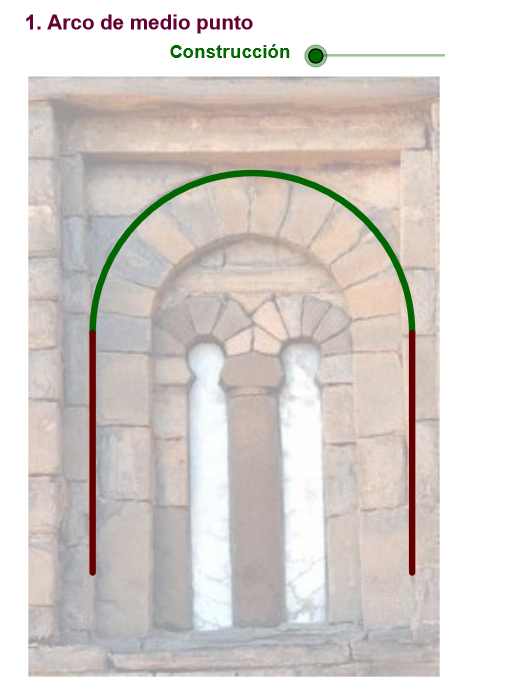
This GeoGebra example demonstrates a geometric configuration built from circle arcs: key points are created as intersections of lines and circles, then the diagram is completed using rotation and reflection so the corresponding structure is preserved. The main mathematics includes circle geometry (circles and arcs), construction of intersection points, generation of circumferential arcs via CircumcircleArc, and rigid transformations such as Rotate and Mirror. Construction workflow: Segment and Line define essential segments/lines; Midpoint provides reference points for transformation; Circle creates the needed circles; Intersect computes the critical points where constructions meet; If selects construction cases when conditions apply; Rotate and Mirror map parts of the figure to obtain the full arc-based proposal; CircumcircleArc draws arcs related to circumcircles to complete the arc segment pattern. Suitable for upper-secondary geometry, enrichment on geometric construction, and classroom demonstrations of invariance under transformations.
GeoGebra Commands & Parameters
Segment(D, B) → eMidpoint(C, D) → KCircle(K, C) → f_1Midpoint(C, D) → FLine(F, e) → kIntersect(f_1, k, 1) → LIf(zz < 0, 10, zz) → cMidpoint(C, D) → ESegment(A, C) → dSegment(E, C) → fRotate(C, Max[((-(c - 3)) * 180 / (5°)), 180°], E) → C'Rotate(C, 359.91000000000014°, E) → C''CircumcircleArc(C, C'', C') → gSegment(C', E) → hSegment(C, F) → rMirror(D, k) → D'_1Segment(K, C) → h_1Mirror(L, k) → L'Mirror(L, k) → L'_1Circle(K, C) → c_2Line(T, T1) → n_1
AI Drawing Prompt Reference
Draw a geometric figure composed of arcs, including circles, line segments, intersection points, centers, and arcs. First, draw two line segments, then draw a circle at the midpoint of one of the line segments, with the circle's center at the intersection point of the circle and the line segment. Next, use rotation and reflection to extend the figure to the entire arc based on the position of the arc and the center. Finally, draw the arcs related to the arc segments to form the complete figure.
The prompt above was compiled from the original drawing commands and is for reference only.