
Approximating the Area Under a Curve with LRAM and RRAM
Loading the math board and drawing, please wait…
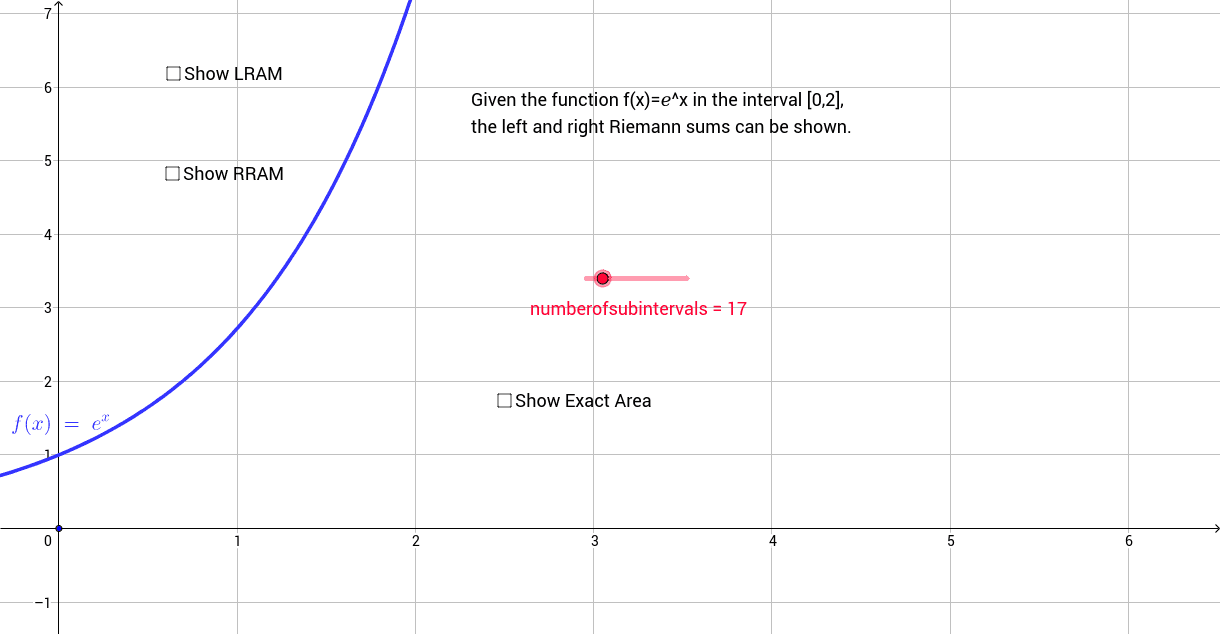
This example demonstrates how to approximate the area under a curve using the left rectangle method (LRAM) and the right rectangle method (RRAM). By adjusting the number of rectangles, students can observe how the approximations approach the actual area. The example involves the concept of definite integrals in calculus. Using GeoGebra commands such as Sequence, Sum, and Integral, students can dynamically explore the placement of rectangles and the calculation of areas. Suitable for high school calculus education.
GeoGebra Commands & Parameters
Sequence(d * n, n, d, numberofsubintervals) → xcrightSequence(d * n, n, 1, numberofsubintervals) → A1Sequence((d * n, 0), n, 0, numberofsubintervals) → xcoordSequence(Polygon[(n, 0), (n + d, 0), (n + d, f(n + d)), (n, f(n + d))], n, 0, 2 - d, d) → rightrectSum(rightrect) → RRAMSequence(Polygon[(n, 0), (n + d, 0), (n + d, f(n)), (n, f(n))], n, 0, 2 - d, d) → leftrectSequence((n + d, f(n)), n, 0, 2 - d, d) → list1Sequence((n, f(n + d)), n, 0, 2 - d, d) → list2Sequence(f(d * n), n, 0, numberofsubintervals) → list4Sum(leftrect) → LRAMIntegral(f, 0, 2) → cSequence((d * n, f(d * n)), n, 0, numberofsubintervals) → ycoord