
Applications of Similar Figures: Polygon Similarity and Geometric Construction
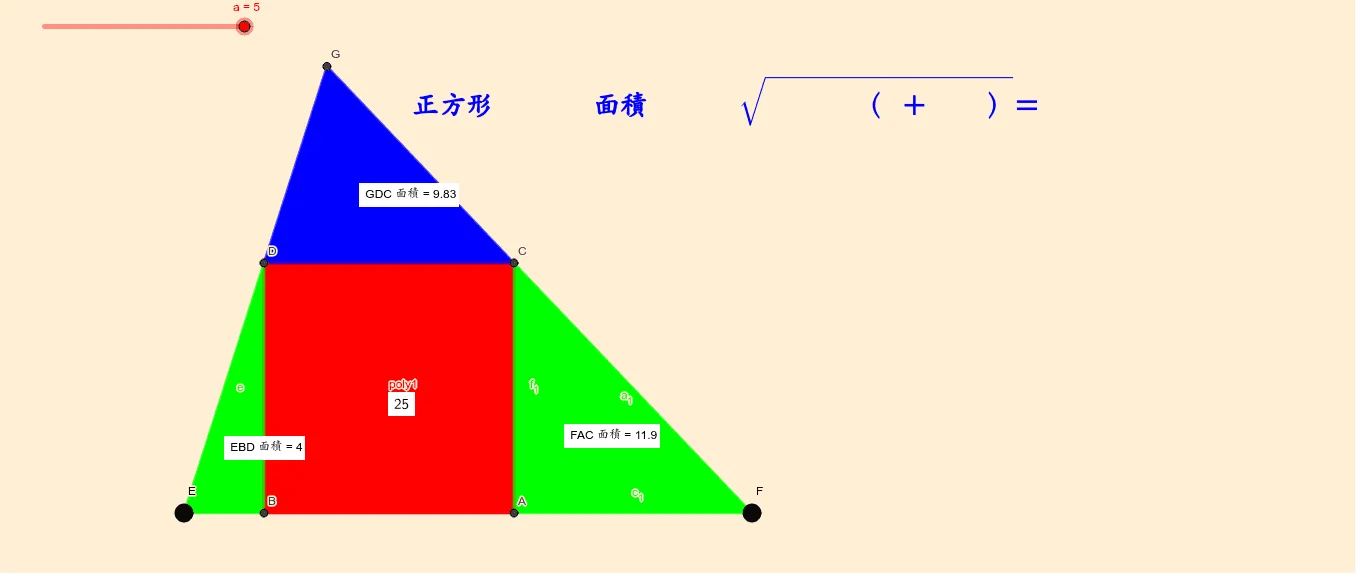
This GeoGebra example demonstrates practical applications of similar figures in geometry. Using commands such as Intersect, Polygon, Point, and Line, it constructs multiple points (A, B, C, D, E, F, G), lines, and polygons (poly1) to explore properties of similar shapes. The example covers similarity criteria and proportional relationships in triangles, making it suitable for secondary geometry education.
Students can interactively manipulate the constructed figure by dragging key points to observe how the properties of similar polygons remain invariant. The applet visually reinforces that corresponding angles of similar figures are equal and that corresponding sides are proportional. Through dynamic visualization, learners can verify similarity criteria including the AA (Angle-Angle) similarity theorem, the SAS (Side-Angle-Side) similarity theorem, and the SSS (Side-Side-Side) similarity theorem.
The construction features multiple intersection points and overlapping polygons that allow students to investigate how scaling transformations affect geometric figures. By adjusting point positions, learners can test conjectures about ratio relationships between corresponding sides and observe that these ratios remain constant throughout the transformation. This hands-on exploration helps students move beyond rote memorization of similarity rules toward a deeper conceptual understanding grounded in visual and dynamic evidence.
The applet is particularly valuable for classroom instruction as it supports inquiry-based learning. Teachers can guide students through structured activities such as measuring side lengths, calculating ratios, and comparing angle measures across different configurations. The interactive nature of the tool encourages experimentation and discovery, enabling students to formulate and test geometric hypotheses independently.
Overall, this applet serves as an effective pedagogical resource for middle school and high school geometry courses. It bridges the gap between abstract similarity theorems and concrete geometric intuition, helping learners build a solid foundation for more advanced topics in Euclidean geometry and trigonometry.
Loading the math board and drawing, please wait…