
Application of Equation of Motion in Pulleys
Loading the math board and drawing, please wait…
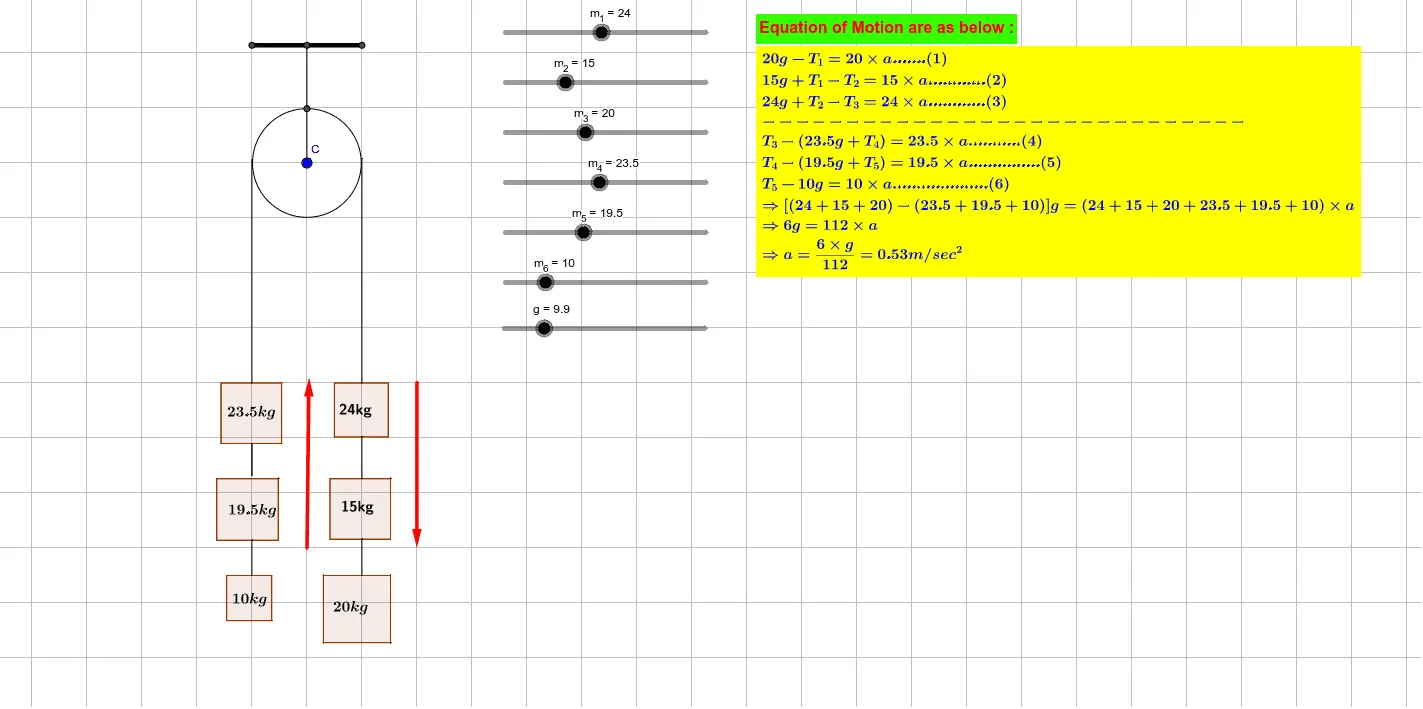
This example demonstrates the application of the equation of motion in pulley systems. Key mathematical concepts include equations of motion, vectors, and geometric construction. Using GeoGebra commands such as Point, Vector, and Polygon, a dynamic model of the pulley system is constructed. Suitable for high school physics and mathematics education.
GeoGebra Commands & Parameters
Point(xAxis) → AOrthogonalLine(A, xAxis) → fPoint(xAxis) → BOrthogonalLine(B, xAxis) → g_3Circle(C, D) → cLine(C, g_3) → hLine(E, xAxis) → iIntersect(c, h) → F, GIntersect(i, h) → HIntersect(i, g_3) → IIntersect(f, i) → JSegment(J, I) → jPoint(f) → KPoint(f) → LLine(K, xAxis) → kLine(M, xAxis) → lIntersect(k, g_3) → NIntersect(l, g_3) → OSegment(C, H) → mPoint(k) → PPoint(k) → QPolygon(Q, P, 4) → poly1, n, p, q, r, R, SPoint(l) → TPoint(l) → UPolygon(U, T, 4) → poly2, s, t, a, b, V, WLine(Z, xAxis) → dIntersect(g_3, d) → A_1Point(d) → B_1Point(d) → C_1Polygon(C_1, B_1, 4) → poly3, e, f_1, g_1, h_1, D_1, E_1Point(d) → F_1Point(d) → G_1Polygon(F_1, G_1, 4) → poly4, i_1, j_1, k_1, l_1, H_1, I_1Point(l) → J_1Point(l) → K_1Polygon(K_1, J_1, 4) → poly5, m_7, n_1, p_1, q_1, L_1, M_1Point(k) → N_1Point(k) → O_1Polygon(N_1, O_1, 4) → poly6, r_1, s_1, t_1, a_1, P_1, Q_1Intersect(c, g_3) → R_1,Point(g_3) → S_1Point(f) → T_1Intersect(q, g_3) → U_1Intersect(g_3, a) → V_1Intersect(f, t_1) → W_1Intersect(f, p_1) → Z_1Intersect(d, i_1) → A_2Intersect(f, d) → B_2Segment(S_1, N) → b_1Segment(T_1, K) → c_1Segment(U_1, O) → d_1Segment(V_1, A_1) → e_1Segment(K, W_1) → f_2Segment(W_1, L) → g_2Segment(Z_1, B_2) → h_2Segment(W_1, L) → i_2PointIn(poly6) → C_2PointIn(poly1) → D_2PointIn(poly2) → E_2PointIn(poly5) → F_2PointIn(poly3) → G_2PointIn(poly4) → H_2Vector(I_2, J_2) → uVector(K_2, L_2) → vVector(M_2, N_2) → wVector(O_2, P_2) → u_1