
Apple-Shaped Parametric Curves and Surfaces
Loading the math board and drawing, please wait…
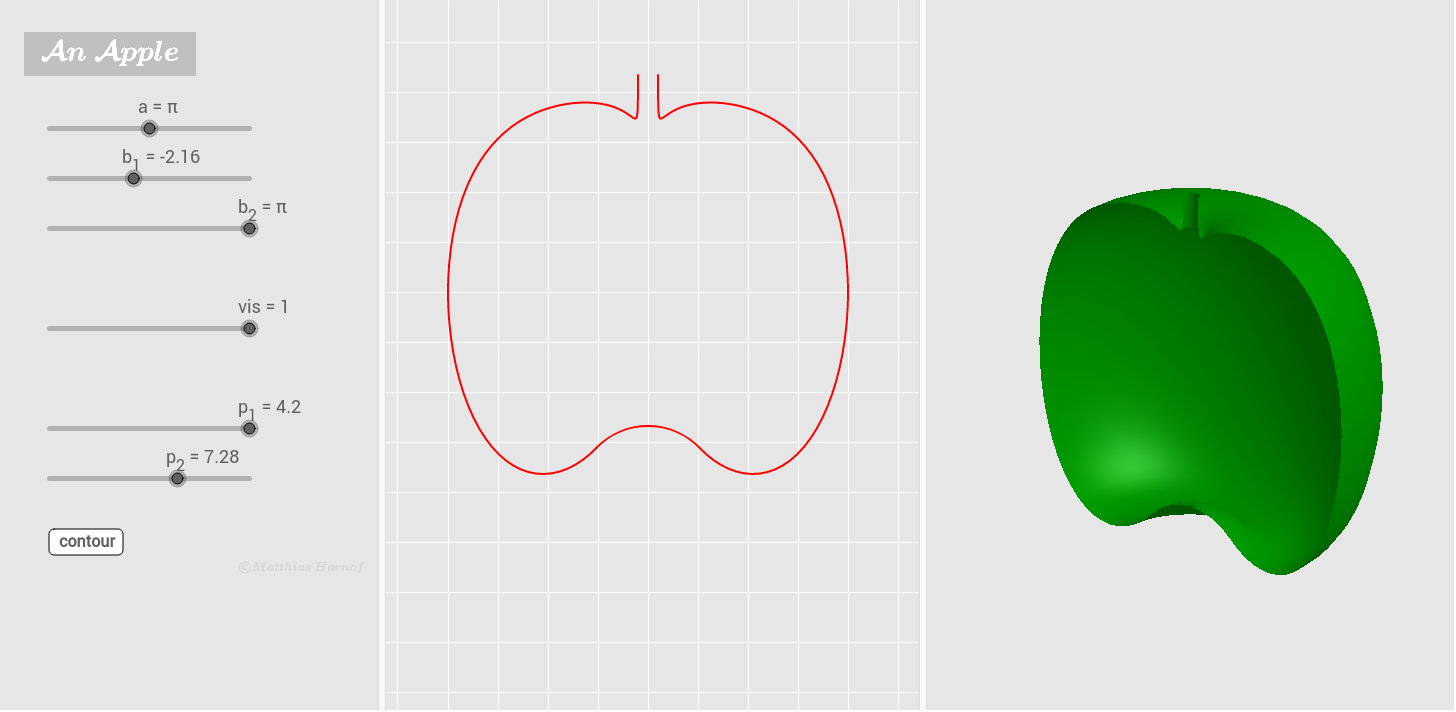
This example demonstrates how to draw an apple-shaped curve and surface using parametric equations. It involves core mathematical concepts such as parametric curves, surfaces, orthogonal lines, intersections, reflections, circular arcs, distances, and angles. The construction utilizes GeoGebra commands like CurveCartesian, Tangent, OrthogonalLine, Intersect, Mirror, CircleArc, Distance, Angle, and Surface. It is suitable for high school and above students to learn the application of parametric equations in geometric plotting.
GeoGebra Commands & Parameters
CurveCartesian((-(p_1 + (3.8 * cos(v)))), (((cos(v) + sin(v) - 1) * (1 + sin(v))) * log(1 - (π * v / 10))) + (p_2 * sin(v)), v, b_1, b_2) → c_3Tangent(B, c_3) → tgOrthogonalLine(B, tg) → lotIntersect(lot, yAxis) → CMirror(B, yAxis) → B'CircleArc(C, B', B) → cDistance(C, B) → rAngle(lot, yAxis) → wiSurface(((r * cos(u)) * sin(v)), ((r * sin(u)) * sin(v)), z(M) - (r * cos(v)), u, π, π + a, v, π, (2 * π) - wi) → eCurveCartesian((r * sin(v)), ((r * 0) * sin(v)), z(M) - (r * cos(v)), v, π, (2 * π) - wi) → k_1CurveCartesian(((r * (-1)) * sin(v)), ((r * 0) * sin(v)), z(M) - (r * cos(v)), v, π, (2 * π) - wi) → k_2Surface((cos(u) * (p_1 + (3.8 * cos(v)))), (sin(u) * (p_1 + (3.8 * cos(v)))), (((cos(v) + sin(v) - 1) * (1 + sin(v))) * log(1 - (π * v / 10))) + (p_2 * sin(v)), u, 0, a, v, b_1, b_2) → appleCurveCartesian((-(p_1 + (3.8 * cos(v)))), (0 * (p_1 + (3.8 * cos(v)))), (((cos(v) + sin(v) - 1) * (1 + sin(v))) * log(1 - (π * v / 10))) + (p_2 * sin(v)), v, b_1, b_2) → c_1CurveCartesian(p_1 + (3.8 * cos(v)), (0 * (p_1 + (3.8 * cos(v)))), (((cos(v) + sin(v) - 1) * (1 + sin(v))) * log(1 - (π * v / 10))) + (p_2 * sin(v)), v, b_1, b_2) → c_2CurveCartesian(p_1 + (3.8 * cos(v)), (((cos(v) + sin(v) - 1) * (1 + sin(v))) * log(1 - (π * v / 10))) + (p_2 * sin(v)), v, b_1, b_2) → c_4