
AP 2006 AB 1b Volume Problem: Quadrilateral Cross-Sections and Solids of Revolut
Loading the math board and drawing, please wait…
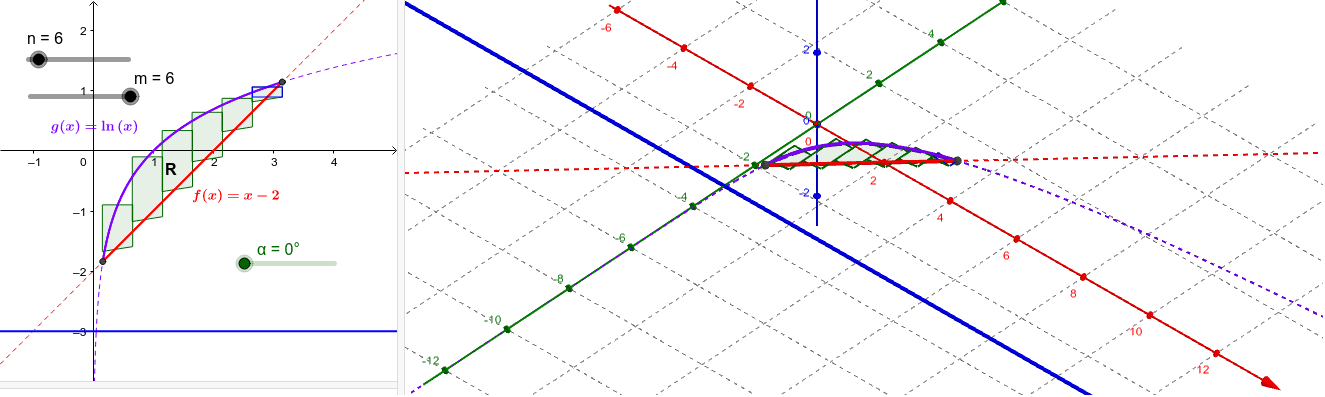
① This example demonstrates how to dynamically construct a volume problem from the AP Calculus 2006 AB exam, showing a planar region rotated about an axis or forming a solid with quadrilateral cross-sections. ② Core mathematical concepts include definite integrals for volume, cross-sectional area of quadrilaterals, solids of revolution, Riemann sum approximations, and background topics like hypergeometric distribution and variance. ③ Construction highlights: uses Intersect to find intersection points, Polygon to build quadrilaterals, Rotate for rotation, Integral for definite integration, Sequence for generating lists, Surface for creating surfaces, RectangleSum for rectangle sums, along with many auxiliary objects (g, f, Left, Right, a, p, m, n, h, b, line, etc.) to define regions and cross-sections. ④ Suitable for high school AP Calculus or introductory college calculus, this visualization helps students understand volume integrals and the cross-section method, bridging 2D regions to 3D solids.
GeoGebra Commands & Parameters
Intersect(f, g, 0, 4) → Left, RightPolygon((a + (DK * h), f(a + ((DK + p) * h))), (a + ((DK + 1) * h), f(a + ((DK + p) * h))), (a + ((DK + 1) * h), g(a + ((DK + p) * h))), (a + (DK * h), g(a + ((DK + p) * h)))) → Rectangle1, c, d, e, kRotate(Rectangle1, (-α), line) → Rectangle1'Integral((π * ((3 + g(x))^(2) - (3 + f(x))^(2))), a, b) → VolIntegSequence(Polygon[(a + (k * h), f(((a + k + p) * h))), (a + ((k + 1) * h), f(a + ((k + p) * h))), (a + ((k + 1) * h), g(a + ((k + p) * h))), (a + (k * h), g(a + ((k + p) * h)))], k, 0, m - 1) → RectanglesRotate(Rectangles, (-α), line) → Rectangles'Rotate(g_1, (-α), line) → iRotate(f_1, (-α), line) → jSurface(a + ((DK + 1) * h), -3 + ((3 + u) * cos(β)), ((3 + u) * sin(β)), u, f(a + ((DK + p) * h)), g(a + ((DK + p) * h)), β, 0, α) → SideRight1Surface(a + (DK * h), -3 + ((3 + u) * cos(β)), ((3 + u) * sin(β)), u, f(a + ((DK + p) * h)), g(a + ((DK + p) * h)), β, 0, α) → SideLeft1Surface(u, -3 + ((3 + g(a + ((DK + p) * h))) * cos(β)), ((3 + g(a + ((DK + p) * h))) * sin(β)), u, a + (DK * h), a + ((DK + 1) * h), β, 0, α) → Outer1Surface(u, -3 + ((3 + f(a + ((DK + p) * h))) * cos(β)), ((3 + f(a + ((DK + p) * h))) * sin(β)), u, a + (DK * h), a + ((DK + 1) * h), β, 0, α) → Inner1Surface(u, -3 + ((3 + g(u)) * cos(β)), ((3 + g(u)) * sin(β)), u, a, b, β, 0, (2 * π)) → InnerSurface(u, -3 + ((3 + f(u)) * cos(β)), ((3 + f(u)) * sin(β)), u, a, b, β, 0, (2 * π)) → OuterRectangleSum((π * ((g(x) + 3)^(2) - (f(x) + 3)^(2))), a, a + (m * h), m, p) → VCSequence(Surface[u, -3 + ((3 + f(a + ((k + p) * h))) * cos(β)), ((3 + f(a + ((k + p) * h))) * sin(β)), u, a + (k * h), a + ((k + 1) * h), β, 0, α], k, 0, m - 1) → InnersSequence(Surface[u, -3 + ((3 + g(a + ((k + p) * h))) * cos(β)), ((3 + g(a + ((k + p) * h))) * sin(β)), u, a + (k * h), a + ((k + 1) * h), β, 0, α], k, 0, m - 1) → OutersSequence(Surface[a + (k * h), -3 + ((3 + u) * cos(β)), ((3 + u) * sin(β)), u, f(a + ((k + p) * h)), g(a + ((k + p) * h)), β, 0, α], k, 0, m - 1) → SidesLeftSequence(Surface[a + ((k + 1) * h), -3 + ((3 + u) * cos(β)), ((3 + u) * sin(β)), u, f(a + ((k + p) * h)), g(a + ((k + p) * h)), β, 0, α], k, 0, m - 1) → SidesRight
AI Drawing Prompt Reference
Draw a solid of revolution formed by rotating a planar region around the x-axis, where the region is defined by functions f(x) and g(x). First, plot the graphs of f(x) and g(x). Then, find the intersection points Left and Right of f(x) and g(x) within the interval [a, b]. Next, construct a series of rectangles with their bases on the x-axis and heights equal to the difference between f(x) and g(x), and rotate these rectangles around the x-axis to form the side surfaces. Finally, use rotation and translation to construct the outer and inner surfaces of the entire solid.
The prompt above was compiled from the original drawing commands and is for reference only.