
Animation of the Sum of the First Odd Numbers
Loading the math board and drawing, please wait…
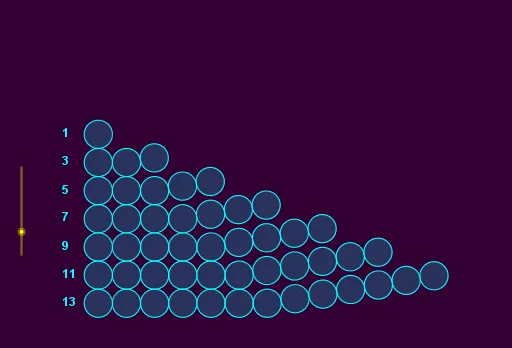
① This GeoGebra example demonstrates that the sum of the first n odd numbers equals n² by folding lines of dots in the middle, creating a visual proof. ② Core mathematical concepts include arithmetic series, square numbers, and the geometric interpretation of algebraic identities. ③ Construction uses the Sequence command to generate dot arrays and the Translate command to move them, with objects f, b, a, n, l4, l5, l6, l7, and a text label; a slider n controls the number of terms. ④ Suitable for middle school to high school students learning sequence summation, number patterns, or for teachers demonstrating mathematical proofs interactively in class.
GeoGebra Commands & Parameters
Sequence(Rotate[Sequence[Circle[(j, k), 0.5], k, j + 2, (2 * j) + 1], (a * 90°), (j, j + 1)], j, 1, n) → l4Sequence(Sequence[Circle[(j, k), 0.5], k, 1, j + 1], j, 0, n) → l5Translate(Rotate[{l4, l5}, (-(90°)), (n, 1)], ((-n), 0)) → l6Sequence(Text[(2 * k) + 1, (-1.3, n - k + 0.9)], k, 0, n) → l7
AI Drawing Prompt Reference
Create a dynamic visual proof that the sum of the first n odd numbers equals n squared. On the left, arrange rows of dots in a staircase pattern, with each row containing an odd number of dots (1, 3, 5, 7, ...) from bottom to top. On the right, rotate and translate the entire left array so that the rows fold together, forming a perfect square. Label each row with its corresponding odd number above the array. Include a slider to control the number of rows n, so that as n changes, both the staircase and the resulting square update accordingly.
The prompt above was compiled from the original drawing commands and is for reference only.