
Angles on Parallel Lines by Mr BM
Loading the math board and drawing, please wait…
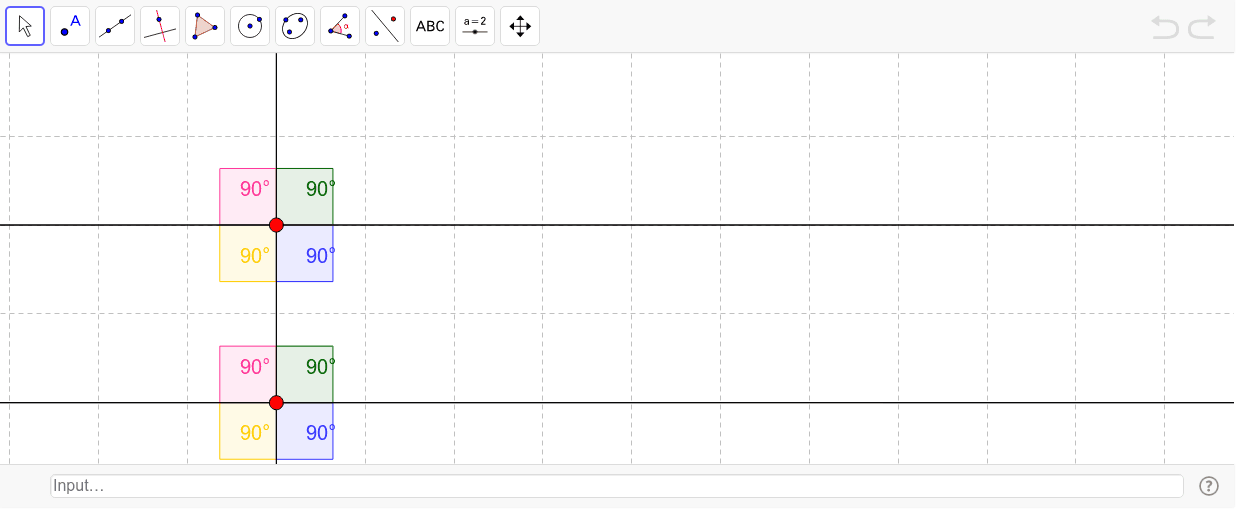
This example demonstrates the geometric relationships and properties of alternate interior, corresponding, and consecutive interior angles formed by parallel lines. It involves core math concepts like parallel line properties, angle relationships, and geometric constructions. Constructed using GeoGebra commands such as Line, Point, Segment, and Angle, it is suitable for middle school and above mathematics education to visually understand parallel line theorems and practical applications.
GeoGebra Commands & Parameters
Line(A, B) → aLine(C, a) → bLine(A, C) → cPoint(b) → DSegment(C, D) → dSegment(C, A) → ePoint(c) → ESegment(C, E) → fPoint(b) → FSegment(C, F) → gPoint(a) → GSegment(A, G) → hPoint(c) → HSegment(A, H) → iPoint(a) → ISegment(A, I) → jAngle(D, C, E) → αAngle(E, C, F) → βAngle(F, C, A) → γAngle(A, C, D) → δAngle(G, A, C) → εAngle(C, A, I) → ζAngle(I, A, H) → ηAngle(H, A, G) → θ
AI Drawing Prompt Reference
Draw two parallel lines and select points on each line to connect them, forming several triangles and quadrilaterals. Label the alternate interior, corresponding, and consecutive interior angles within these shapes using different colors or symbols. Start by sketching the parallel lines, then add auxiliary points and segments, and finally annotate the angle relationships to demonstrate the properties of parallel lines and the application of angle theorems.
The prompt above was compiled from the original drawing commands and is for reference only.