
Angles on Parallel Lines by Alexis Blades
Loading the math board and drawing, please wait…
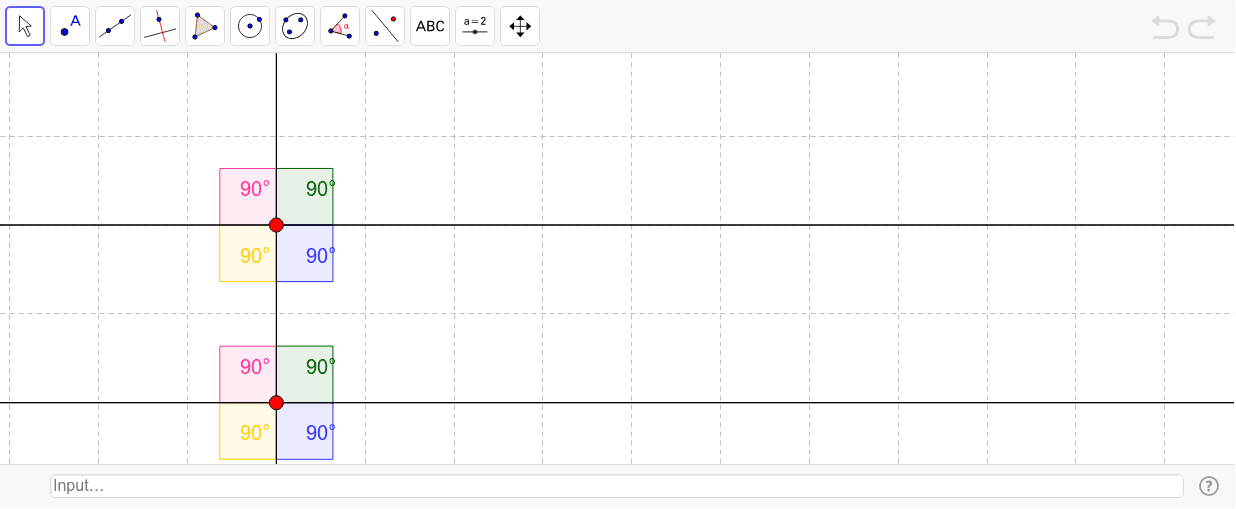
This example demonstrates angles on parallel lines. Key mathematical concepts include the properties of parallel lines and the relationships between angles. Using GeoGebra commands such as Line, Point, Segment, and Angle, you can construct angles on parallel lines. Suitable for middle school and above students for geometric construction.
GeoGebra Commands & Parameters
Line(A, B) → aLine(C, a) → bLine(A, C) → cPoint(b) → DSegment(C, D) → dSegment(C, A) → ePoint(c) → ESegment(C, E) → fPoint(b) → FSegment(C, F) → gPoint(a) → GSegment(A, G) → hPoint(c) → HSegment(A, H) → iPoint(a) → ISegment(A, I) → jAngle(D, C, E) → αAngle(E, C, F) → βAngle(F, C, A) → γAngle(A, C, D) → δAngle(G, A, C) → εAngle(C, A, I) → ζAngle(I, A, H) → ηAngle(H, A, G) → θ
AI Drawing Prompt Reference
Draw two parallel lines and select points on them to connect, forming multiple triangles and angles. Label corresponding angles, alternate interior angles, and exterior angles between the parallel lines, showing their equal or supplementary relationships. Start by drawing the parallel lines, then select points and connect them, finally labeling the angles to illustrate the properties of parallel lines and angle relationships.
The prompt above was compiled from the original drawing commands and is for reference only.