
Angles 6: Geometric Construction of Polygons and Intersecting Angles
Loading the math board and drawing, please wait…
In collections
Angles
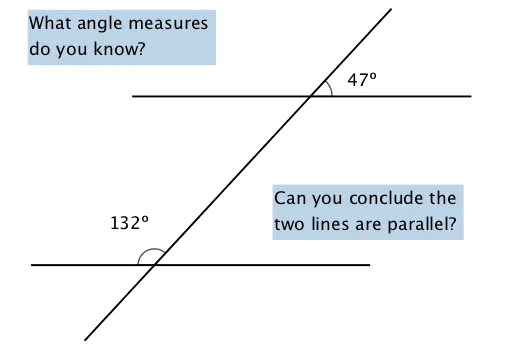
①This example demonstrates how to construct multiple polygons and their intersection points in GeoGebra, then measure related angles to visually explore angle relationships in geometric figures. ②Core mathematical concepts include angle definitions, interior angles of polygons, angles formed by intersecting lines, and numerical verification using angle measurement tools. ③Construction highlights: from the summary, commands such as Segment, Point, Angle, Intersect, and Polygon are used, creating objects A, B, C, D, E, F, G, H, I, auxiliary lines f, g, h, and text labels texto1 to texto4, with angles α and β measured at intersections. ④Suitable for middle school geometry lessons, helping students understand angle properties, polygon interior angle sums, and logical steps in geometric construction, also serving as an introductory dynamic geometry exploration.
GeoGebra Commands & Parameters
Segment(A, B) → fPoint(yAxis) → CSegment(C, D) → gSegment(E, F) → hAngle(g, f) → αPoint(h) → GIntersect(f, h) → HPoint(f) → IPolygon(G, H, I) → t1, i, g_1, h_1Angle(I, H, G) → β