
Angle Sum Property of a Polygon
Loading the math board and drawing, please wait…
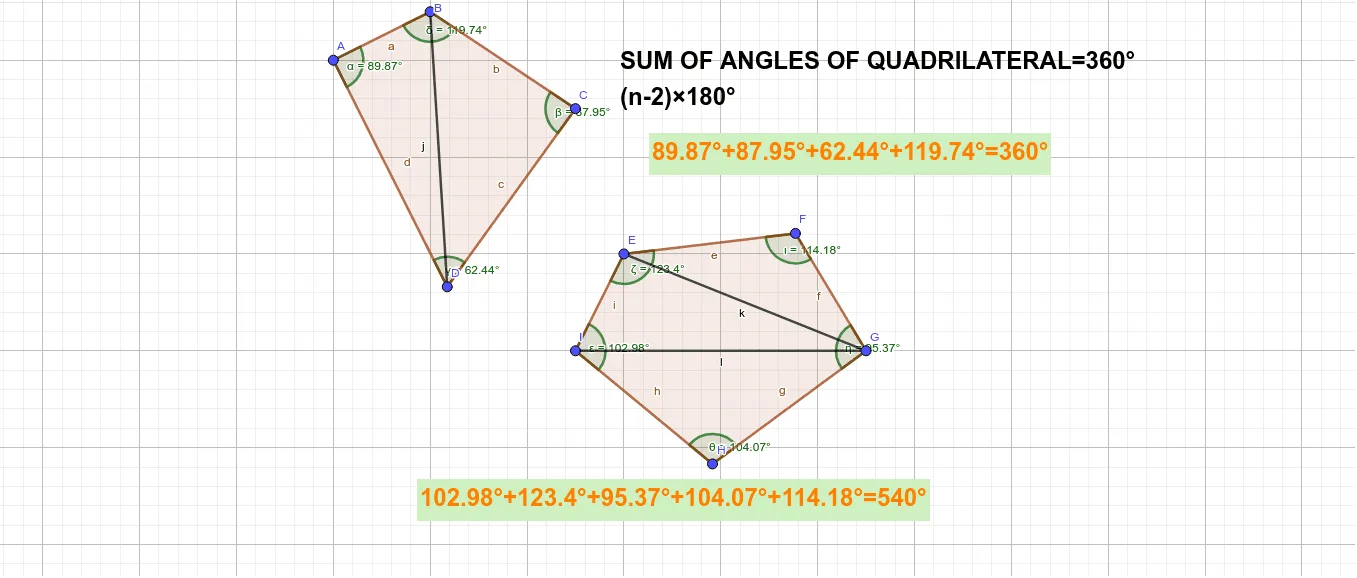
This example illustrates the angle sum property of a polygon. Key mathematical concepts include polygons and their interior angles. Using GeoGebra commands such as Polygon, Angle, and Segment, the construction allows for dynamic exploration of the angle sum property. Suitable for middle school and above students studying polygon geometry.
GeoGebra Commands & Parameters
Polygon(A, B, C, D) → q1, a, b, c, dAngle(D, A, B) → αAngle(B, C, D) → βAngle(C, D, A) → γAngle(A, B, C) → δPolygon(E, F, G, H, I) → poly1, e, f, g, h, iAngle(H, I, E) → εAngle(I, E, F) → ζAngle(F, G, H) → ηAngle(G, H, I) → θAngle(E, F, G) → ιSegment(B, D) → jSegment(E, G) → kSegment(I, G) → l
AI Drawing Prompt Reference
Draw a quadrilateral ABCD and a pentagon EFGHI. First, draw quadrilateral ABCD and measure the angles at A, B, C, and D. Then, draw pentagon EFGHI and measure the angles at E, F, G, H, and I. Finally, draw line segments BD, EG, and IG.
The prompt above was compiled from the original drawing commands and is for reference only.