
Angle Size Independent of Arm Length
Loading the math board and drawing, please wait…
In collections
Introduction to Geometry
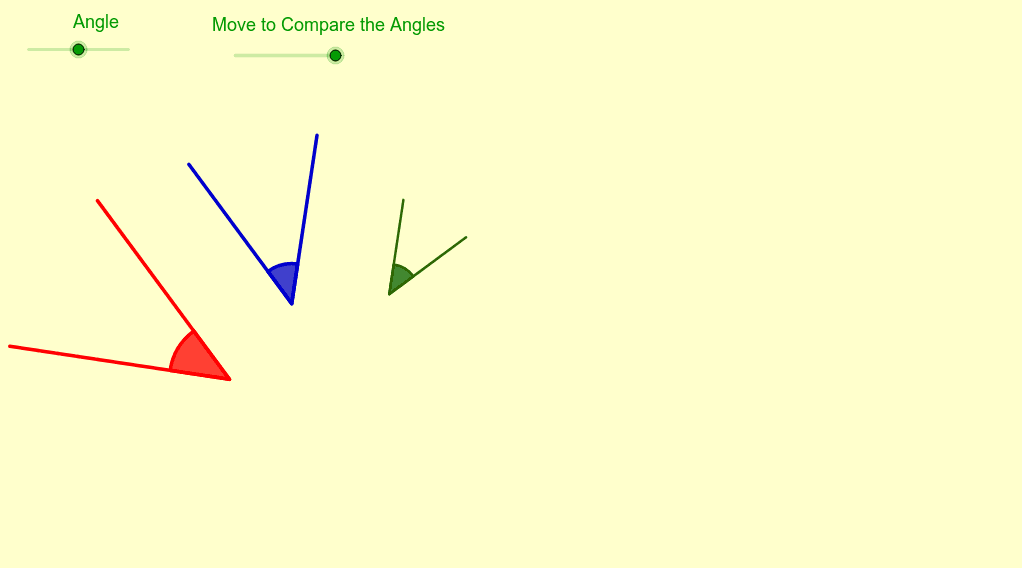
This example demonstrates that the size of an angle remains constant regardless of the lengths of its arms. It involves core mathematical concepts such as angle definition and invariance. The construction utilizes GeoGebra commands like Intersect, Circle, Point, Rotate, Angle, and Segment to build an angle model and verify its size invariance. Suitable for middle school students and math enthusiasts learning about angle properties and invariants in geometric transformations.
GeoGebra Commands & Parameters
Intersect(xAxis, yAxis) → ACircle(A, B) → cCircle(A, C) → dPoint(c) → DPoint(d) → ERotate(E, -Angle, D) → E'_1Angle(E'_1, D, E) → βSegment(E, D) → aSegment(E'_1, D) → bPoint(a) → FPoint(b) → GSegment(G, D) → eSegment(D, F) → fRotate(E, θ, A) → E'_2Rotate(D, θ, A) → D'_1Segment(E'_2, D'_1) → a'_1Rotate(E'_1, θ, A) → HRotate(D, θ, A) → D'_2Segment(D'_2, H) → gAngle(H, D'_2, E'_2) → γRotate(E, θ / 2, A) → E'Rotate(D, θ / 2, A) → D'_3Segment(E', D'_3) → a'Rotate(E'_1, θ / 2, A) → IRotate(D, θ / 2, A) → D'Segment(I, D') → b'Point(a') → JPoint(b') → KSegment(J, D') → hSegment(K, D') → iAngle(K, D', J) → δ
AI Drawing Prompt Reference
Draw an angle model with point A as the center, and points B and C on two different circles. Keep angle β unchanged by rotating points E and D, regardless of the arm lengths. Construct two segments a and b, then rotate them to form new segments a' and b', ensuring that angles γ and δ are equal to the original angle β.
The prompt above was compiled from the original drawing commands and is for reference only.