
Angle Bisector as a Locus: The Incenter of a Triangle
Loading the math board and drawing, please wait…
In collections
Angle Bisector as a locus. The Incenter of a Triangle
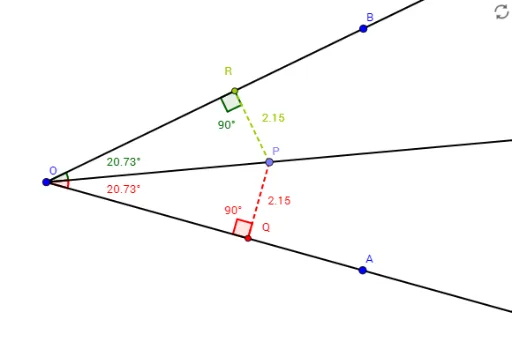
This example demonstrates the locus of an angle bisector, which is the incenter of a triangle. Key mathematical concepts include angle bisectors, incenter, and similarity transformations. Using GeoGebra commands such as Ray, AngularBisector, Point, OrthogonalLine, Intersect, Segment, and Angle, the formation of the angle bisector is dynamically illustrated. Suitable for students at the middle school level and above to learn about geometric constructions and loci.
GeoGebra Commands & Parameters
Ray(O, A) → fRay(O, B) → gAngularBisector(A, O, B) → hPoint(h) → PRay(O, P) → iOrthogonalLine(P, g) → jOrthogonalLine(P, f) → kIntersect(j, g) → RIntersect(k, f) → QSegment(P, R) → lSegment(P, Q) → mAngle(P, O, R) → αAngle(Q, O, P) → βAngle(P, Q, O) → γAngle(O, R, P) → δ
AI Drawing Prompt Reference
Draw a triangle OAB, then draw the angle bisector of angle AOB and mark its intersection with the sides as point P. Next, draw two perpendicular lines from P to the sides, intersecting them at points Q and R. Finally, connect P to Q and R to observe the angles formed.
The prompt above was compiled from the original drawing commands and is for reference only.