
Angle Addition Postulate: Dynamic Demonstration and Geometric Construction
Loading the math board and drawing, please wait…
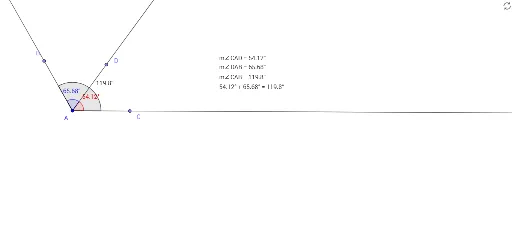
This GeoGebra example dynamically demonstrates the Angle Addition Postulate, showing that when a ray lies between two rays forming an angle, the measure of the larger angle equals the sum of the two smaller angles. The core mathematical concept is angle measurement and additive properties, involving rays, vertices, and angle notation. Construction details: the Circle command creates an auxiliary circle, Point defines vertices and ray endpoints, Ray generates the sides of angles, Angle marks and measures angles α, β, γ, δ, and text objects display angle values and the equality relationship. Suitable for middle school geometry to help students understand angle decomposition and composition, also useful for high school review of angle measurement basics, or as a dynamic geometry teaching aid for visualizing angle operations.
GeoGebra Commands & Parameters
Circle(A, 4) → cPoint(c) → BPoint(c) → CPoint(c) → DRay(A, B) → fRay(A, D) → gRay(A, C) → hAngle(C, A, D) → αAngle(D, A, B) → βAngle(C, A, B) → γ
AI Drawing Prompt Reference
Draw a circle with center A and radius 4, then select three points B, C, and D on the circle. Create three rays with A as the vertex: AB, AD, and AC. Mark the angles as α (CAD), β (DAB), and γ (BAC).
The prompt above was compiled from the original drawing commands and is for reference only.