
Ancient 14-Sided Die for Chinese Game Bo
Loading the math board and drawing, please wait…
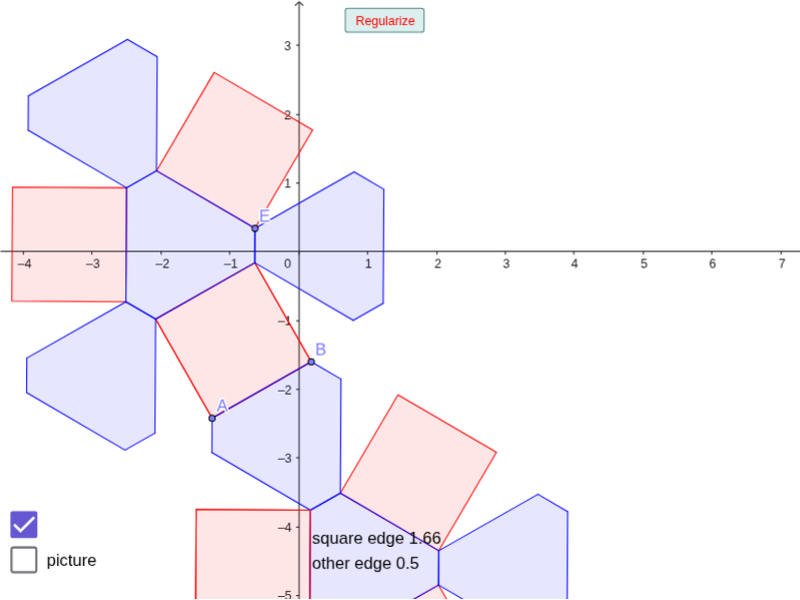
This example demonstrates constructing an ancient 14-sided die using GeoGebra, relevant to the Chinese game Bo, covering core concepts like probability & statistics, polygon construction, and geometric transformations. It leverages commands such as Polygon, Rotate, Ray, Point, Intersect, Midpoint, Mirror, and Line as per the construction summary. Suitable for high school students learning probability, geometric constructions, and solid geometry, or game design education.
GeoGebra Commands & Parameters
Polygon(A, B, 4) → poly1, a, b, c, d, C, DRotate(C, -120*°, C) → C'Rotate(D, -120*°, C) → D'Ray(C', D') → ePoint(e) → EIntersect(LineBisector[a], LineBisector[Segment[C, E]]) → FRotate(E, 120*°, F) → E'Rotate(C, 120*°, F) → C'_1Rotate(C, -120*°, F) → C'_2Polygon(D, C, E, C'_1, E', C'_2) → poly2, d_1, c_1, e_1, c'_1, e', c'_2Midpoint(A, C) → GMirror(D, c'_1) → D'_1Mirror(C, c'_1) → C'_3Mirror(E, c'_1) → E'_1Mirror(C'_1, c'_1) → HMirror(E', c'_1) → E''Mirror(C'_2, c'_1) → IPolygon(D'_1, C'_3, E'_1, H, E'', I) → poly2', d'_1, c'_3, e'_1, h, e'', iMirror(D, c'_2) → D'_2Mirror(C, c'_2) → C'_4Mirror(E, c'_2) → E'_2Mirror(C'_1, c'_2) → JMirror(E', c'_2) → E''_1Mirror(C'_2, c'_2) → KPolygon(D'_2, C'_4, E'_2, J, E''_1, K) → poly2'_1, d'_2, c'_4, e'_2, j, e''_1, kMirror(D, c_1) → D'_3Mirror(C, c_1) → C'_5Mirror(E, c_1) → E'_3Mirror(C'_1, c_1) → LMirror(E', c_1) → E''_2Mirror(C'_2, c_1) → MPolygon(D'_3, C'_5, E'_3, L, E''_2, M) → poly2'_2, d'_3, c'_5, e'_3, l, e''_2, mRotate(poly1, 120*°, F) → poly1'Rotate(poly1', 120*°, F) → poly1''Line(G, c) → fMirror(D, f) → D'_4Mirror(C, f) → C'_6Mirror(E, f) → E'_4Mirror(C'_1, f) → NMirror(E', f) → E''_3Mirror(C'_2, f) → OPolygon(D'_4, C'_6, E'_4, N, E''_3, O) → poly2'_3, d'_4, c'_6, e'_4, n, e''_3, oMirror(D'_4, n) → PMirror(C'_6, n) → QMirror(E'_4, n) → RMirror(N, n) → N'Mirror(E''_3, n) → SMirror(O, n) → O'Polygon(P, Q, R, N', S, O') → poly3, p, q, r, n', s, o'Intersect(LineBisector[o'], LineBisector[q]) → TRotate(D'_4, 120*°, T) → URotate(C'_6, 120*°, T) → VRotate(E'_4, 120*°, T) → WRotate(N, 120*°, T) → N'_1Rotate(E''_3, 120*°, T) → ZRotate(O, 120*°, T) → O'_1Polygon(U, V, W, N'_1, Z, O'_1) → poly4, u, v, w, n'_1, z_1, o'_1Rotate(U, 120*°, T) → U'Rotate(V, 120*°, T) → V'Rotate(W, 120*°, T) → W'Rotate(N'_1, 120*°, T) → A_1Rotate(Z, 120*°, T) → Z'Rotate(O'_1, 120*°, T) → B_1Polygon(U', V', W', A_1, Z', B_1) → poly4', u', v', w', a_1, z', b_1Polygon(O', E''_3, 4) → poly5, g, t, f_1, g_1, C_1, D_1Rotate(poly5, 120*°, T) → poly5'Rotate(poly5', 120*°, T) → poly5''
AI Drawing Prompt Reference
Draw an ancient 14-sided die used in the Chinese game Bo. Start by constructing a quadrilateral, then rotate it around one vertex to form three identical quadrilaterals. Connect the non-adjacent vertices of these quadrilaterals to create rays and mark points on them. Using midlines, midpoints, rotations, and reflections, extend these points and quadrilaterals into multiple connected polygons, ultimately forming a complex solid geometric shape that illustrates core concepts in probability, geometric construction, and solid geometry.
The prompt above was compiled from the original drawing commands and is for reference only.