
Ambiguous Case of Sines
Loading the math board and drawing, please wait…
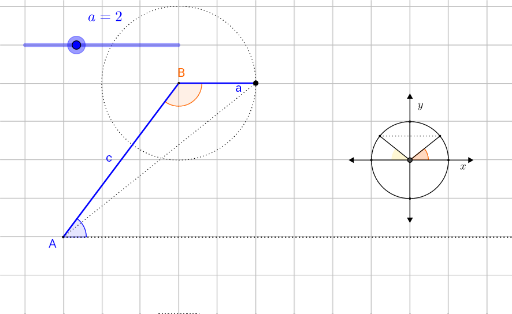
This example demonstrates the ambiguous case of the Law of Sines, where given two angles and one side (AaC or AaB), there might be two possible triangles. It involves core concepts like the Law of Sines, triangle solving, and the relationship between angles and sides. Constructed using commands like Segment, Point, Circle, Ray, Angle, Intersect, OrthogonalLine, Rotate, Mirror in GeoGebra, it illustrates the ambiguity. Suitable for high school mathematics education to help students understand the applicability and limitations of the Law of Sines.
GeoGebra Commands & Parameters
Segment(A, B) → cPoint(Circle[B, a_1]) → CSegment(B, C) → aCircle(B, C) → c_1Ray(A, Z) → gAngle(Z, A, B) → αIntersect(c_1, g) → C_2, C_1Segment(B, C_2) → iSegment(B, C_1) → jSegment(A, C_2) → b_2Segment(A, C_1) → b_1Angle(A, B, C) → βAngle(B, C, A) → γAngle(B, C, A) → δSegment(A, C) → fCircle(D, E) → dSegment(D, E) → hOrthogonalLine(D, h) → kOrthogonalLine(E, k) → lIntersect(d, l, 2) → FIntersect(d, k, 2) → GIntersect(d, k, 1) → HIntersect(k, l) → ISegment(D, F) → mSegment(D, G) → nSegment(D, H) → sRotate(E, δ, D) → E'Angle(E, D, E') → εSegment(D, E') → tMirror(E', k) → E''Segment(D, E'') → bAngle(E'', D, F) → ζSegment(E'', E') → ePoint(k) → JPoint(k) → KSegment(J, K) → f_1Point(l) → LPoint(l) → MSegment(L, M) → g_1Segment(A, C) → h_1
AI Drawing Prompt Reference
Draw a triangle ABC with given angles A and B, and side a, which may have two solutions. First, draw side a and angle A, then draw a circle with center B and radius a, intersecting line ZA at point C to form side BC. Next, construct the exterior angle of B, intersecting the circle at points C1 and C2, and connect B to C1 and C2 to form sides b1 and b2. Then, construct side f opposite angle B, intersecting the circle at points D and E, and construct perpendicular lines k and l, intersecting at points F, G, and H, and connect D to F, G, and H to form sides m, n, and s. Rotate E to get E', construct angle δ, and connect D to E' to form side t. Mirror E' to get E'', and connect D to E'' to form side b. Finally, construct angle ζ, and connect E'' to E' to form side e.
The prompt above was compiled from the original drawing commands and is for reference only.