
Alternate Exterior Angles Theorem (V2) – Transformational Proof
Loading the math board and drawing, please wait…
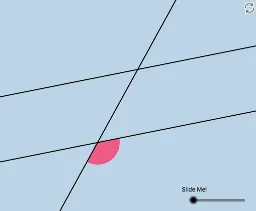
This GeoGebra example provides a visual, wordless proof that alternate exterior angles are congruent when a transversal intersects two parallel lines, using a transformational approach. The core mathematical concepts include parallel lines, transversal angle relationships, alternate exterior angles, and similarity transformations (rotation, translation, dilation) as a proof strategy. The construction employs GeoGebra commands such as Point, Rotate, Angle, Line, Circle, Intersect, Dilate, Vector, Midpoint, Segment, Ray, and CircleArc, creating objects like lines m and a, points A and B, angles α and β, and transformed points B' and A' to dynamically illustrate the congruence. This resource is ideal for middle and high school geometry classes, helping students grasp angle relationships and explore elegant proof methods without words.
GeoGebra Commands & Parameters
Point(a) → BRotate(B, α, A) → B'Angle(B, A, B') → βLine(A, B') → bCircle(A, 1) → eIntersect(b, d) → CCircle(C, 1) → fIntersect(e, a) → D, EIntersect(e, b) → F, GIntersect(f, b) → H, IIntersect(f, d) → J, KCircleSector(C, J, H) → kCircleSector(C, H, K) → pCircleSector(A, F, E) → tDilate(A, If[0 < i < 1, 1 - i], C) → A'Vector(A, A') → uVector(A, C) → vMidpoint(C, A) → LRotate(A, (((-i) * 180))°, L) → A'_1Segment(L, A'_1) → gSegment(C, L) → nSegment(L, A) → sPoint(b) → MPoint(b) → NRay(C, M) → a_1Ray(A, N) → b_1Rotate(E, (((-i) * 180))°, L) → E'Ray(A'_1, E') → d_1Circle(A'_1, Distance[L, A'_1]) → e_1Intersect(e_1, d_1, 1) → ORotate(A, ((i * 180))°, L) → A'_2Rotate(D, ((i * 180))°, L) → D'Circle(A'_2, L) → k_1Ray(A'_2, D') → i_1Intersect(k_1, i_1) → P,Segment(A'_2, P) → j_1Intersect(e, b, 1) → QIntersect(f, n, 1) → RCircleSector(A, Q, E) → c_1Rotate(c_1, (((-i) * 180))°, L) → qRotate(Q, (((-i) * 180))°, L) → Q'Circle(A, g) → g_1Intersect(g_1, b_1, 1) → SIntersect(g_1, a, 2) → TSegment(A, S) → h_1Rotate(A, (((-i) * 180))°, L) → A'_3Rotate(S, (((-i) * 180))°, L) → S'Segment(A'_3, S') → l_1Segment(A, T) → m_1Rotate(A, (((-i) * 180))°, L) → A'_4Rotate(T, (((-i) * 180))°, L) → T'Segment(A'_4, T') → n_1CircleArc(A, Q, E) → p_1Intersect(e_1, a, 1) → USegment(A, U) → q_1Intersect(a, q_1) → VIntersect(a, q_1) → WIntersect(e, a, 1) → ZCircleSector(A, Z, Q) → rRotate(A, ((i * 180))°, L) → A'_5Rotate(r, ((i * 180))°, L) → r'Rotate(A, ((i * 180))°, L) → A'_6Rotate(S, ((i * 180))°, L) → S'_1Segment(A'_6, S'_1) → hSegment(L, A'_5) → r_1CircleArc(A, Z, Q) → f_1
AI Drawing Prompt Reference
Draw two parallel lines cut by a transversal and mark the pair of alternate exterior angles; using the intersection of the transversal with one parallel line as a center, rotate the corresponding point on the other parallel line by 180 degrees and dilate it so the two angles coincide, illustrating a transformational proof that the alternate exterior angles are congruent through rotation, translation, and scaling steps.
The prompt above was compiled from the original drawing commands and is for reference only.