
AI HL Multiplication of Complex Numbers
Loading the math board and drawing, please wait…
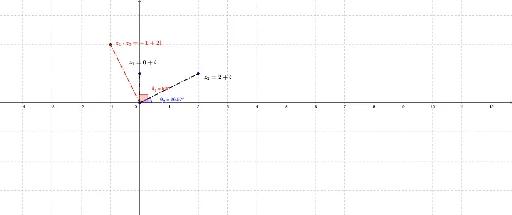
This example demonstrates the geometric interpretation of complex number multiplication using dynamic visuals, showing how the product of two complex numbers relates to vector transformations. Core math concepts include polar form of complex numbers, multiplication rules for magnitudes and angles, and vector rotation/scaling. GeoGebra commands like Angle, Segment, and CurveCartesian are used to construct the geometric representations of complex numbers z1, z2, and their product. Suitable for high school and advanced learners to grasp the visual geometric meaning of complex operations.
GeoGebra Commands & Parameters
Angle(z_4, z_3, z_1) → θ_1Segment(z_3, z_1) → r_1Segment(z_3, z_2) → r_2Segment(z_2, z_{z_1+z_2}) → dSegment(z_1, z_{z_1+z_2}) → eSegment(z_3, z_{z_1*z_2}) → r_{z_1*z_2}Angle(z_4, z_3, z_2) → θ_2Angle(z_4, z_3, z_{z_1*z_2}) → βSegment(z_2, z_{z_1*z_2}) → cCurveCartesian(((1 - t) * x(z_1)) + (t * x(z_{z_1*z_2})), ((1 - t) * y(z_1)) + (t * y(z_{z_1*z_2})), t, 0, 1) → f
AI Drawing Prompt Reference
Create a dynamic visualization showing the geometric interpretation of complex number multiplication, including two complex number vectors and their product, demonstrating vector rotation and scaling relationships. Start by drawing the magnitudes and angles of the two complex numbers, then show the magnitude and angle changes of their product, and finally connect the product vector to the original vectors with a curve to illustrate the transformation process.
The prompt above was compiled from the original drawing commands and is for reference only.