
After Sol LeWitt: Minimalist Line Generation via Geometric Transformations
Loading the math board and drawing, please wait…
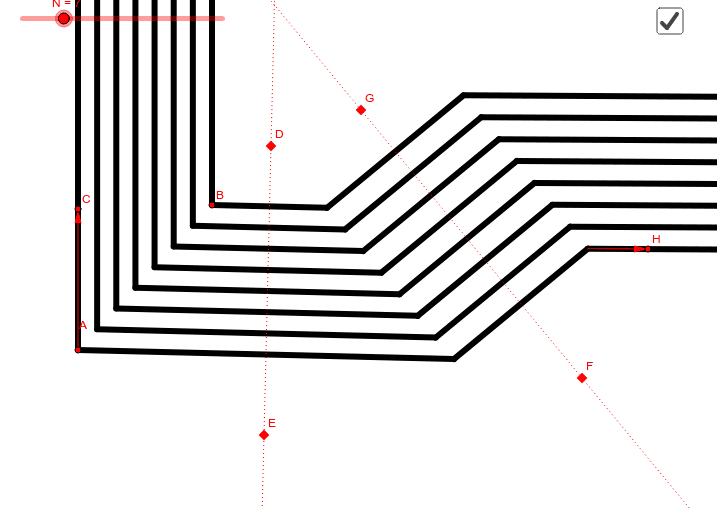
① This example demonstrates how to generate a minimalist line pattern inspired by Sol LeWitt's artworks, using sequences, vectors, lines, and mirror transformations. ② Core mathematical concepts include line segments, straight lines, vectors, matrices (for reflection), sequence generation, and continuity (controlling density via parameters). ③ Construction highlights: from the summary, commands include Sequence (generating point lists), Vector (defining directions), Line (drawing base lines), and Mirror (applying symmetry); objects such as A, B, N, list1, C, u, list2, D, E, a, list1', list3, F, G, b, list1'', list4, H, v, list5, c are used, showing layered iterations and transformations. ④ Suitable for high school and above, this serves as an engaging case for integrating mathematics and art, and for teaching analytic geometry, transformations, and sequences.
GeoGebra Commands & Parameters
Sequence(A + (i / N * (B - A)), i, 0, N) → list1Vector(A, C) → uSequence(Ray[Element[list1, i], u], i, 1, N + 1) → list2Line(D, E) → aMirror(list1, a) → list1'Sequence(Segment[Element[list1, i], Element[list1', i]], i, 1, N + 1) → list3Line(F, G) → bMirror(list1', b) → list1''Sequence(Segment[Element[list1', i], Element[list1'', i]], i, 1, N + 1) → list4Vector(Element[list1'', 1], H) → vSequence(Ray[Element[list1'', i], v], i, 1, N + 1) → list5