
Addition of Two Vectors by Casper Buisman
Loading the math board and drawing, please wait…
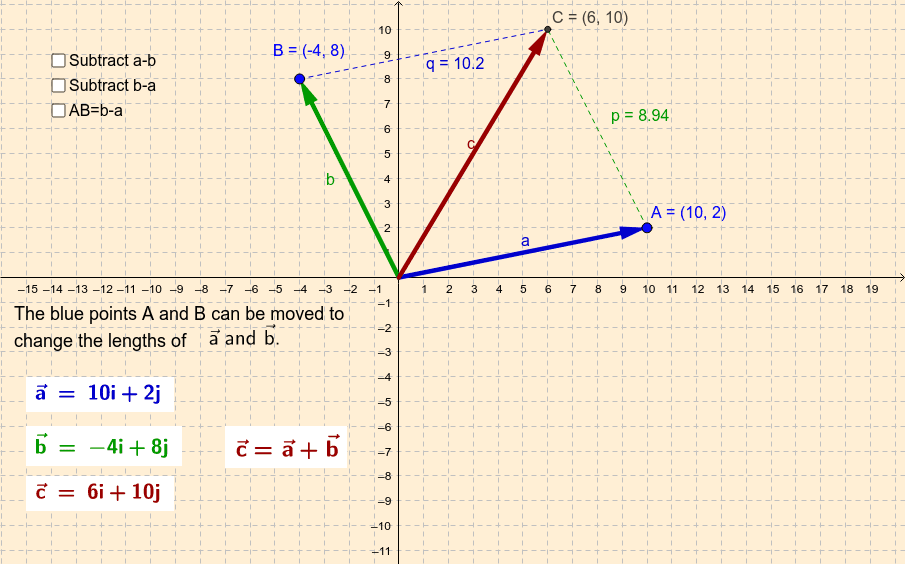
This example demonstrates the addition and subtraction of two vectors. Key mathematical concepts include the geometric representation and operations of vectors. Using GeoGebra commands such as Vector, Line, Intersect, etc., it provides a visual understanding of vector addition and subtraction. Suitable for students at the junior high school level and above to learn basic vector operations.
GeoGebra Commands & Parameters
Vector(A) → aVector(B) → bLine(B, a) → mLine(A, b) → nIntersect(m, n) → CSegment(A, C) → pSegment(B, C) → qVector(D) → uVector(A + D) → vPoint(v) → ESegment(A, E) → eSegment(E, D) → fPoint(j) → FPoint(i) → GSegment(F, B) → kSegment(F, G) → lVector(A, B) → w
AI Drawing Prompt Reference
Draw a diagram showing vector addition. Draw two vectors starting from the origin, draw a line segment from their midpoint, and mark line segments from the origin to the midpoint. Also draw a vector from the origin to the midpoint and another vector from the origin to the midpoint to another point, then mark the endpoint. Ensure the diagram is clear and labeled to help understand the concept of vector addition.
The prompt above was compiled from the original drawing commands and is for reference only.