
Adding Integers on the Number Line by Karen ODonnell
Loading the math board and drawing, please wait…
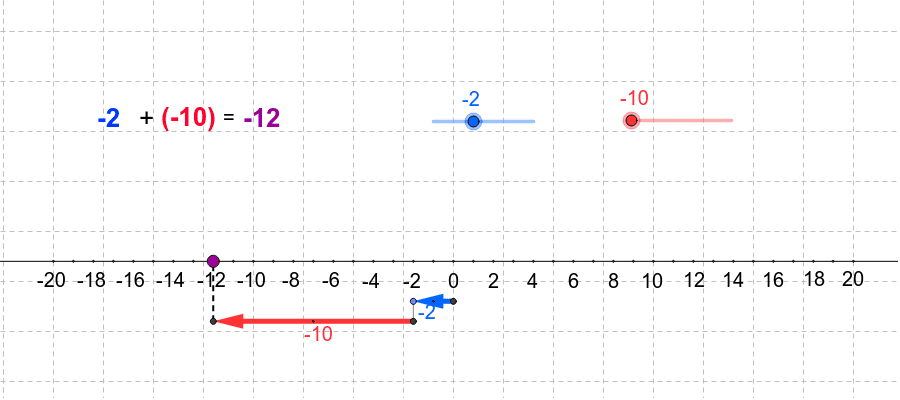
This example dynamically demonstrates how to perform integer addition using a number line. It involves core math concepts like number line, integer operations, and vector addition. Construction highlights include commands like Line, Point, Vector, Translate, and Segment from GeoGebra. Suitable for middle school mathematics teaching to visually explain the geometric meaning of integer addition.
GeoGebra Commands & Parameters
Line(A, B) → aPoint(a) → CCircle(C, 2) → pOrthogonalLine(C, a) → dPoint(a) → DPoint(a) → EPoint(a) → FPoint(a) → GPoint(a) → HPoint(a) → IPoint(a) → JPoint(a) → KPoint(a) → LPoint(a) → MPoint(a) → NPoint(a) → OPoint(a) → PPoint(a) → QPoint(a) → RPoint(a) → SPoint(a) → TPoint(a) → UPoint(a) → VPoint(a) → WPoint(a) → YPoint(a) → ZPoint(a) → A_1Point(a) → B_1Point(a) → C_1Point(a) → D_1Point(a) → E_1Point(a) → F_1Point(a) → G_1Point(a) → H_1Intersect(p, d) → I_1, L_5OrthogonalLine(I_1, d) → eVector(I_1, L_1) → vOrthogonalLine(L_5, d) → hCircle(C, 4) → kIntersect(k, d, 1) → J_1OrthogonalLine(J_1, d) → fVector(J_1, K_1) → uVector(L_5, M_1) → wCircle(L_5, 1) → gIntersect(g, d, 1) → N_1OrthogonalLine(N_1, d) → iCircle(M_1, 1) → qIntersect(q, i) → O_1, P_1Translate(O_1, v) → Q_1Vector(O_1, Q_1) → zIntersect(k, d, 2) → R_1Circle(R_1, N_1) → rIntersect(r, d, 2) → S_1OrthogonalLine(S_1, d) → jVector(S_1, T_1) → lSegment(J_1, S_1) → mSegment(M_1, O_1) → tOrthogonalLine(K_1, a) → nIntersect(n, a) → U_1OrthogonalLine(L_1, a) → sOrthogonalLine(T_1, a) → a_1Intersect(s, a) → W_1Intersect(a_1, a) → Y_1Segment(K_1, U_1) → b_1Segment(T_1, Y_1) → c_1Segment(L_1, W_1) → d_1Segment(I_1, L_1) → b_2Segment(J_1, K_1) → e_1Segment(L_5, M_1) → f_1Segment(Q_1, O_1) → g_1Segment(T_1, S_1) → h_1Midpoint(J_1, K_1) → Z_1Midpoint(I_1, L_1) → A_2Midpoint(L_5, M_1) → B_2Midpoint(Q_1, O_1) → C_2Segment(Q_1, Y_1) → i_1Point(a) → V_1Point(a) → D_2Point(a) → E_2Point(a) → F_2Point(a) → G_2Point(a) → H_2Point(a) → I_2Point(a) → J_2Point(a) → K_2Point(a) → L_2