
Adding 3 Sine Waves
Loading the math board and drawing, please wait…
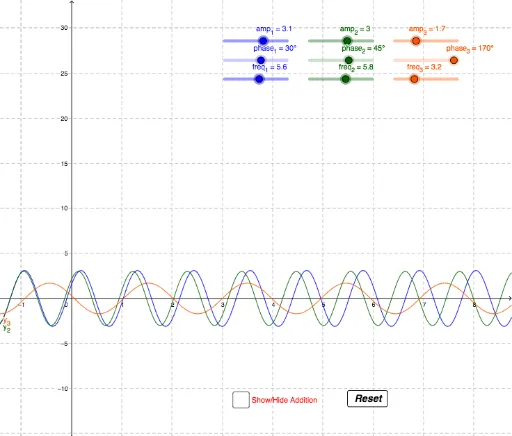
This example demonstrates the superposition of three sine waves with different amplitudes, frequencies, and phases, showing the resulting composite wave. Key math concepts include sine functions, amplitude, frequency, phase, and the principle of superposition. The construction uses GeoGebra commands/objects like amp_{1}, amp_{2}, phase_{1}, phase_{2}, freq_{1}, freq_{2}, y_1, y_2, button1, a, phase_3, freq_{3}, amp_{3}, y_{3}, f, allowing parameter adjustments via sliders. Suitable for high school and above students studying function superposition, signal processing, and wave phenomena in physics.
GeoGebra Commands & Parameters
Numeric amp_{1}(3.1)Numeric amp_{2}(3)Angle phase_{1}(0.5235987755982988)Angle phase_{2}(0.7853981633974483)Numeric freq_{1}(5.6)Numeric freq_{2}(5.8)y_1(x) = (amp_{1} * sin((freq_{1} * x) + phase_{1}))y_2(x) = (amp_{2} * sin((freq_{2} * x) + phase_{2}))falseAngle phase_3(2.9670597283903604)Numeric freq_3(3.2)Numeric amp_{3}(1.7)y_{3}(x) = (amp_{3} * sin((freq_3 * x) + phase_3))f(x) = y_1(x) + y_2(x) + y_{3}(x)
AI Drawing Prompt Reference
Draw three sine waves with different amplitudes, frequencies, and phases, and show their superposition. First, plot the first sine wave with amplitude 3.1, frequency 5.6, and phase 0.5236 radians. Then, plot the second sine wave with amplitude 3, frequency 5.8, and phase 0.7854 radians. Next, plot the third sine wave with amplitude 1.7, frequency 3.2, and phase 2.9671 radians. Finally, superimpose these three waves to obtain the composite wave and adjust parameters to observe changes.
The prompt above was compiled from the original drawing commands and is for reference only.