
Activity 12R: Perimeter Misconceptions
Loading the math board and drawing, please wait…
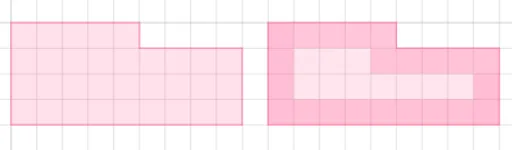
This example dynamically demonstrates polygon transformations to reveal common misconceptions in perimeter calculations. It involves core concepts like perimeter, random experiments, tangent function, median line, and surface area. Construction highlights include using GeoGebra commands Polygon, Point, Rotate, Intersect. Suitable for high school mathematics teaching to help students understand the variation patterns of perimeter in complex geometric problems.
GeoGebra Commands & Parameters
Polygon(B, A, D, E, F, C) → poly1, b, a, d, e, f, cPoint(Circle[G, Segment[B, A]]) → HRotate(H + (Segment[A, D], 0), Angle[D - A] + Angle[H - G] - Angle[A - B], H) → IRotate(I + (Segment[D, E], 0), Angle[E - D] + Angle[I - H] - Angle[D - A], I) → JRotate(J + (Segment[E, F], 0), Angle[F - E] + Angle[J - I] - Angle[E - D], J) → KRotate(K + (Segment[F, C], 0), Angle[C - F] + Angle[K - J] - Angle[F - E], K) → LPolygon(G, H, I, J, K, L) → poly2, g, h, i, j, k, lPoint(l) → MPoint(h) → NPolygon(M, N, H, G) → q1, m, n, h_1, g_1Intersect(k, l) → OIntersect(j, k) → PPoint(m) → QPolygon(M, O, P, Q) → q2, m_1, o, p, qPoint(p) → RPoint(i) → TIntersect(i, j) → UPolygon(R, S, T, U) → q3, r, s, t, uPoint(s) → VPoint(h) → WIntersect(h, i) → ZPolygon(V, W, Z, T) → q4, v, w, z_1, t_1Point(v) → A_1Point(m) → B_1Polygon(N, W, A_1, B_1) → q5, n_1, w_1, a_1, b_1
AI Drawing Prompt Reference
Draw a hexagon ABCDEF, then rotate it around each vertex to generate a new hexagon GHIJKL. Use points G, H, I, J, K, L to construct new polygons, and generate a series of polygons through rotation and intersection, ultimately forming a series of nested polygons to illustrate misconceptions about perimeter variations.
The prompt above was compiled from the original drawing commands and is for reference only.