
AC Method: Geometric Link Between Roots and Factoring of Quadratics
Loading the math board and drawing, please wait…
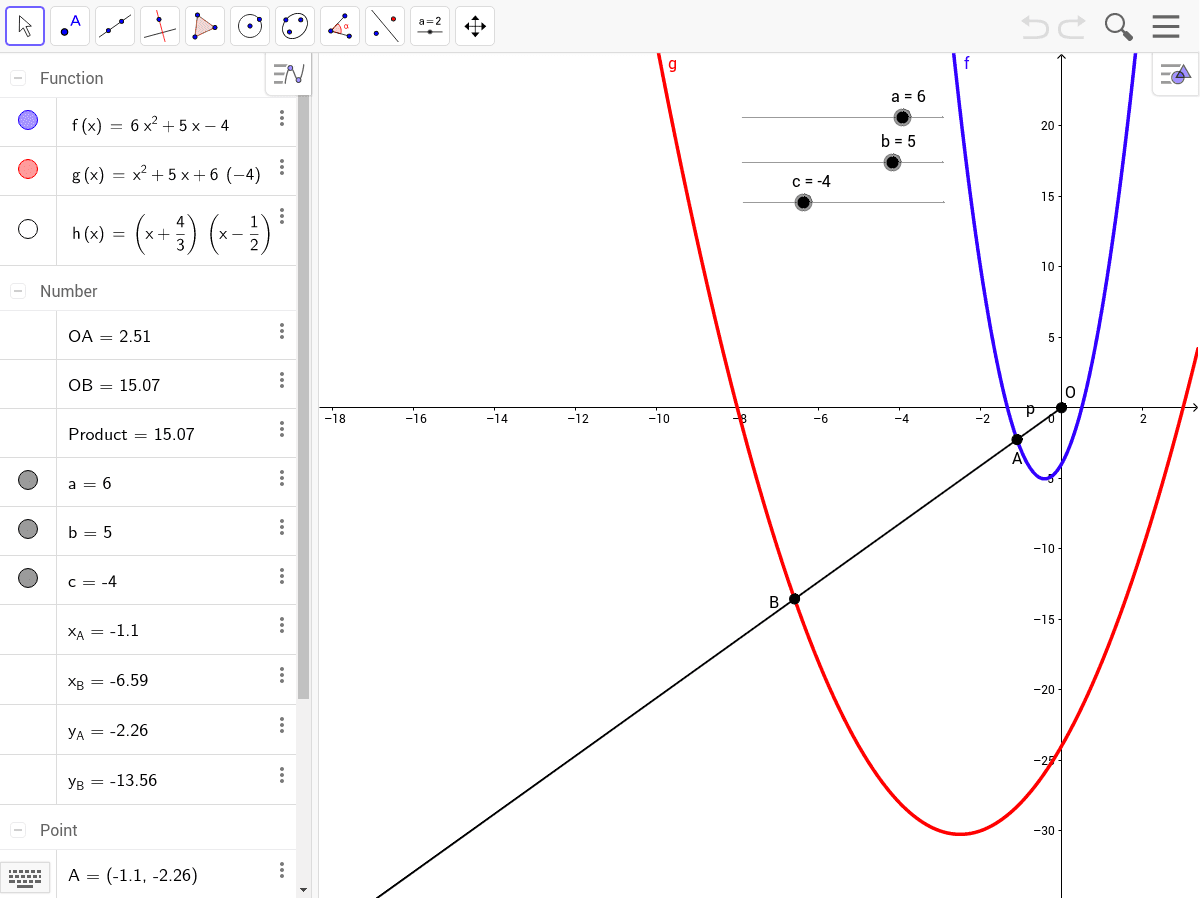
This GeoGebra example dynamically illustrates the relationship between the roots of two quadratic functions f(x)=ax²+bx+c and g(x)=x²+bx+ac, and how their factored forms are connected through the classic 'AC method' of factoring. The core mathematical concepts include quadratic roots, factoring, Vieta's formulas, and transformations of function graphs. Construction details: using GeoGebra commands such as Point, Ray, Intersect, Distance, and Product, sliders for parameters a, b, c are created, the two parabolas f and g are plotted, and intersection points O, A, B along with segment lengths and their products are displayed, allowing users to adjust parameters and observe how roots change. This is suitable for high school algebra or pre-calculus students, and serves as an excellent visual aid for teachers explaining the geometric meaning behind algebraic factoring techniques.
GeoGebra Commands & Parameters
Point(f) → ARay(O, A) → pIntersect(g, p, 1.0) → BDistance(O, A) → OADistance(O, B) → OBProduct({a, OA}) → Product
AI Drawing Prompt Reference
Create a dynamic coordinate system with two parabolas: one standard quadratic curve and another transformed curve. Place a movable point on the first parabola, draw a ray from the origin through this point, and let it intersect the second parabola at another point. Display the origin, both intersection points, the distances between the origin and each point, and a value equal to the product of the first parabola's parameter and the distance from the origin to the first point. Use three sliders to adjust the shapes and positions of the parabolas, observing how the intersections and distances change, thereby illustrating the geometric relationship between quadratic roots and factoring.
The prompt above was compiled from the original drawing commands and is for reference only.