
AB2009_4c Volume by Shells
Loading the math board and drawing, please wait…
In collections
AP Calculus volume problems
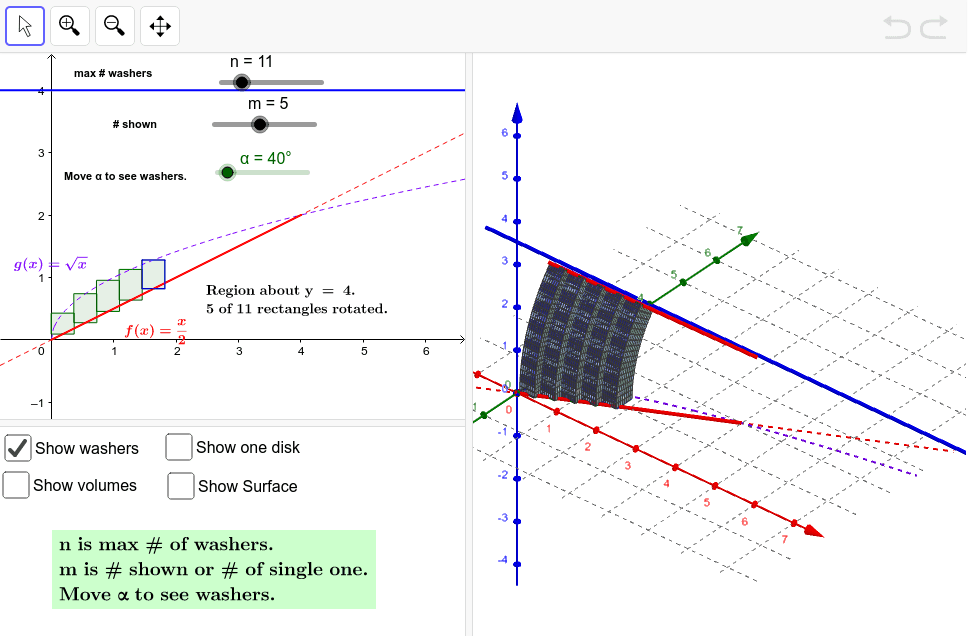
This applet illustrates the solution for problem 4c from the 2009 AP AB test, focusing on calculating the volume of a solid of revolution using the shell method. It involves using GeoGebra commands such as Sequence, Polygon, Rotate, Integral, Surface, and RectangleSum. Suitable for high school calculus education and learning.
GeoGebra Commands & Parameters
Sequence(Polygon[((k * h), f(((k + p) * h))), (((k + 1) * h), f(((k + p) * h))), (((k + 1) * h), g(((k + p) * h))), ((k * h), g(((k + p) * h)))], k, 0, m - 1) → RectanglesPolygon(((DK * h), g(((DK + p) * h))), (((DK + 1) * h), g(((DK + p) * h))), (((DK + 1) * h), f(((DK + p) * h))), ((DK * h), f(((DK + p) * h)))) → Rectangle1, b, c, d, eRotate(Rectangle1, α, a) → Rectangle1'Integral((π * ((4 - f(x))^(2) - (4 - g(x))^(2))), 0, 4) → VolIntegRotate(f_1, α, a) → iRotate(g_1, α, a) → jSurface(((DK + 1) * h), 4 - ((4 - u) * cos(β)), ((4 - u) * sin(β)), u, f(((DK + p) * h)), g(((DK + p) * h)), β, 0, α) → SideRight1Surface((DK * h), 4 - ((4 - u) * cos(β)), ((4 - u) * sin(β)), u, f(((DK + p) * h)), g(((DK + p) * h)), β, 0, α) → SideLeft1Surface(u, 4 - ((4 - f(((DK + p) * h))) * cos(β)), ((4 - f(((DK + p) * h))) * sin(β)), u, (DK * h), ((DK + 1) * h), β, 0, α) → Outer1Surface(u, 4 - ((4 - g(((DK + p) * h))) * cos(β)), ((4 - g(((DK + p) * h))) * sin(β)), u, (DK * h), ((DK + 1) * h), β, 0, α) → Inner1Rotate(Rectangles, α, a) → Rectangles'Surface(u, 4 - ((4 - g(u)) * cos(β)), ((4 - g(u)) * sin(β)), u, 0, 4, β, 0, (2 * π)) → InnerSurface(u, 4 - ((4 - f(u)) * cos(β)), ((4 - f(u)) * sin(β)), u, 0, 4, β, 0, (2 * π)) → OuterSequence(Surface[u, 4 - ((4 - g(((k + p) * h))) * cos(β)), ((4 - g(((k + p) * h))) * sin(β)), u, (k * h), ((k + 1) * h), β, 0, α], k, 0, m - 1) → InnersSequence(Surface[u, 4 - ((4 - f(((k + p) * h))) * cos(β)), ((4 - f(((k + p) * h))) * sin(β)), u, (k * h), ((k + 1) * h), β, 0, α], k, 0, m - 1) → OutersSequence(Surface[(k * h), 4 - ((4 - u) * cos(β)), ((4 - u) * sin(β)), u, f(((k + p) * h)), g(((k + p) * h)), β, 0, α], k, 0, m - 1) → SidesLeftSequence(Surface[((k + 1) * h), 4 - ((4 - u) * cos(β)), ((4 - u) * sin(β)), u, f(((k + p) * h)), g(((k + p) * h)), β, 0, α], k, 0, m - 1) → SidesRightRectangleSum(A, 0, (m * h), m, p) → WS
AI Drawing Prompt Reference
Create a 3D solid of revolution illustrating the shell method. The solid is formed by rotating a region between two curves, f(x) and g(x), from x=0 to x=4, around a vertical axis at x=4. Show a series of thin vertical rectangles approximating the region, each of which rotates to form a cylindrical shell with inner and outer surfaces and side caps. Display the complete outer and inner surfaces of the solid, along with a highlighted shell to emphasize the method. Include a numerical integral value representing the volume. The visual should clearly show the transition from discrete rectangular shells to the smooth solid, aiding in understanding the shell method for volume calculation.
The prompt above was compiled from the original drawing commands and is for reference only.