
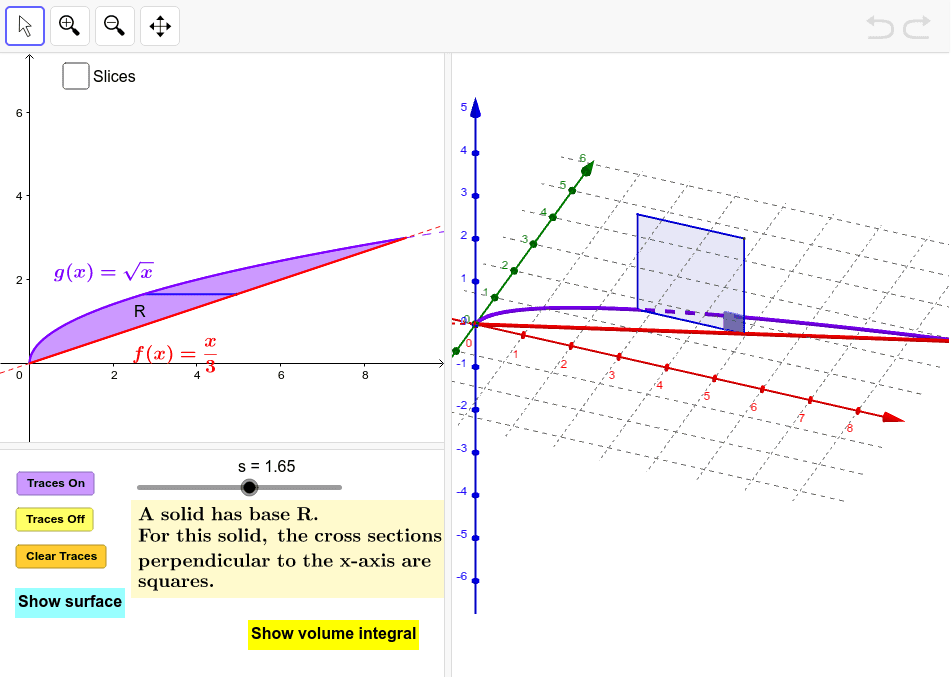
AB2008_1c_B Volume, Square Cross Sections
Loading the math board and drawing, please wait…
This example demonstrates the volume of a solid formed by rotating a region, using square cross sections. It involves core calculus concepts like volume calculation, integration, limits, and geometric construction. GeoGebra commands used include Sequence, Intersect, Segment, Integral, Locus, Polygon, etc. Suitable for high school calculus students to understand volume calculation of solids of revolution.
GeoGebra Commands & Parameters
Sequence(Polygon[(fI(((k + p) * h)), (k * h), 0), (gI(((k + p) * h)), (k * h), 0), (gI(((k + p) * h)), (k * h), ht(((k + p) * h))), (fI(((k + p) * h)), (k * h), ht(((k + p) * h)))], k, 0, m - 1) → SlicesFrontIntersect(f, g, 3, 5) → ESegment(A, B) → eIntegral((fI(x) - gI(x))^(2), 0, 3) → IntegLocus(C, s) → loc1If(togS ≟ 1, "Hide surface", "Show surface") → ShowSurfaceLocus(D, s) → loc2Polygon(A, B, C, D) → Rect, a, b, c, dAngle(B, A, D) → αSegment((0, 6, 27), (9, 6, 27)) → iIf(togDF ≟ 1, "Show Directions", "Show volume integral") → ToggleDirectionVolumeIntegralSequence(Area[Element[SlicesFront, k]], k, 1, m) → AreasSequence(Surface[gI(((k + p) * h)), ((k + u) * h), (v * ht(((k + p) * h))), u, 0, 1, v, 0, 1], k, 0, m - 1) → SlicesLeftSequence(Surface[(v * fI(((k + p) * h))) + ((1 - v) * gI(((k + p) * h))), ((k + u) * h), ht(((k + p) * h)), u, 0, 1, v, 0, 1], k, 0, m - 1) → SlicesTopSequence(Polygon[(fI(((k + p) * h)), (k * h), 0), (gI(((k + p) * h)), (k * h), 0), (gI(((k + p) * h)), ((k + 1) * h), 0), (fI(((k + p) * h)), ((k + 1) * h), 0)], k, 0, m - 1) → SlicesBaseSequence(Polygon[(fI(((k + p) * h)), ((k + 1) * h), 0), (gI(((k + p) * h)), ((k + 1) * h), 0), (gI(((k + p) * h)), ((k + 1) * h), ht(((k + p) * h))), (fI(((k + p) * h)), ((k + 1) * h), ht(((k + p) * h)))], k, 0, m - 1) → SlicesBackSequence(Surface[fI(((k + p) * h)), ((k + u) * h), (v * ht(((k + p) * h))), u, 0, 1, v, 0, 1], k, 0, m - 1) → SlicesRightSurface((v * fI(u)) + ((1 - v) * gI(u)), u, 0, u, 0, 3, v, 0, 1) → BaseSurface((v * fI(u)) + ((1 - v) * gI(u)), u, ht(u), u, 0, 3, v, 0, 1) → TopSurface(fI(u), u, (v * ht(u)), u, 0, 3, v, 0, 1) → SurfaceFrontSurface(gI(u), u, (v * ht(u)), u, 0, 3, v, 0, 1) → SurfaceBack