
AAS Congruence Theorem Demo
Loading the math board and drawing, please wait…
In collections
Chapter 4 - Triangle Congruence - Geometry
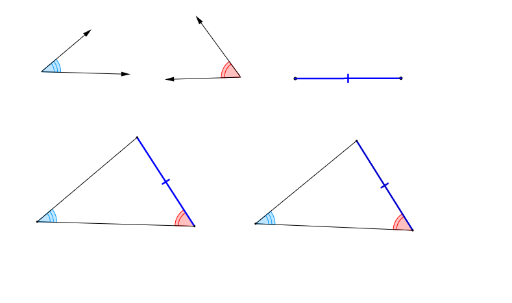
This example dynamically demonstrates the AAS (Angle-Angle-Side) Congruence Theorem, illustrating triangle congruence criteria, angle-side relationships, and involving concepts like circles and loci. It uses commands such as Vector, Segment, Angle, Circle, Point, Intersect, Line, and Ray for construction, making it suitable for high school geometry education and understanding congruence conditions.
GeoGebra Commands & Parameters
Vector(D, E) → wVector(D, F) → aSegment(G, H) → fAngle(E, D, F) → γCircle(I, Segment[G, H]) → cPoint(c) → JSegment(I, J) → gCircle(J, Segment[E, D]) → dCircle(J, Segment[D, F]) → eIntersect(d, g, 1) → KCircle(K, Segment[F, E]) → hIntersect(e, h, 1) → LLine(J, L) → iCircle(J, Segment[D, F]) → kCircle(J, Segment[D, E]) → pIntersect(p, g, 1) → BCircle(B, Segment[F, E]) → qIntersect(k, q, 1) → MLine(M, J) → jPoint(j) → NSegment(I, N) → lSegment(N, J) → mAngle(I, J, N) → αCircle(R, Segment[G, H]) → c_1Point(c_1) → SSegment(R, S) → bPoint(a) → TPoint(w) → UPoint(a) → VCircle(R, Segment[T, U]) → d_1Circle(R, Segment[T, V]) → e_1Circle(S, Segment[U, V]) → f_1Circle(R, Segment[D, E]) → g_1Circle(R, Segment[D, F]) → h_1Intersect(g_1, b, 1) → WCircle(W, Segment[E, F]) → k_1Intersect(h_1, k_1, 1) → ZLine(R, Z) → i_1Circle(R, Segment[J, N]) → p_1Intersect(p_1, i_1, 2) → A_1Circle(A_1, Segment[N, I]) → q_1Circle(R, Segment[J, I]) → r_1Segment(S, A_1) → j_1Segment(R, A_1) → l_1Angle(S, R, A_1) → βAngle(R, A_1, S) → δAngle(J, N, I) → εCircle(A, Segment[J, N]) → rPoint(r) → CSegment(A, C) → nCircle(A, Segment[N, I]) → sCircle(C, Segment[J, I]) → tIntersect(s, t, 1) → ORay(A, O) → m_1Point(n) → PVector(A, P) → uPoint(m_1) → QVector(A, Q) → vAngle(P, A, Q) → ζ