
AAA Non-congruence by Counter-example
Loading the math board and drawing, please wait…
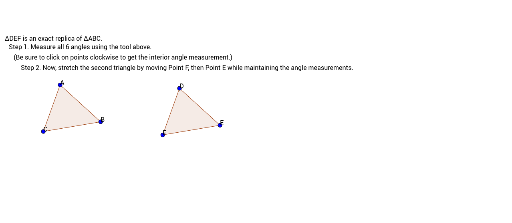
This GeoGebra example demonstrates that Angle-Angle-Angle (AAA) does not guarantee triangle congruence by constructing two triangles with identical corresponding angles but different side lengths. The core mathematical concept is the distinction between congruence and similarity: equal angles imply similarity, not congruence. The construction uses the Polygon command to create two triangles, with multiple text objects (text1 to text10) labeling angles and sides. By dragging vertices (D, E, F and their copies D_1, E_1, F_1), users can dynamically adjust the shapes while observing that corresponding angles remain equal but side lengths differ, providing a clear counter-example. This is suitable for middle school or high school geometry lessons, helping students understand the conditions for triangle congruence and similarity, and can serve as an interactive teaching tool for visual proof.
GeoGebra Commands & Parameters
Polygon(D, E, F) → poly2, f, d, ePolygon(D_1, E_1, F_1) → poly2_1, f_1, d_1, e_1
AI Drawing Prompt Reference
Draw two triangles with three pairs of corresponding angles equal but side lengths clearly different. First construct one triangle, then construct a second triangle whose three angles match the first triangle's angles one-to-one, but with side lengths scaled by different factors. Label each vertex with an angle mark and each side with a length value to visually show equal angles but unequal sides. Allow dragging vertices to reshape both triangles while keeping corresponding angles equal and side lengths different, serving as a counter-example that equal angles alone do not guarantee triangle congruence.
The prompt above was compiled from the original drawing commands and is for reference only.