
A Proof of Pythagoras' Theorem
Loading the math board and drawing, please wait…
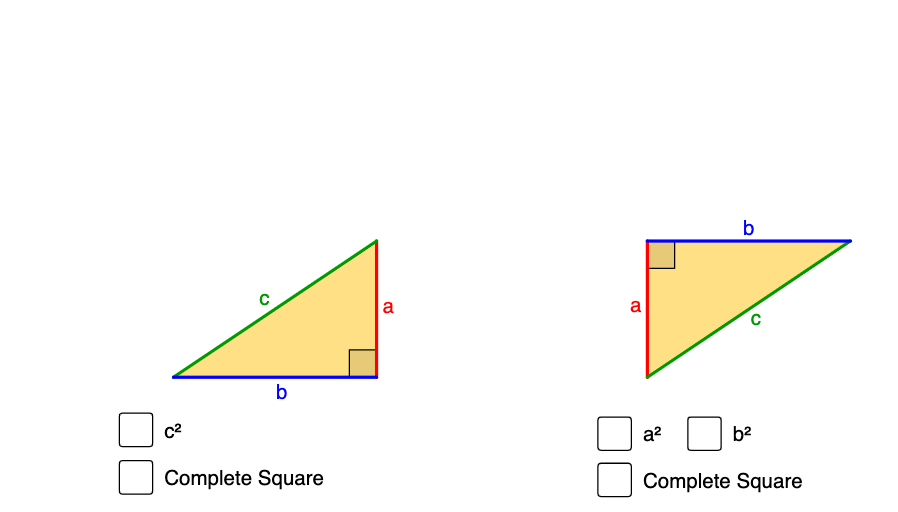
This example demonstrates one proof of Pythagoras' Theorem, which states that in a right-angled triangle, the square of the hypotenuse is equal to the sum of the squares of the other two sides. Using commands like Intersect, Angle, and Polygon, the construction involves multiple geometric objects such as polygons, angles, and segments. Suitable for students in middle school and above to learn geometric proofs.
GeoGebra Commands & Parameters
Intersect(c_2, h) → AIntersect(c_2, e) → BIntersect(e, i) → CIntersect(h, i) → DIntersect(a_1, h) → EIntersect(a_1, e) → FIntersect(e, g) → GIntersect(g, h) → HIntersect(e, b_2) → IIntersect(c_2, d) → JIntersect(h, f) → KIntersect(i, j) → LIntersect(j, k) → MIntersect(e, k) → NIntersect(a_1, j) → OIntersect(g, j) → QAngle(L, C, I) → lbr90Polygon(J, K, L, I) → cc, cc2, cc3, cc4, cc1Polygon(C, L, I) → lbr, lbra, lbrc, lbrbPolygon(K, D, L) → ltr, ltra, ltrb, ltrcPolygon(A, J, K) → ltl, ltla, ltlc, ltlbPolygon(B, I, J) → lbl, lbla, lblc, lblbIntersect(h, k) → PPolygon(Q, N, G) → rbr, rbrc, rbrb, rbraPolygon(M, N, Q) → rbc, rbca, rbcc, rbcbPolygon(O, F, N, M) → aa, aal, aab, aar, aatPolygon(P, M, Q, H) → bb, bbl, bbb, bbr, bbtPolygon(O, M, E) → rtl, rtla, rtlc, rtlbPolygon(P, E, M) → rtc, rtca, rtcc, rtcbAngle(N, M, Q) → rbc90
AI Drawing Prompt Reference
Draw a right-angled triangle to prove Pythagoras' Theorem. Construct a right triangle with two legs and a hypotenuse. Use geometric tools to mark the right angle, hypotenuse, and legs. Ensure the diagram is clear and shows the relationship between the triangle's parts.
The prompt above was compiled from the original drawing commands and is for reference only.