
A Pattern of Triangles Satisfying a²+b²=2c²
Loading the math board and drawing, please wait…
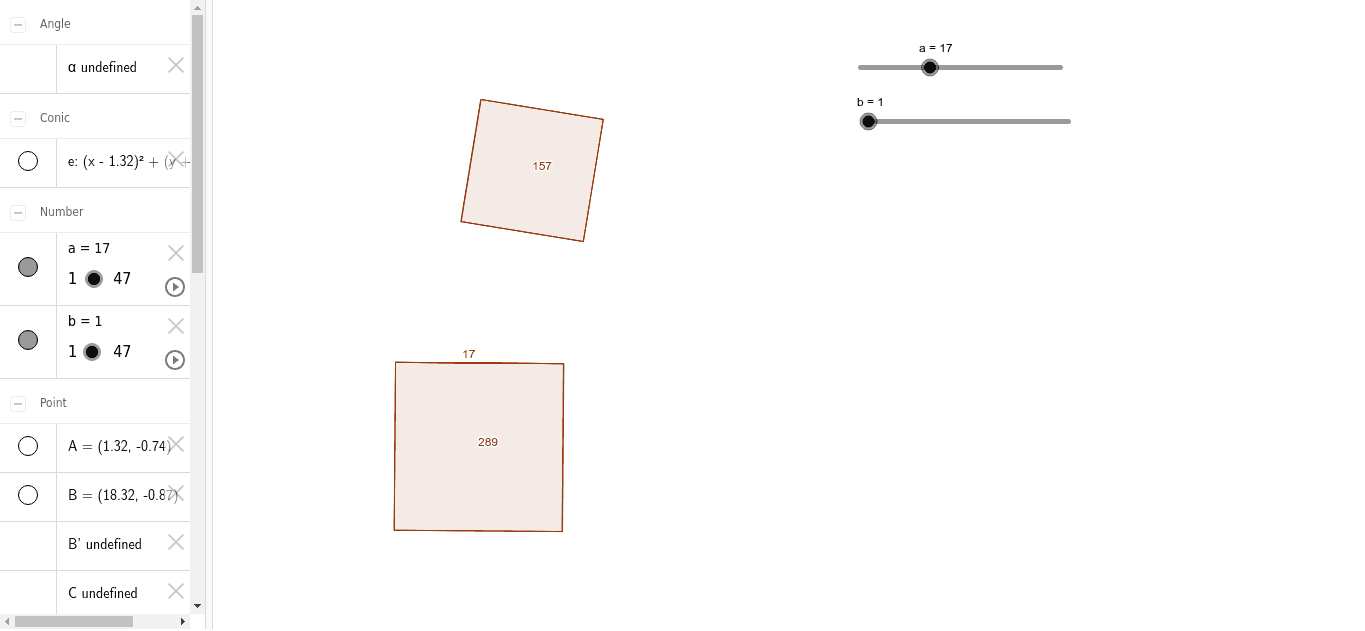
This example demonstrates a pattern of triangles whose side lengths satisfy the relationship a² + b² = 2c², a variant of the Pythagorean theorem. It visually explores how such triangles differ from right triangles and what geometric properties emerge. The core mathematical concept involves the Pythagorean theorem and its generalization, focusing on the relationship between side squares and triangle shape. The construction uses GeoGebra commands such as Point, Segment, Rotate, Angle, Line, Circle, Intersect, and Polygon, creating multiple triangles and associated objects like points A, B, C, segments a, b, c, rotated point B', and polygons poly1 through poly5. This resource is suitable for middle and high school students to investigate non-standard Pythagorean relationships, practice geometric constructions, and understand how algebraic conditions translate into geometric configurations.
GeoGebra Commands & Parameters
Point(Circle[A, a]) → BSegment(A, B) → cRotate(B, acos(((a * a) + (b * b)) / (((4 * a) * b))), A) → B'Angle(B, A, B') → αLine(A, B') → dCircle(A, b) → eIntersect(e, d, 2) → CPolygon(C, B, A) → poly1, a_1, c_1, b_1Polygon(B, A, 4) → poly2, f, g, h, i, D, EPolygon(A, C, 4) → poly3, j, k, l, m, F, GPolygon(C, B, 4) → poly4, n, p, q, r, H, IPolygon(I, H, 4) → poly5, s, t, d_1, e_1, J, K