
4 Numbers - Fifth Grade Version
Loading the math board and drawing, please wait…
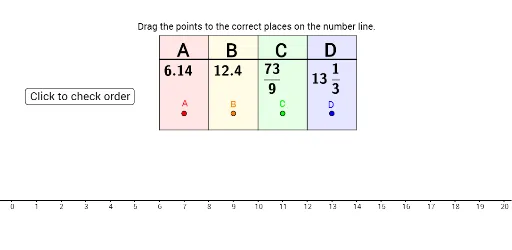
This example demonstrates how to perform various operations with four numbers, involving fractions, isosceles triangles, interest calculation, and function graphs. Using GeoGebra commands such as RandomElement, If, Polygon, and Segment, an interactive math game is constructed. Suitable for fifth-grade students to practice and explore mathematics.
GeoGebra Commands & Parameters
RandomElement(possibleDecimals) → ARandomElement(Remove[possibleDecimals, {A}]) → BRandomElement({2, 3, 4, 5, 6, 7, 8, 9, 10, 11, 12}) → CdenomIf(Cdenom ≟ 2, Random[0, 40, true], If[Cdenom ≟ 3, Random[0, 60, true], If[Cdenom ≟ 4, Random[0, 80, true], If[Cdenom ≟ 5, Random[0, 100, true], If[Cdenom ≟ 6, Random[0, 120, true], If[Cdenom ≟ 7, Random[0, 140, true], If[Cdenom ≟ 8, Random[0, 160, true], If[Cdenom ≟ 9, Random[0, 180, true], If[Cdenom ≟ 10, Random[0, 200, true], If[Cdenom ≟ 11, Random[0, 220, true], If[Cdenom ≟ 12, Random[0, 240, true]]]]]]]]]]]) → CnumPolygon(I + (10, 0), W + (10, 0), V + (10, 0), J + (10, 0)) → poly1, g, h, i, jPolygon(J + (10, 0), V + (10, 0), U + (10, 0), K + (10, 0)) → poly2, k, n, p, qPolygon(K + (10, 0), U + (10, 0), T + (10, 0), L + (10, 0)) → poly3, l, r, t, aPolygon(L + (10, 0), T + (10, 0), S + (10, 0), M + (10, 0)) → poly4, m, s, b, f_1Segment(H, G) → cSegment(G, Z) → dSegment(Z, E) → eSegment(E, F) → fFractionText(C) → CfancyRandom(1, 19) → DwholeRandomElement({2, 3, 4, 5, 6, 7, 8, 9, 10, 11, 12}) → DdenomRandom(1, Ddenom - 1, true) → DnumFractionText(Dnum / Ddenom) → DfancyIf(Dwhole < 0, Dwhole - Dnum / Ddenom, Dwhole + Dnum / Ddenom) → DSegment(A_1, Aact) → aerrSegment(B_1, Bact) → berrSegment(C_1, Cact) → cerrSegment(D_1, Dact) → derrSort({A, B, C, D}) → testSort({x(A_1), x(B_1), x(C_1), x(D_1)}) → test2If(IndexOf[A, Sort[{A, B, C, D}]] ≟ IndexOf[x(A_1), Sort[{x(A_1), x(B_1), x(C_1), x(D_1)}]], 1) → orderAIf(IndexOf[B, Sort[{A, B, C, D}]] ≟ IndexOf[x(B_1), Sort[{x(A_1), x(B_1), x(C_1), x(D_1)}]], 1) → orderBIf(IndexOf[C, Sort[{A, B, C, D}]] ≟ IndexOf[x(C_1), Sort[{x(A_1), x(B_1), x(C_1), x(D_1)}]], 1) → orderCIf(IndexOf[D, Sort[{A, B, C, D}]] ≟ IndexOf[x(D_1), Sort[{x(A_1), x(B_1), x(C_1), x(D_1)}]], 1) → orderD