
3D Vector and Geometric Transformation Animation
Loading the math board and drawing, please wait…
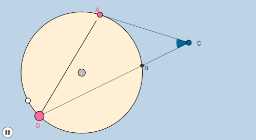
This example demonstrates the relationships and transformations between circles, triangles, and vectors in three-dimensional space through animation. It involves core mathematical concepts such as 3D vectors, geometric transformations (rotation, translation), similarity and congruence of triangles, and calculus applications. The construction utilizes commands like Circle, Segment, PointIn, Tangent, Intersect, CircleArc, Point, Dilate, CircleSector, Line, Angle, Vector, Translate, Rotate, Polygon, OrthogonalLine. It is suitable for high school students and mathematics enthusiasts to learn spatial geometry and vector knowledge, helping to understand complex geometric phenomena.
GeoGebra Commands & Parameters
Circle(A_1, B_1) → cSegment(A_1, B_1) → fPointIn(a_2) → CTangent(C, c) → g, hIntersect(c, g) → D_1Intersect(c, h) → E_1CircleArc(A_1, D_1, E_1) → dPoint(d) → ACircleArc(A_1, D_1, A) → eCircleArc(A_1, A, E_1) → kPoint(k) → DCircleArc(A_1, E_1, D_1) → pSegment(C, A) → iSegment(C, D) → jIntersect(p, i, 1) → EIntersect(p, j, 1) → BSegment(D, E) → lSegment(B, A) → mCircleArc(A_1, B, E) → qCircleArc(A_1, E, D_1) → rCircleArc(A_1, E_1, B) → sCircle(D, (0.2 * f)) → tCircle(A, (0.2 * f)) → c_1Intersect(t, j, 1) → JIntersect(t, l, 1) → KDilate(D, If[0 < b_2 ≤ 1, 1 - b_2, 0], E) → G'Segment(D, G') → nDilate(B, If[1 < b_2 ≤ 2, 2 - b_2, 0], A) → I'Segment(B, I') → f_1CircleSector(D, J, K) → d_1Line(A, n) → g_1Intersect(c_1, g_1, 2) → LIntersect(c_1, i, 1) → MAngle(M, A, L) → αDilate(D, If[2 < b_2 ≤ 3, 3 - b_2, 0], A) → G'_1Vector(D, G'_1) → uTranslate(d_1, u) → e_1Rotate(e_1, If[3 < b_2 ≤ 4, ((-(b_2 - 3)) * α), (-α)], A) → h_1Circle(C, (0.2 * f)) → k_1Intersect(k_1, j, 1) → NIntersect(k_1, i, 1) → OCircleSector(C, O, N) → p_1Segment(A, E) → i_1Segment(E, C) → j_1Segment(D, B) → l_1Segment(B, C) → m_1Polygon(D, C, E) → poly1, h_2, g_2, c_2OrthogonalLine(E, i_1) → n_1OrthogonalLine(B, l_1) → q_1Circle(E, (0.1 * f)) → r_1Circle(B, (0.1 * f)) → s_1Intersect(s_1, q_1, 1) → PIntersect(r_1, n_1, 2) → QLine(Q, i_1) → t_1Line(P, l_1) → a_1OrthogonalLine(A, t_1) → b_1OrthogonalLine(C, t_1) → f_2OrthogonalLine(D, a_1) → i_2OrthogonalLine(C, a_1) → j_2Intersect(t_1, b_1) → RIntersect(t_1, f_2) → SIntersect(a_1, j_2) → TIntersect(a_1, i_2) → UDilate(R, If[4 < b_2 ≤ 5, 5 - b_2, 0], S) → R'Segment(R, R') → aPolygon(A, C, B) → poly2, i_3, f_3, c_3Dilate(U, If[5 < b_2 ≤ 6, 6 - b_2, 0], T) → U'Segment(U, U') → bSegment(C, E) → k_2Segment(C, B) → l_2CircleArc(A_1, B, E) → d_2