
3D Rainbow Formation Simulation
Loading the math board and drawing, please wait…
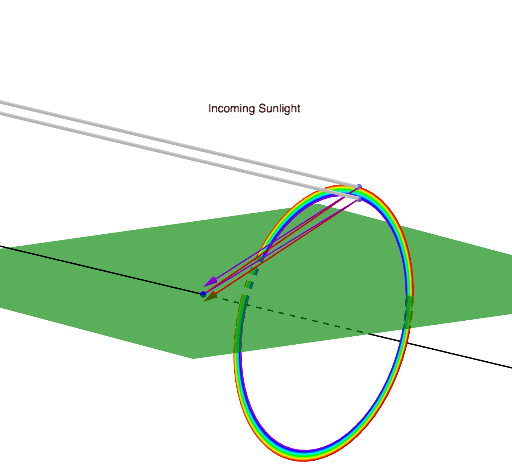
This example demonstrates the processes involved in the formation of a rainbow through a 3D simulation. It involves core mathematical concepts such as reflection, area, quadratic functions, differential equations, and 2D vectors. The construction utilizes GeoGebra commands and objects like Circle, Point, Angle, Rotate, Ray, Intersect, Sphere, Line, Plane, Segment, Vector, and Mirror. It is suitable for high school and above students studying optics, geometry, and mathematical modeling.
GeoGebra Commands & Parameters
Circle(Q, R) → cPoint(c) → UPoint(xAxis) → CAngle(C, Viewer, S) → αRotate(U, (-α), Q) → TRotate(I_1, (-α), T) → J_1Ray(Q, T) → rRay(T, J_1) → dAngle(r, d) → δRotate(Q, asin(sin(δ) / 1.33), T) → Q'Ray(T, Q') → sIntersect(c, s) → V, WAngle(Q, T, Q') → εRotate(Q', (2 * ε), W) → Q''Ray(W, Q'') → a_1Intersect(c, a_1) → Z, A_1Ray(Q, A_1) → c_1Sphere(Viewer, 5.55) → lLine(S, Viewer) → aIntersect(a, l) → K, LCircle(L, B2, a) → C1Point(xAxis) → FPoint(yAxis) → GPlane(F, E, G) → bPoint(C1) → ALine(A, a) → fPoint(f) → BRay(A, B) → eSegment(A, Viewer) → gPoint(e) → DPoint(e) → IAngle(e, g) → βCircle(L, B3, a) → C2Circle(L, B4, a) → C3Circle(L, B5, a) → C4Circle(L, B6, a) → C5Circle(L, B7, a) → C6Circle(L, B8, a) → C7Circle(L, B9, a) → C8Circle(L, B10, a) → C9Circle(L, B11, a) → C10Circle(L, B12, a) → C11Circle(L, B13, a) → C12Circle(L, B14, a) → C13Circle(L, B15, a) → C14Circle(L, B16, a) → C15Circle(L, B17, a) → C16Circle(L, B18, a) → C17Circle(L, B19, a) → C18Circle(L, B20, a) → C19Circle(L, B21, a) → C20Circle(L, B22, a) → C21Circle(L, B23, a) → C22Circle(L, B24, a) → C23Circle(L, B25, a) → C24Circle(L, B26, a) → C25Circle(L, B27, a) → C26Circle(L, B28, a) → C27Circle(L, B29, a) → C28Circle(L, B30, a) → C29Circle(L, B31, a) → C30Circle(L, B32, a) → C31Circle(L, B33, a) → C32Circle(L, B34, a) → C33Circle(L, B35, a) → C34Circle(L, B36, a) → C35Circle(L, B37, a) → C36Circle(L, B38, a) → C37Circle(L, B39, a) → C38Circle(L, B40, a) → C39Circle(L, B41, a) → C40Circle(L, B42, a) → C41Circle(L, B43, a) → C42Circle(L, B44, a) → C43Circle(L, B45, a) → C44Circle(L, B46, a) → C45Circle(L, B47, a) → C46Circle(L, B48, a) → C47Circle(L, B49, a) → C48Circle(L, B50, a) → C49Circle(L, B51, a) → C50Circle(L, B52, a) → C51Circle(L, B53, a) → C52Circle(L, B54, a) → C53Circle(L, B55, a) → C54Circle(L, B56, a) → C55Circle(L, B57, a) → C56Circle(L, B58, a) → C57Circle(L, B59, a) → C58Circle(L, B60, a) → C59Circle(L, B61, a) → C60Circle(L, B62, a) → C61Circle(L, B63, a) → C62Circle(L, B64, a) → C63Circle(L, B65, a) → C64Circle(L, B66, a) → C65Circle(L, B67, a) → C66Circle(L, B68, a) → C67Circle(L, B69, a) → C68Circle(L, B70, a) → C69Circle(L, B71, a) → C70Circle(L, B72, a) → C71Circle(L, B73, a) → C72Circle(L, B74, a) → C73Circle(L, B75, a) → C74Circle(L, B76, a) → C75Circle(L, B77, a) → C76Circle(L, B78, a) → C77Angle(Viewer, A, M) → γPoint(C77) → OSegment(O, Viewer) → mLine(O, e) → pPoint(p) → PRay(O, P) → qVector(O, N) → nVector(A, M) → kRay(Q, W) → tPoint(c_1) → B_1Rotate(B_1, (-δ), A_1) → C_1Angle(C_1, A_1, B_1) → ζSegment(W, A_1) → d_1Segment(T, Z) → e_1Rotate(Q, asin(sin(δ) / 1.345), T) → Q'_1Ray(T, Q'_1) → f_1Intersect(c, f_1) → D_1, E_1Segment(T, E_1) → g_1Ray(Q, E_1) → h_1Mirror(T, h_1) → T'Mirror(E_1, h_1) → F_1Segment(T', F_1) → i_1Angle(Q, T, E_1) → ηRay(Q, T') → j_1Point(j_1) → G_1Rotate(G_1, (-δ), T') → H_1Vector(T', H_1) → k_1Vector(A_1, C_1) → b_1Point(q) → K_1Vector(L_1, M_1) → uVector((0.3, 0, -0.4), Viewer) → v
AI Drawing Prompt Reference
Create a 3D simulation showing the formation of a rainbow through light reflection in water droplets. Start with a circle and a point on it, then construct reflected rays and vectors using angles and rotations. Determine the rainbow's position by intersecting a sphere with the circle, and simulate the color bands with multiple concentric circles. The final image should depict the dynamic process of light reflection and refraction within water droplets.
The prompt above was compiled from the original drawing commands and is for reference only.