
3D Pythagorean Theorem: Longest Diagonal in a Rectangular Box
Loading the math board and drawing, please wait…
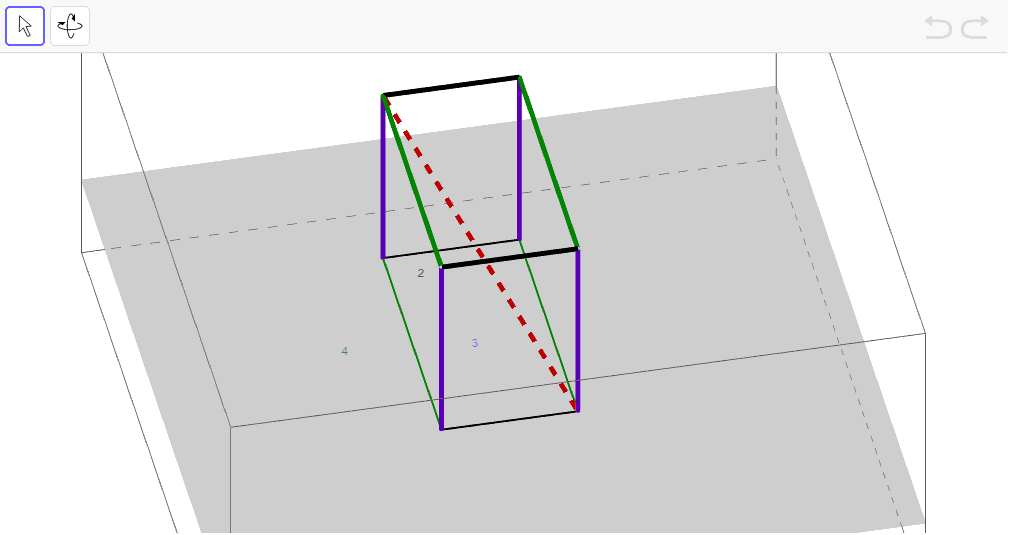
This GeoGebra example demonstrates the construction and measurement of the longest space diagonal inside a rectangular box (right prism), providing a dynamic visualization of the 3D Pythagorean theorem. Core mathematical concepts include the three-dimensional Pythagorean theorem, space diagonal length formula, right prism geometry, polygonal faces, and segment length calculation in solid geometry. The construction uses GeoGebra commands such as Polygon to build base and lateral faces, Prism to generate the rectangular box, Segment to draw vertical edges AE, BF, DG, CH and the space diagonal, and Perimeter to compute polygon perimeters. Key objects include vertices A through H, faces faceABFE, faceBDGF, faceCDGH, faceACHE, faceEFGH, edges edgeAE, edgeBF, edgeDG, edgeCH, edgeEF, edgeFG, edgeGH, edgeEH, polygon poly1, and segments a, b, c, d, e, f. Suitable for middle school solid geometry, high school spatial vectors and analytic geometry review, classroom demonstrations, and inquiry-based learning.
GeoGebra Commands & Parameters
Polygon(A, B, D, C) → poly1, a, b, d, cPrism(poly1, 3) → e, E, edgeAE, edgeBF, edgeDG, edgeCH, edgeEF, edgeFG, edgeGH, edgeEH, F, G, H, faceABFE, faceBDGF, faceCDGH, faceACHE, faceEFGHSegment(B, H) → fPerimeter(poly1) → perimeterpoly1
AI Drawing Prompt Reference
Draw a rectangular box with a rectangular base and a height of three units. First sketch the base rectangle and its four edges, then extrude it upward to form the six rectangular faces, indicate all edges, and draw the longest space diagonal connecting opposite vertices. Also display the perimeter of the base rectangle. Show each face as a distinct polygon, label the vertical edges, and compute the base perimeter dynamically.
The prompt above was compiled from the original drawing commands and is for reference only.