
3D Projection
Loading the math board and drawing, please wait…
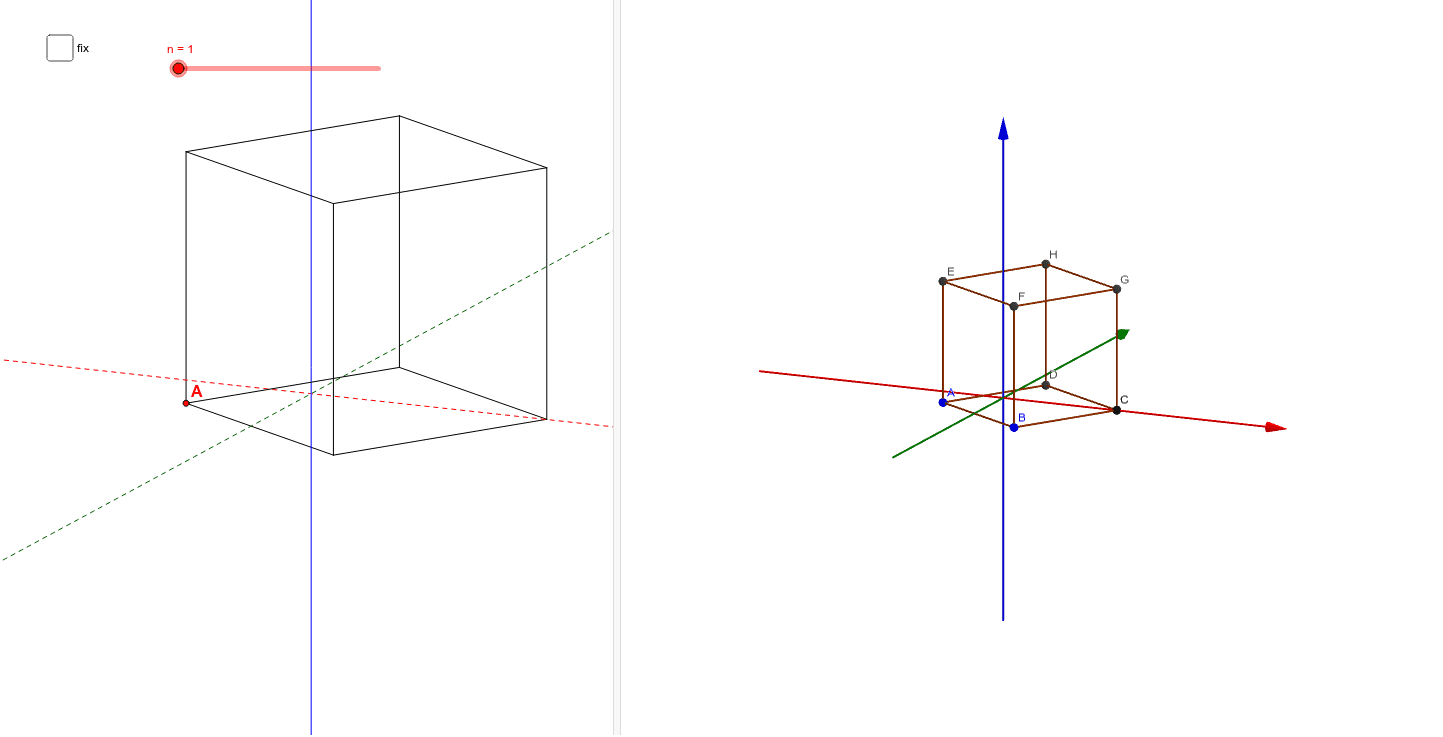
This example demonstrates the projection of a cube in 3D space. Key mathematical concepts include solid geometry and projection transformations. Using GeoGebra commands such as Point, Cube, Mirror, Rotate, etc., the construction of the cube and its projection plane is achieved. Suitable for high school and above students to learn solid geometry and projection transformations.
GeoGebra Commands & Parameters
Point(Circle[B, Distance[A, B], Segment[A, B]]) → CCube(A, B, C) → cub, D, faceCDHG, faceEFGH, arêteAD, arêteAB, arêteBC, arêteCD, arêteAE, arêteDH, arêteEH, arêteEF, E, arêteBF, arêteFG, arêteCG, arêteGH, F, G, H, faceABCD, faceADHE, faceABFE, faceBCGFPointIn(Sphere[Midpoint[A, G], (2 * Distance[A, B])]) → V''CornerThreeD(-1, 11) → VMirror(V'', (0, 0, 0)) → V'If(fix, V', V) → WLine((0, 0, 0), W) → axOrthogonalPlane(W, ax) → plLine(ClosestPointRegion[pl, (0, 0, 0)], ClosestPointRegion[pl, (0, 0, 1)]) → jRotate(j, 1.5707963267948966, ax) → iIntersect(i, Sphere[W, 1], 2) → IIntersect(j, Sphere[W, 1], 2) → JSequence(ClosestPointRegion[pl, Element[liste0, p]], p, 1, 10) → liste1Sequence(ClosestPoint[i, Element[liste1, p]], p, 1, 10) → listx2Sequence(ClosestPoint[j, Element[liste1, p]], p, 1, 10) → listy2Sequence(((If[Distance[Element[listx2, p], I] - Distance[Element[listx2, p], W] ≟ 1, -1, 1] * Distance[Element[listx2, p], W]), (If[Distance[Element[listy2, p], J] - Distance[Element[listy2, p], W] ≟ 1, -1, 1] * Distance[Element[listy2, p], W])), p, 1, 10) → liste3Sequence(Segment[Element[liste3, p], Element[liste3, p + 1]], p, 1, 3) → listS1Sequence(Segment[Element[liste3, p], Element[liste3, p + 1]], p, 5, 7) → listS2Segment(Element[liste3, 4], Element[liste3, 1]) → s5Segment(Element[liste3, 8], Element[liste3, 5]) → s6Sequence(Segment[Element[liste3, p], Element[liste3, p + 4]], p, 1, 4) → listS3Element(liste3, n) → PPElement(liste1, n) → PElement(listx2, n) → PxElement(listy2, n) → PyElement({"A", " B", "C", "D", "E", "F", "G", "H"}, n) → texte1Line((0, 0), Element[liste3, 10]) → aLine((0, 0), Element[liste3, 9]) → bSequence(Segment[Element[liste0, p], Element[liste1, p]], p, 1, 8) → liste2Segment(P, Px) → dSegment(P, Py) → eSequence(Segment[Element[liste1, p], Element[liste1, p + 1]], p, 1, 3) → listeS1Sequence(Segment[Element[liste1, p], Element[liste1, p + 4]], p, 1, 4) → listeS3Sequence(Segment[Element[liste1, p], Element[liste1, p + 1]], p, 5, 7) → listeS2Segment(Element[liste1, 4], Element[liste1, 1]) → ss5Segment(Element[liste1, 8], Element[liste1, 5]) → ss6
AI Drawing Prompt Reference
Draw a projection of a cube in 3D space. The cube is defined by points A, B, and C. The projection plane is defined by a line through the origin and point W, and a plane perpendicular to that line. The plane contains a sphere with center at the midpoint of A and G, radius twice the distance AB, and another sphere centered at W with radius 1. The projection involves mirroring, rotation, and intersection operations, resulting in a 2D projection of the cube and spheres.
The prompt above was compiled from the original drawing commands and is for reference only.