
3D i Clock
Loading the math board and drawing, please wait…
In collections
Complex Math
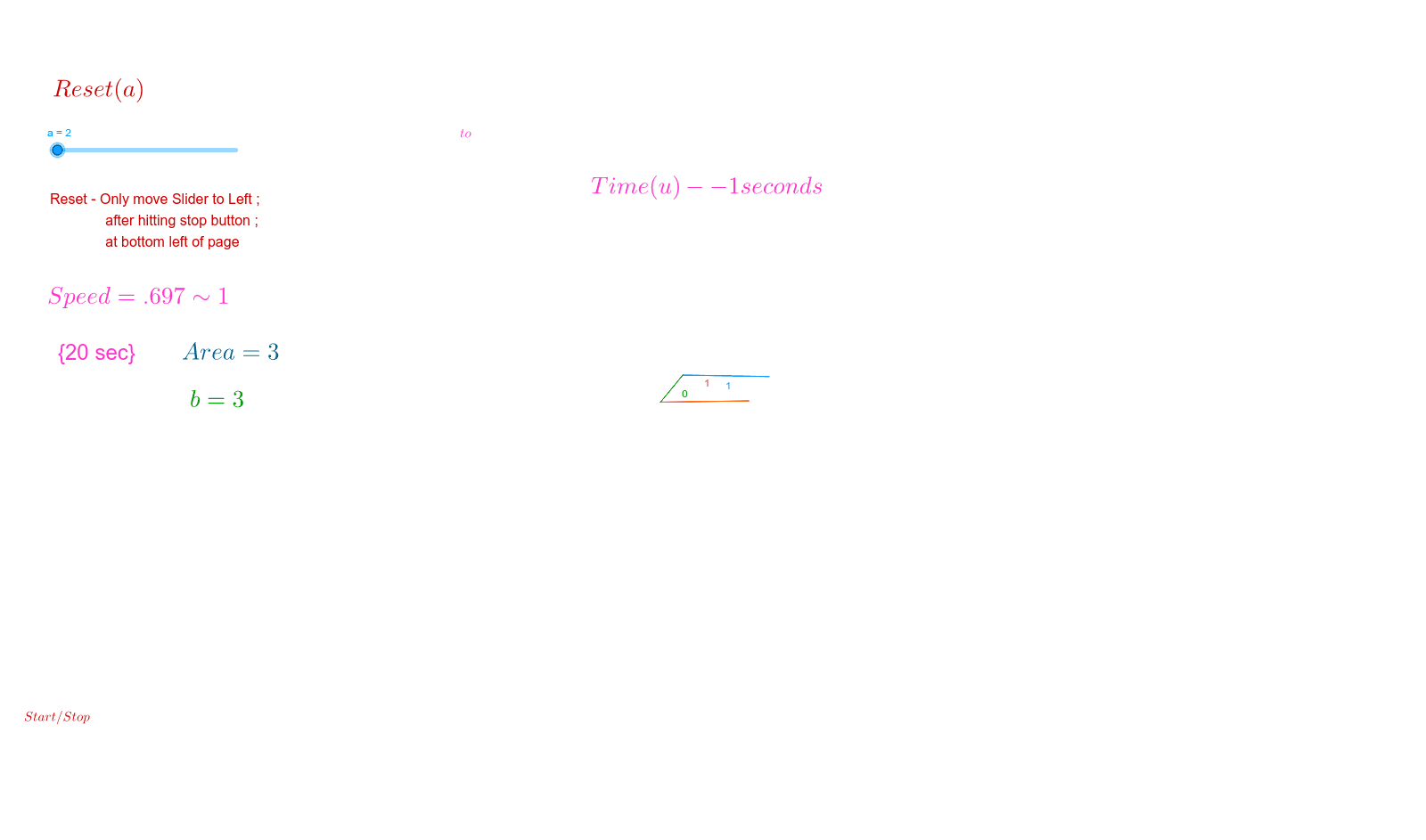
This is a beautiful representation of the i clock in 3D. It illustrates the geometric meaning of complex numbers in three-dimensional space. Key mathematical concepts include complex numbers, vectors, and solid geometry. Using GeoGebra commands such as Point, Segment, Polygon, Slope, Circle, and Area, this dynamic 3D model can be constructed. Suitable for high school students and math enthusiasts to learn about complex numbers and solid geometry.
GeoGebra Commands & Parameters
Point(b) → APoint(c) → BSegment(C, A) → dSegment(C, B) → fPoint(c) → DSegment(B, D) → iPoint(Circle[A, 1.4142135623730951]) → FSegment(A, F) → gSegment(A, F) → hPolygon(B, C, D) → poly1, d_1, b_1, c_1Segment(C, D) → d_hPoint(c) → EPoint(c) → GSegment(B, G) → τSegment(F, G) → nSlope(n) → mSlope(d_h) → m_1Circle(C, A) → kArea(k) → ePointIn(k) → PointkLine(H, f) → jIntersect(k, j, 2) → ISegment(C, I) → lLine(I, b) → pIntersect(p, d) → JSegment(C, J) → qSegment(J, I) → sPoint(s) → KSegment(C, K) → tSegment(I, F) → a_1Segment(J, A) → e_1Polygon(C, I, F, G, B) → poly2, c_2, i_1, f_1, g_1, b_2Name(o) → A1Name(u) → B1Name(a) → C1Point(k) → LCircle(M, N) → h_1Point(h_1) → OPoint(h_1) → PMidpoint(O, P) → QSegment(M, O) → j_1Segment(z_1, z_2) → k_1Vector(R, S) → vTranslate(z_1, v) → z_3Translate(z_2, v) → z_4Segment(z_3, z_4) → l_1Segment(O, z_3) → n_1