
(10/3) vs (10/4) Pattern Comparison: Fractions and Symmetry in Islamic Geometric
Loading the math board and drawing, please wait…
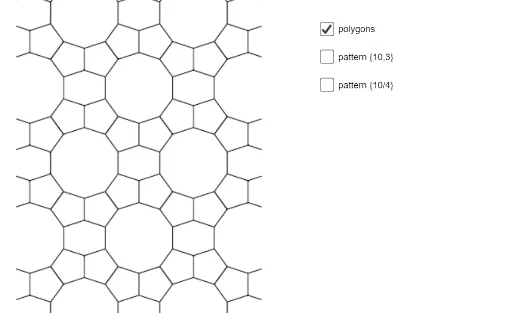
① This example compares the Islamic geometric patterns generated by the fractions (10/3) and (10/4), demonstrating how the numerator and denominator of a fraction influence the rotational symmetry and visual structure of the resulting tiling. ② Core mathematical concepts include fractions, symmetry, rotational symmetry order, polygon tessellation, and the limit concept (as the denominator increases, the pattern approaches finer circular or spherical projections). ③ Construction details: Based on the construction summary, the GeoGebra file uses points A, B, C, D, segments a, b, c, and three image objects (afbeelding1, afbeelding2, afbeelding3) to overlay and compare the two fractional patterns. ④ Suitable for high school or early college students in interdisciplinary math-art courses, for understanding the link between fractions and symmetry, and for teaching Islamic geometric art or mathematical modeling.
GeoGebra Commands & Parameters
Point A(0, 0)Point B(9, 0)Point C(0, 0)Point D(8.870497727799567, -0.020827193738997028)Boolean a(true)Boolean b(false)Boolean c(false)
AI Drawing Prompt Reference
Create a comparative illustration of two Islamic geometric patterns generated by the fractions 3/10 and 4/10. The image shows two main pattern areas, each corresponding to one fraction, composed of polygonal tessellations with distinct rotational symmetries: the 3/10 pattern has 3-fold rotational symmetry, while the 4/10 pattern has 4-fold symmetry. Both patterns radiate from a central point outward, with edges gradually curving toward circular forms. Place the two patterns side by side or overlapping to highlight differences in symmetry order and visual structure. Keep the background simple to emphasize geometric lines and symmetric beauty.
The prompt above was compiled from the original drawing commands and is for reference only.