
牟合方蓋和球體的體積
几何画板及绘图内容加载中,请稍等……
所属专题
Volumes and Surface Areas of Pyramids, Cones and Spheres
Volumes in Ancient Chinese Mathematics 中国古算中的体积
Volumes of Pyramid and Sphere in Ancient Chinese Mathematics
Volume of Spheres in Ancient Chinese Mathematics
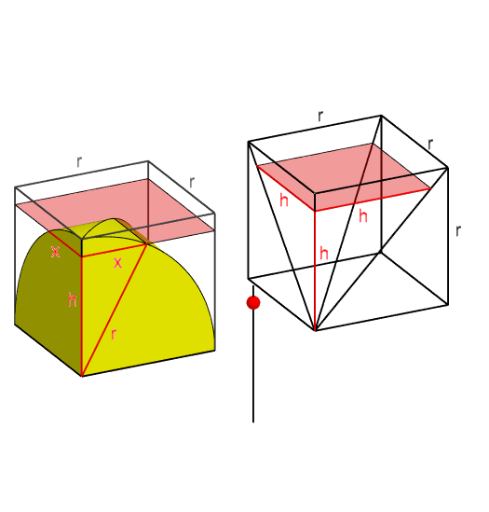
①这个范例演示了牟合方蓋与球體的几何关系和体积计算;②涉及的核心数学概念包括立体几何、体积计算、几何作图;③作图要点使用了Point, Sequence, CircleSector, Polygon, CircleArc, Segment, Prism, OrthogonalPlane, If, Intersect, Surface, CurveCartesian, Translate等GeoGebra命令和对象;④适合高中及以上学段,用于学习和探索立体几何体积问题。
GeoGebra 命令及参数
Point(Segment[I, I + (0, 0, 1)]) → PSequence(Polygon[((-sin(θ)), (-sin(θ)), 1 - cos(θ)), (sin(θ), (-sin(θ)), 1 - cos(θ)), (sin(θ), sin(θ), 1 - cos(θ)), ((-sin(θ)), sin(θ), 1 - cos(θ))], θ, 0, π, π / n) → list4CircleSector((0, 0, 0), (0, 0, 1), (-1, 0, 0)) → dCircleSector((0, 0, 0), (0, 1, 0), (0, 0, 1)) → gPolygon((0, 0), (-1, 0), (-1, 1), (0, 1)) → poly1, i, j, k, lCircleArc((0, 0, 0), (0, 1, 0), (0, 0, 1)) → hSegment((0, 0, 0), (0, 0, 1)) → mPrism(Polygon[A, B, C, D], F) → a, G, edgeBI, edgeCJ, edgeDK, edgeFI, edgeIJ, edgeJK, edgeFK, H, E, faceABIF, faceBCJI, faceCDKJ, faceADKF, faceFIJK, edgeAFSegment(B, F) → pSegment(B, E) → qSegment(B, H) → sSegment(I, I + (0, 0, 1)) → tOrthogonalPlane(P, t) → uPrism(Polygon[(0, 0, 0), (-1, 0, 0), (-1, 1, 0), (0, 1, 0)], -1) → v, M, edge1, edge2, edge3, edge4, edge5, edge6, edge7, edge8, N, O, Q, face1, face2, face3, face4, face5If(z(P) ≠ 1, (0, sqrt(1 - z(P)^(2)), z(P)), (0, 0, 1)) → KIf(z(P) ≠ 1, ((-sqrt(1 - z(P)^(2))), 0, z(P)), (0, 0, 1)) → LIntersect(q, u) → UIntersect(p, u) → VIntersect(edgeBI, u) → WIntersect(s, u) → ZSurface((s * sqrt(1 - t^(2))), sqrt(1 - t^(2)), t, s, -1, 0, t, 0, 1) → cSurface((-sqrt(1 - t^(2))), (s * sqrt(1 - t^(2))), t, s, 0, 1, t, 0, 1) → bCircleArc((0, 0, 0), (0, 0, 1), (-1, 0, 0)) → eCurveCartesian((-sqrt(1 - t^(2))), sqrt(1 - t^(2)), t, t, 0, 1) → fIntersect(edge4, u) → RIntersect(edge3, u) → SIf(z(P) ≠ 1, ((-sqrt(1 - z(P)^(2))), sqrt(1 - z(P)^(2)), z(P)), (0, 0, 1)) → JIntersect(edge2, u) → TTranslate(Polygon[K, R, S, T, L, J], Vector[(0, 0)]) → poly2Segment((0, 0, 0), K) → f_1Segment(A_1, K) → g_1Segment((0, 0, 0), A_1) → h_1Segment(B, W) → j_1Translate(Polygon[W, Z, U, V], Vector[(0, 0)]) → poly3Segment(W, Z) → i_1Translate(Polygon[K, R, S, T, L, J], Vector[(0, 0)]) → poly4Translate(Polygon[W, Z, U, V], Vector[(0, 0)]) → poly5Segment(G, W) → k_1Segment(A_1, (0, 0, 1)) → l_1Segment(L, A_1) → m_1Segment(V, W) → n_1Segment(A, B) → p_1Segment(B, C) → q_1Segment(C, D) → r_1Segment(D, A) → s_1Segment((0, 0), (0, 1)) → t_1Segment((0, 0), (-1, 0)) → b_1Segment((-1, 1), (0, 1)) → c_1Segment((-1, 0), (-1, 1)) → d_1