
长方体体积公式推导:已知底面积与高度求体积
几何画板及绘图内容加载中,请稍等……
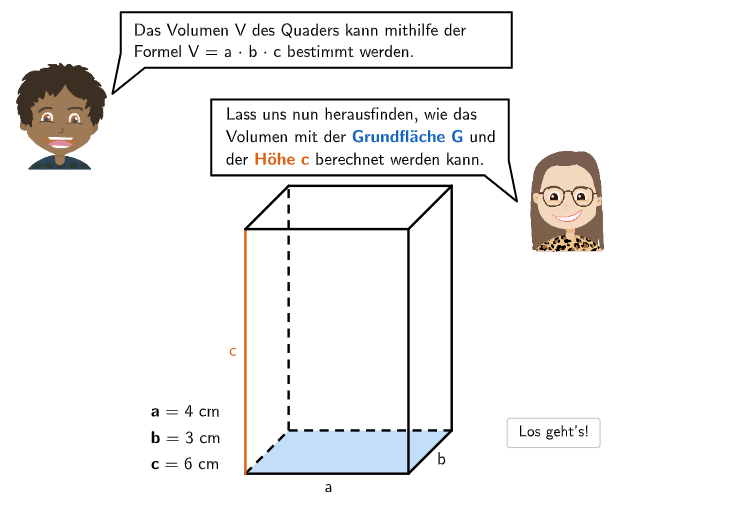
本范例演示如何利用底面积G和高度c计算长方体体积。核心数学概念是体积公式V=G×c的应用,以及从单位立方体分割推导体积公式的过程。构造要点:使用Sequence命令生成三维立方体网格展示cubesHorizontal和cubesVertical,配合SpeechBubbleLeft/Right呈现学生对话(Selina、Jule、Stef的讨论),通过Textfield和input输入框实现交互式计算练习。第二个问题拓展到立方体已知底面积(9cm²)时如何推导边长并计算体积。适合5-6年级学生理解体积概念、掌握公式应用、培养空间观念。
GeoGebra 命令及参数
SpeechBubbleLeft(Pbubble1, 9, 1) → bubble1SpeechBubbleRight(Pbubble2, 6.7, 1.5) → bubble2Segment(A, B) → abSegment(A, E) → aeSegment(B, F) → bfSegment(E, F) → efSegment(A, D) → adSegment(E, H) → ehSegment(D, H) → dhSegment(C, D) → cdSegment(B, C) → bcSegment(F, G) → fgSegment(C, G) → cgSegment(H, G) → hgSpeechBubbleLeft(Pbubble1 - (0, 0.1), 9.8, 1.1) → bubble3Textfield(input1) → InputBox1Sequence(Sequence[Polygon[A + (i, j), A + (i, j) + (cubeLengthWuerfel / 10, 0), A + (i, j) + (cubeLengthWuerfel / 10, cubeLengthWuerfel / 10), A + (i, j) + (0, cubeLengthWuerfel / 10)], i, 0, cubesHorizontal - 1], j, 0, cubesVertical - 1) → m1, {{0.9999999999999991, 0.9999999999999982, 1, 1}}Sequence(Sequence[Polygon[A + (i, cubesVertical) + ((j * cubeDepthCathetersWuerfel / 10), (j * cubeDepthCathetersWuerfel / 10)), A + (i, cubesVertical) + ((j * cubeDepthCathetersWuerfel / 10), (j * cubeDepthCathetersWuerfel / 10)) + (cubeLengthWuerfel / 10, 0), A + (i, cubesVertical) + ((j * cubeDepthCathetersWuerfel / 10), (j * cubeDepthCathetersWuerfel / 10)) + (cubeLengthWuerfel / 10 + cubeDepthCathetersWuerfel / 10, cubeDepthCathetersWuerfel / 10), A + (i, cubesVertical) + ((j * cubeDepthCathetersWuerfel / 10), (j * cubeDepthCathetersWuerfel / 10)) + (cubeDepthCathetersWuerfel / 10, cubeDepthCathetersWuerfel / 10)], i, 0, cubesHorizontal - 1], j, 0, cubesDepth - 1) → m2, {{0.3535533905932735, 0.35355339059327395, 0.35355339059327395, 0.35355339059327306}, {0.3535533905932744, 0.3535533905932722, 0.3535533905932766, 0.35355339059327306}, {0.35355339059327395, 0.35355339059327306, 0.35355339059327573, 0.3535533905932713}}Sequence(Sequence[Polygon[A + (cubesHorizontal, j) + ((i * cubeDepthCathetersWuerfel / 10), (i * cubeDepthCathetersWuerfel / 10)), A + (cubesHorizontal, j) + ((i * cubeDepthCathetersWuerfel / 10), (i * cubeDepthCathetersWuerfel / 10)) + (cubeDepthCathetersWuerfel / 10, cubeDepthCathetersWuerfel / 10), A + (cubesHorizontal, j) + ((i * cubeDepthCathetersWuerfel / 10), (i * cubeDepthCathetersWuerfel / 10)) + (cubeDepthCathetersWuerfel / 10, cubeDepthCathetersWuerfel / 10 + cubeLengthWuerfel / 10), A + (cubesHorizontal, j) + ((i * cubeDepthCathetersWuerfel / 10), (i * cubeDepthCathetersWuerfel / 10)) + (0, cubeLengthWuerfel / 10)], i, 0, cubesDepth - 1], j, 0, cubesVertical - 1) → m3, {{0.3535533905932766, 0.35355339059327306, 0.35355339059327484}}SpeechBubbleRight(Pbubble3, 11, 1.6) → bubble4Textfield(input2) → InputBox2Textfield(input3) → InputBox3SpeechBubbleLeft(Pbubble1 - (0, 2), 9.8, 3.1) → bubble5Textfield(input4) → InputBox4Textfield(input5) → InputBox5SpeechBubbleRight(Pbubble3, 6.3, 1.2) → bubble6SpeechBubbleRight(Pbubble3 - (0, 0.5), 11, 2) → bubble7SpeechBubbleRight(Pbubble3 + (0, 0.4), 11.5, 1.2) → bubble8Textfield(input6) → InputBox6Textfield(input7) → InputBox7Textfield(input8) → InputBox8Sequence(Sequence[Polygon[A + (cubesHorizontal, j) + ((i * cubeDepthCathetersWuerfel / 10), (i * cubeDepthCathetersWuerfel / 10)), A + (cubesHorizontal, j) + ((i * cubeDepthCathetersWuerfel / 10), (i * cubeDepthCathetersWuerfel / 10)) + (cubeDepthCathetersWuerfel / 10, cubeDepthCathetersWuerfel / 10), A + (cubesHorizontal, j) + ((i * cubeDepthCathetersWuerfel / 10), (i * cubeDepthCathetersWuerfel / 10)) + (cubeDepthCathetersWuerfel / 10, cubeDepthCathetersWuerfel / 10 + cubeLengthWuerfel / 10), A + (cubesHorizontal, j) + ((i * cubeDepthCathetersWuerfel / 10), (i * cubeDepthCathetersWuerfel / 10)) + (0, cubeLengthWuerfel / 10)], i, 0, cubesDepth - 1], j, 0, 1 - 1) → m9, {{0.3535533905932766, 0.35355339059327306, 0.35355339059327484}}SpeechBubbleRight(Pbubble3 + (0.2, -0.7), 11.5, 1.5) → bubble9SpeechBubbleLeft(Pbubble1, 12, 1) → bubble10Sequence(Sequence[Segment[A + (i, j), A + (i, j) + (cubeLengthWuerfel / 10, 0)], i, 0, cubesHorizontal - 1], j, 1, cubesVertical) → m11, {{0.9999999999999998, 1, 1, 1}}Sequence(Sequence[Segment[A + (cubesHorizontal, j) + ((i * cubeDepthCathetersWuerfel / 10), (i * cubeDepthCathetersWuerfel / 10)), A + (cubesHorizontal, j) + ((i * cubeDepthCathetersWuerfel / 10), (i * cubeDepthCathetersWuerfel / 10)) + (cubeDepthCathetersWuerfel / 10, cubeDepthCathetersWuerfel / 10)], i, 0, cubesDepth - 1], j, 1, cubesVertical) → m12, {{0.5000000000000003, 0.5000000000000003, 0.5000000000000003}}Polygon(A, E, F, B) → q1, a, e, f, bSequence(Sequence[Polygon[A + (i, j), A + (i, j) + (cubeLengthWuerfel / 10, 0), A + (i, j) + (cubeLengthWuerfel / 10, cubeLengthWuerfel / 10), A + (i, j) + (0, cubeLengthWuerfel / 10)], i, 0, 4 - 1], j, 0, 1 - 1) → m7, {{0.9999999999999991, 0.9999999999999982, 1, 1}}Sequence(Sequence[Polygon[A + (i, 1) + ((j * cubeDepthCathetersWuerfel / 10), (j * cubeDepthCathetersWuerfel / 10)), A + (i, 1) + ((j * cubeDepthCathetersWuerfel / 10), (j * cubeDepthCathetersWuerfel / 10)) + (cubeLengthWuerfel / 10, 0), A + (i, 1) + ((j * cubeDepthCathetersWuerfel / 10), (j * cubeDepthCathetersWuerfel / 10)) + (cubeLengthWuerfel / 10 + cubeDepthCathetersWuerfel / 10, cubeDepthCathetersWuerfel / 10), A + (i, 1) + ((j * cubeDepthCathetersWuerfel / 10), (j * cubeDepthCathetersWuerfel / 10)) + (cubeDepthCathetersWuerfel / 10, cubeDepthCathetersWuerfel / 10)], i, 0, cubesHorizontal - 1], j, 0, 4) → m8, {{0.3535533905932735, 0.35355339059327395, 0.35355339059327395, 0.35355339059327306}, {0.3535533905932744, 0.3535533905932722, 0.3535533905932766, 0.35355339059327306}, {0.35355339059327395, 0.35355339059327306, 0.35355339059327573, 0.3535533905932713}, {0.35355339059327306, 0.35355339059327306, 0.35355339059327306, 0.35355339059327306}, {0.35355339059327395, 0.35355339059327484, 0.35355339059327395, 0.3535533905932722}}
AI 绘图提示语参考
画一个立方体,展示其体积公式推导。立方体由多个小立方体组成,通过网格线和小立方体堆叠,直观表达体积等于底面积乘以高度。在立方体周围添加对话气泡,分别标注底面积和高度数值,并展示计算过程和结果。在立方体下方添加输入框,用于交互式输入底面积和高度,计算并显示体积。
以上提示语为根据原始绘图命令整理而来,仅供参考。