
钻石切工中的全反射几何模拟
几何画板及绘图内容加载中,请稍等……
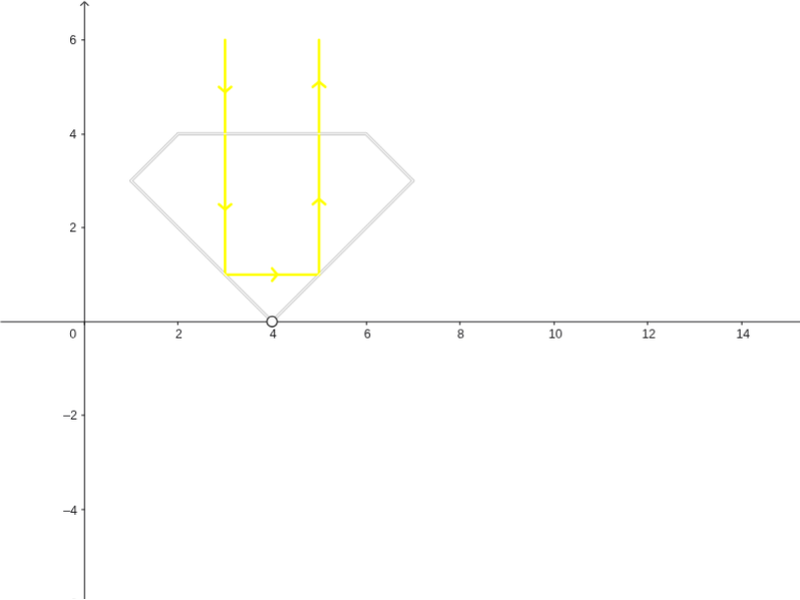
本 GeoGebra 范例演示了光线在钻石多面体切工内部发生全反射(Total Internal Reflection)并折射出璀璨光芒的几何物理现象。涉及的核心数学概念包括几何光学中的全反射临界角、入射角、折射率,以及空间几何中多边形(Polygon)、射线(Ray)、线段(Segment)、角平分线(LineBisector)和旋转变换(Rotate)。作图要点上,该模型利用了 GeoGebra 的 Segment、Ray、Line 构建钻石剖面与光线路径,通过 Intersect 求交点,利用 OrthogonalLine 和 Angle 计算入射角与法线,结合 If 条件判断是否发生全反射,并运用 Rotate、Circle、LineBisector 和 Polygon 等命令精细模拟光线在不同界面反射、折射的动态轨迹。适合高中物理、几何光学课程,或大学应用数学、几何建模兴趣小组,用于直观探究全反射条件、临界角计算以及几何切工对折射效果的影响。
GeoGebra 命令及参数
Segment(A, C) → aPoint(a) → FSegment(G, F) → fLine(F, f) → gRay(I, E_1) → jPoint(j) → ESegment(D, E) → eSegment(B, E) → dIntersect(g, d) → HCircle(H, 1) → kOrthogonalLine(H, d) → iIntersect(k, i, 2) → JAngle(J, H, F) → αIf((180° > α) ∧ (α > asin(1 / n)), Rotate[J, -α, H]) → J'Line(H, J') → rIntersect(r, e) → MOrthogonalLine(M, e) → a_1Circle(M, 1) → tIntersect(t, a_1, 1) → NAngle(N, M, H) → δIf((360° - asin(1 / n) > δ) ∧ (δ > asin(1 / n)), Rotate[N, -δ, M]) → N'Line(M, N') → d_1Intersect(d_1, a) → QOrthogonalLine(Q, a) → i_1Circle(Q, 1) → h_1Intersect(h_1, i_1, 1) → SAngle(S, Q, M) → ζIntersect(h_1, i_1, 2) → RSegment(A, B) → bSegment(C, D) → cCircle(H, 2) → pIntersect(k, i, 1) → KSegment(J, K) → lAngle(J', H, J) → βRotate(K, asin(n * sin(α)), H) → K'Angle(K, H, K') → γLine(H, K') → mIntersect(p, m, 2) → LSegment(H, L) → qCircle(M, 2) → c_1Angle(N', M, N) → εCircle(Q, 2) → k_1Segment(R, S) → j_1Segment(F, H) → hAngle(S, Q, M) → ηIf(η > asin(1 / n), Rotate[S, -η, Q]) → S'Angle(S', Q, S) → θLine(Q, S') → l_1Intersect(h_1, l_1, 2) → TSegment(Q, T) → m_1Rotate(R, asin(n * sin(ζ)), Q) → R'Angle(R, Q, R') → ιIntersect(t, a_1, 2) → OSegment(N, O) → b_1Segment(H, M) → sSegment(M, Q) → e_1Line(Q, R') → f_1Intersect(k_1, f_1, 2) → PSegment(Q, P) → g_1Rotate(O, asin(n * sin(δ)), M) → O'Angle(O, M, O') → κLine(M, O') → n_1Intersect(c_1, n_1, 2) → USegment(M, U) → p_1Intersect(r, a) → WCircle(W, 1) → s_1OrthogonalLine(W, a) → t_1Intersect(s_1, t_1, 2) → ZIntersect(s_1, t_1, 1) → A_1Segment(Z, A_1) → a_2Angle(H, W, A_1) → λRotate(A_1, λ, W) → B_1Angle(A_1, W, B_1) → μLine(W, B_1) → b_2Intersect(b_2, e) → C_1Segment(H, W) → c_2Circle(C_1, 1) → d_2OrthogonalLine(C_1, e) → e_2Intersect(d_2, e_2) → D_1, F_1Segment(D_1, F_1) → f_2Angle(D_1, C_1, W) → νRotate(D_1, -ν, C_1) → G_1Angle(G_1, C_1, D_1) → ξLine(C_1, G_1) → g_2Intersect(g_2, c) → H_1LineBisector(C_1, H_1) → h_2Segment(H_1, C_1) → i_2Intersect(h_2, i_2) → I_1Segment(C_1, I_1) → j_2Segment(W, C_1) → k_2Intersect(d_1, d) → VSegment(M, V) → q_1Intersect(b_2, c) → K_1Circle(K_1, 1) → p_2OrthogonalLine(K_1, c) → m_2Intersect(p_2, m_2, 1) → L_1Intersect(p_2, m_2, 2) → M_1Segment(L_1, M_1) → n_2Angle(W, K_1, L_1) → οRotate(L_1, ο, K_1) → N_1Angle(L_1, K_1, N_1) → ρLine(K_1, N_1) → q_2Intersect(q_2, e) → O_1Segment(W, K_1) → r_2Segment(K_1, O_1) → s_2Circle(O_1, 1) → t_2OrthogonalLine(O_1, e) → a_3Intersect(t_2, a_3) → P_1, Q_1Segment(P_1, Q_1) → b_3Angle(P_1, O_1, K_1) → σRotate(Q_1, asin(n * sin(σ)), O_1) → R_1Angle(Q_1, O_1, R_1) → τIntersect(r, c) → S_1Circle(S_1, 1) → d_3OrthogonalLine(S_1, c) → e_3Intersect(d_3, e_3) → T_1, U_1Segment(U_1, T_1) → f_3Angle(H, S_1, T_1) → υRotate(U_1, -asin(n * sin(υ)), S_1) → V_1Angle(U_1, S_1, V_1) → ϕLine(O_1, R_1) → c_3Circle(O_1, 2) → g_3Intersect(g_3, c_3) → W_1, Z_1Segment(O_1, Z_1) → h_3Circle(S_1, 2) → k_3Line(S_1, V_1) → i_3Intersect(k_3, i_3, 2) → A_2Segment(S_1, A_2) → j_3Segment(H, S_1) → l_3Rotate(T_1, -υ, S_1) → B_2Angle(B_2, S_1, T_1) → χRotate(T_1, υ, S_1) → C_2Angle(T_1, S_1, C_2) → ψLine(S_1, C_2) → m_3Intersect(m_3, e) → D_2LineBisector(S_1, D_2) → n_3Segment(S_1, D_2) → p_3Intersect(n_3, p_3) → E_2Segment(S_1, E_2) → q_3Line(M, N') → r_3Intersect(r_3, c) → F_2Circle(F_2, 1) → s_3OrthogonalLine(F_2, c) → t_3Intersect(s_3, t_3) → G_2, H_2Segment(H_2, G_2) → a_4Angle(G_2, F_2, M) → ωRotate(H_2, asin(n * sin(ω)), F_2) → I_2Angle(I_2, F_2, H_2) → α_1Circle(F_2, 2) → c_4Line(F_2, I_2) → b_4Intersect(c_4, b_4, 2) → J_2Segment(F_2, J_2) → d_4Segment(M, F_2) → e_4If(ω > asin(1 / n), Rotate[G_2, -ω, F_2]) → K_2Angle(K_2, F_2, G_2) → β_1Line(F_2, K_2) → f_4Intersect(f_4, d) → L_2Circle(L_2, 1) → g_4OrthogonalLine(L_2, d) → h_4Intersect(g_4, h_4) → M_2, N_2Segment(N_2, M_2) → i_4Angle(F_2, L_2, N_2) → γ_1Rotate(N_2, γ_1, L_2) → O_2Angle(N_2, L_2, O_2) → δ_1Segment(F_2, L_2) → j_4Line(L_2, O_2) → k_4Intersect(k_4, a) → P_2Segment(L_2, P_2) → l_4Circle(P_2, 1) → p_4OrthogonalLine(P_2, a) → m_4Intersect(p_4, m_4) → Q_2, R_2Segment(R_2, Q_2) → n_4Angle(L_2, P_2, Q_2) → ε_1Rotate(R_2, -asin(n * sin(ε_1)), P_2) → S_2Angle(S_2, P_2, R_2) → ζ_1Circle(P_2, 2) → q_4Line(P_2, S_2) → r_4Intersect(q_4, r_4, 2) → T_2Segment(P_2, T_2) → s_4Intersect(k_4, b) → U_2Circle(U_2, 1) → t_4OrthogonalLine(U_2, b) → a_5Intersect(t_4, a_5) → V_2, W_2Segment(V_2, W_2) → b_5Angle(L_2, U_2, W_2) → η_1Rotate(W_2, η_1, U_2) → Z_2Angle(W_2, U_2, Z_2) → θ_1Line(U_2, Z_2) → c_5Intersect(c_5, a) → A_3Segment(U_2, A_3) → d_5LineBisector(U_2, A_3) → e_5Intersect(e_5, d_5) → B_3Segment(U_2, B_3) → f_5Segment(L_2, U_2) → g_5Circle(V, 1) → h_5OrthogonalLine(V, d) → r_1Intersect(h_5, r_1) → J_1, C_3Segment(J_1, C_3) → l_2Segment(M, V) → i_5Angle(C_3, V, M) → ι_1Rotate(J_1, asin(n * sin(ι_1)), V) → D_3Angle(D_3, V, J_1) → κ_1Circle(V, 2) → k_5Line(V, D_3) → j_5Intersect(k_5, j_5, 2) → E_3Segment(V, E_3) → l_5If((360° - asin(1 / n) > ι_1) ∧ (ι_1 > asin(1 / n)), Rotate[C_3, -ι_1, V]) → F_3Angle(F_3, V, C_3) → λ_1Line(V, F_3) → m_5Intersect(m_5, e) → G_3Circle(G_3, 1) → p_5OrthogonalLine(G_3, e) → n_5Intersect(p_5, n_5) → H_3, I_3Angle(V, G_3, H_3) → μ_1Segment(H_3, I_3) → q_5If(μ_1 > asin(1 / n), Rotate[H_3, μ_1, G_3]) → J_3Angle(H_3, G_3, J_3) → ν_1Rotate(I_3, -asin(n * sin(μ_1)), G_3) → K_3Angle(K_3, G_3, I_3) → ξ_1Circle(G_3, 2) → r_5Line(G_3, K_3) → s_5Segment(V, G_3) → t_5Intersect(r_5, s_5, 2) → L_3Segment(G_3, L_3) → a_6Line(G_3, J_3) → b_6Intersect(b_6, d) → M_3LineBisector(G_3, M_3) → c_6Intersect(b_6, c_6) → N_3Segment(G_3, N_3) → d_6Polygon(B, A, C, D, E) → poly1, e_6, f_6, g_6, h_6, i_6
AI 绘图提示语参考
绘制一个钻石切面的几何光学示意图。先画出钻石的轮廓多边形,包含多个顶点和边。从钻石内部一个点发出光线,光线在钻石内壁发生反射和折射。在每条边与光线的交点处,画出该边的法线,并构造一个单位圆,用于测量入射角。根据折射率计算临界角,当入射角大于临界角时,光线发生全内反射,用旋转后的光线表示反射路径。依次追踪光线在多个面之间的反射,每次反射后更新光线方向,并画出反射光线与下一条边的交点。在钻石内部画出多条反射光线路径,并标注各个反射点处的角度关系,包括入射角、反射角和临界角。整体图形展示光线在钻石内部多次全内反射后从顶部射出的过程,体现钻石的璀璨效果。
以上提示语为根据原始绘图命令整理而来,仅供参考。