
图形面积总和
几何画板及绘图内容加载中,请稍等……
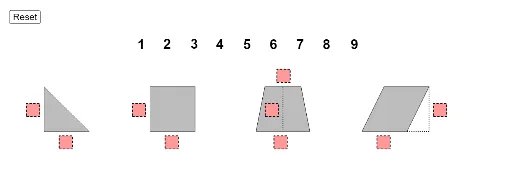
这个范例演示了如何通过几何作图计算平行四边形、梯形、矩形和三角形的面积总和。核心数学概念包括面积计算、多边形和直线条。通过使用GeoGebra命令如Point、Polygon、If、Segment、Sequence等,可以动态调整图形参数,观察面积变化。适合初中及以上学生学习面积计算和优化问题。
GeoGebra 命令及参数
Point({36, 0}) → parStarterPoint({24, 0}) → trapStarterPoint({12, 0}) → rectStarterPolygon((triLength / 3, -2), (triLength / 3 + 1.5, -2), 4) → poly1Polygon(rectStarter + (rectLength / 3, -2), rectStarter + (rectLength / 3 + 1.5, -2), 4) → poly3Polygon((-2, triHeight / 3), (-0.5, triHeight / 3), 4) → poly2Polygon(trapStarter + (trapB1 / 3, -2), trapStarter + (trapB1 / 3 + 1.5, -2), 4) → poly5Polygon(trapStarter + (trapB2 / 3 + (trapB1 - trapB2) / 2, trapHeight + 0.5), trapStarter + (trapB2 / 3 + (trapB1 - trapB2) / 2 + 1.5, trapHeight + 0.5), 4) → poly6Polygon(parStarter + (parLength / 3, -2), parStarter + (parLength / 3 + 1.5, -2), 4) → poly8Polygon(parStarter + (parLength + 3, parHeight / 3), parStarter + (parLength + 4.5, parHeight / 3), 4) → poly9Polygon(rectStarter + (-2, rectHeight / 3), rectStarter + (-0.5, rectHeight / 3), 4) → poly4Polygon(trapStarter + (trapB1 / 2 - 2, trapHeight / 3), trapStarter + (trapB1 / 2 - 0.5, trapHeight / 3), 4) → poly7If(IsInRegion[A, poly9], 1, If[IsInRegion[B, poly9], 2, If[IsInRegion[C, poly9], 3, If[IsInRegion[D, poly9], 4, If[IsInRegion[E, poly9], 5, If[IsInRegion[F, poly9], 6, If[IsInRegion[G, poly9], 7, If[IsInRegion[H, poly9], 8, If[IsInRegion[I, poly9], 9, 0]]]]]]]]) → nineSumIf(IsInRegion[A, poly8], 1, If[IsInRegion[B, poly8], 2, If[IsInRegion[C, poly8], 3, If[IsInRegion[D, poly8], 4, If[IsInRegion[E, poly8], 5, If[IsInRegion[F, poly8], 6, If[IsInRegion[G, poly8], 7, If[IsInRegion[H, poly8], 8, If[IsInRegion[I, poly8], 9, 0]]]]]]]]) → eightSumIf(IsInRegion[A, poly6], 1, If[IsInRegion[B, poly6], 2, If[IsInRegion[C, poly6], 3, If[IsInRegion[D, poly6], 4, If[IsInRegion[E, poly6], 5, If[IsInRegion[F, poly6], 6, If[IsInRegion[G, poly6], 7, If[IsInRegion[H, poly6], 8, If[IsInRegion[I, poly6], 9, 0]]]]]]]]) → sixSumIf(IsInRegion[A, poly5], 1, If[IsInRegion[B, poly5], 2, If[IsInRegion[C, poly5], 3, If[IsInRegion[D, poly5], 4, If[IsInRegion[E, poly5], 5, If[IsInRegion[F, poly5], 6, If[IsInRegion[G, poly5], 7, If[IsInRegion[H, poly5], 8, If[IsInRegion[I, poly5], 9, 0]]]]]]]]) → fiveSumIf(IsInRegion[A, poly3], 1, If[IsInRegion[B, poly3], 2, If[IsInRegion[C, poly3], 3, If[IsInRegion[D, poly3], 4, If[IsInRegion[E, poly3], 5, If[IsInRegion[F, poly3], 6, If[IsInRegion[G, poly3], 7, If[IsInRegion[H, poly3], 8, If[IsInRegion[I, poly3], 9, 0]]]]]]]]) → threeSumIf(IsInRegion[A, poly2], 1, If[IsInRegion[B, poly2], 2, If[IsInRegion[C, poly2], 3, If[IsInRegion[D, poly2], 4, If[IsInRegion[E, poly2], 5, If[IsInRegion[F, poly2], 6, If[IsInRegion[G, poly2], 7, If[IsInRegion[H, poly2], 8, If[IsInRegion[I, poly2], 9, 0]]]]]]]]) → twoSumPoint({0, 0}) → triangleStarterPolygon(triangleStarter, triangleStarter + (triLength, 0), triangleStarter + (0, triHeight)) → triangle, f, g, hPolygon(rectStarter, rectStarter + (rectLength, 0), rectStarter + (rectLength, rectHeight), rectStarter + (0, rectHeight)) → rect, i, j, k, pIf(IsInRegion[A, poly1], 1, If[IsInRegion[B, poly1], 2, If[IsInRegion[C, poly1], 3, If[IsInRegion[D, poly1], 4, If[IsInRegion[E, poly1], 5, If[IsInRegion[F, poly1], 6, If[IsInRegion[G, poly1], 7, If[IsInRegion[H, poly1], 8, If[IsInRegion[I, poly1], 9, 0]]]]]]]]) → oneSumPolygon(trapStarter, trapStarter + (trapB1, 0), trapStarter + ((trapB1 + trapB2) / 2, trapHeight), trapStarter + ((trapB1 - trapB2) / 2, trapHeight)) → trap, q, r, s, tSegment(trapStarter + (trapB1 / 2, 0), trapStarter + (trapB1 / 2, trapHeight)) → trapHeightSegmentIf(IsInRegion[A, poly4], 1, If[IsInRegion[B, poly4], 2, If[IsInRegion[C, poly4], 3, If[IsInRegion[D, poly4], 4, If[IsInRegion[E, poly4], 5, If[IsInRegion[F, poly4], 6, If[IsInRegion[G, poly4], 7, If[IsInRegion[H, poly4], 8, If[IsInRegion[I, poly4], 9, 0]]]]]]]]) → fourSumIf(IsInRegion[A, poly7], 1, If[IsInRegion[B, poly7], 2, If[IsInRegion[C, poly7], 3, If[IsInRegion[D, poly7], 4, If[IsInRegion[E, poly7], 5, If[IsInRegion[F, poly7], 6, If[IsInRegion[G, poly7], 7, If[IsInRegion[H, poly7], 8, If[IsInRegion[I, poly7], 9, 0]]]]]]]]) → sevenSumPolygon(parStarter, parStarter + (parLength, 0), parStarter + (parLength + 2.5, parHeight), parStarter + (2.5, parHeight)) → par, parstarter, a, b, cSegment(parStarter + (parLength, 0), parStarter + (parLength + 2.5, 0)) → dSegment(parStarter + (parLength + 2.5, parHeight), parStarter + (parLength + 2.5, 0)) → eSequence(Point[{i, 10}], i, 11, 11 + 24, 3) → anchors
AI 绘图提示语参考
绘制一个平行四边形、一个梯形、一个矩形和一个三角形。首先在 x 轴上依次放置三个点,分别作为每个图形的起点。接着,依次绘制这四个图形,确保它们的边与 x 轴平行或垂直。最后,绘制每个图形的高或长度的线段,以便观察面积的变化。
以上提示语为根据原始绘图命令整理而来,仅供参考。