
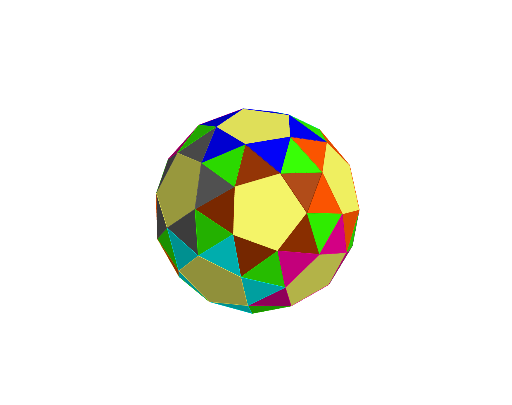
Snub Dodecahedron
几何画板及绘图内容加载中,请稍等……
所属专题
Archimedean Solids
①本范例演示了Snub Dodecahedron(扭棱十二面体)这一复杂三维几何图形的构造与性质;②涉及的核心数学概念包括立体几何、多边形构造、旋转、中心点计算、正交线与面等;③作图要点提炼自构造摘要,主要运用了Polygon(多边形)、Rotate(旋转)、Centroid(中心点)、OrthogonalLine(正交线)、Line(直线)、Sequence(序列)、Intersect(交点)、Midpoint(中点)、Plane(平面)、OrthogonalPlane(正交平面)等GeoGebra命令与对象;④适合高中及以上学段学生及数学爱好者学习三维几何构造方法,也可用于相关课题的演示与探究。
GeoGebra 命令及参数
Polygon(A, B, 5, xOyPlane) → poly1, f, g, h, i, j, C, D, EPolygon(A, B, 3, xOyPlane) → poly2, k, l, m, FRotate(poly2, 152.93°, k) → poly2'Rotate(F, 152.93°, k) → F'Centroid(poly1) → GOrthogonalLine(G, poly1) → nRotate(poly2', 72°, n) → poly2''Rotate(poly2', 144°, n) → poly2''_{1}Rotate(poly2', -72°, n) → poly2''_{2}Rotate(poly2', -144°, n) → poly2''_{3}Line(B, F') → pRotate(poly2', -164.18°, p) → t2Rotate(A, -164.18°, p) → A'Rotate(A', 72°, n) → A''Rotate(F', 72°, n) → F''Polygon(F'', B, A') → t3_{1}, a', f'', bSequence(Rotate[t3_{1}, (72° * i), n], i, 1, 4) → l1, {1.9096081418592432, 1.9096081418592432, 1.9096081418592432, 1.9096081418592432}Centroid(poly2') → HOrthogonalLine(H, poly2') → qIntersect(n, q) → IMidpoint(F', B) → JMidpoint(F', A) → KLine(A'', F'') → rRotate(C, -152.93°, r) → C'Plane(C', F'', A'') → p_1OrthogonalLine(A'', p_1) → sRotate(F'', -108°, s) → F'''Midpoint(A'', F'') → MOrthogonalLine(F''', p_1) → tRotate(A'', -108°, t) → A'''OrthogonalLine(A''', p_1) → aRotate(F''', -108°, a) → LPolygon(A''', F''', A'', F'', L) → p1, a''', f''', a'', c, l_1Sequence(Rotate[p1, (i * 72°), n], i, 1, 4) → l3, {7.587305336597347, 7.587305336597347, 7.587305336597347, 7.587305336597347}Rotate(L, 72°, n) → L'Rotate(L, 72°, n) → L'_{1}Rotate(L, 144°, n) → L'_{2}Rotate(L, -72°, n) → L'_{3}Rotate(L, -144°, n) → L'_{4}Polygon(L, F'', A') → t3, d, l_2, ePolygon(L'_{1}, A'', F''') → t4, f_1, l'_{1}, g_1Centroid(p1) → NOrthogonalLine(N, p1) → h_1Rotate(t4, -72°, h_1) → t5Rotate(L'_{1}, -72°, h_1) → ORotate(O, -72°, h_1) → O'Rotate(O, 72°, n) → O'_{1}Rotate(O, 144°, n) → O'_{2}Rotate(O, -72°, n) → O'_{3}Rotate(O, -144°, n) → O'_{4}Rotate(O', 72°, n) → O''Rotate(O', 144°, n) → O''_{1}Rotate(O', -72°, n) → O''_{2}Rotate(O', -144°, n) → O''_{3}Rotate(A''', 72°, n) → PRotate(A''', 144°, n) → QRotate(A''', -72°, n) → RRotate(A''', -144°, n) → SRotate(F''', -72°, n) → TPolygon(O'', F''', L'_{1}) → t7, i_1, o'', j_1Sequence(Rotate[t7, (27° * i)]) → l8Rotate(t7, 72°, n) → t7'Rotate(t7', 72°, n) → t7''Rotate(t7'', 72°, n) → t7'''Rotate(t7''', 72°, n) → t1Polygon(O'', F''', O) → t8, o, k_1, m_1Rotate(t8, 72°, n) → t8'Rotate(t8', 72°, n) → t8''Rotate(t8'', 72°, n) → t8'''Rotate(t8''', 72°, n) → t9Rotate(t8, -72°, h_1) → t8'_{1}Rotate(t1, 72°, h_1) → t1'Line(O'', O) → n_1Rotate(F''', -152.93°, n_1) → UPlane(U, O'', O) → q_1OrthogonalLine(O'', q_1) → r_1Rotate(O, 108°, r_1) → O'_{5}OrthogonalLine(O'_{5}, q_1) → s_1Rotate(O'', 108°, s_1) → O'''OrthogonalLine(O''', q_1) → t_1Rotate(O'_{5}, 108°, t_1) → VPolygon(O''', V, O, O'', O'_{5}) → poly3, o''', v, o_1, a_1, o'_{5}Rotate(poly3, 72°, n) → poly3'Rotate(poly3', 72°, n) → poly3''Rotate(poly3'', 72°, n) → poly3'''Rotate(poly3''', 72°, n) → poly4Rotate(V, 72°, n) → V'Rotate(V, 144°, n) → V'_{1}Rotate(V'_{1}, 72°, n) → WRotate(W, 72°, n) → W'Rotate(O''', 72°, n) → ZRotate(Z, 72°, n) → Z'Rotate(Z', 72°, n) → Z''Rotate(Z'', 72°, n) → Z'''Rotate(O'_{5}, 72°, n) → A_1Rotate(A_1, 72°, n) → B_1Rotate(B_1, 72°, n) → C_1Polygon(B_1, O''_{3}, S) → t10, s_2, b_1, o''_{3}Rotate(t10, 72°, n) → t10'Rotate(t10, 144°, n) → t10'_{1}Rotate(t10, -72°, n) → t10'_{2}Rotate(t10, -144°, n) → t10'_{3}Rotate(t1', 72°, n) → t1''Rotate(t1'', 72°, n) → t1'''Rotate(t1''', 72°, n) → t11Rotate(t11, 72°, n) → t11'Polygon(W, B_1, O'_{4}) → t12, o'_{4}, w, c_1Rotate(t12, 72°, n) → t12'Rotate(t12', 72°, n) → t12''Rotate(t12'', 72°, n) → t12'''Rotate(t12''', 72°, n) → t13Polygon(O''', O'_{5}, V') → t14, v', d_1, e_1Rotate(t14, 72°, n) → t14'Rotate(t14', 72°, n) → t14''Rotate(t14'', 72°, n) → t14'''Rotate(t14''', 72°, n) → t15OrthogonalPlane(I, n) → p_2Rotate(t14'', 72°, h_1) → t14'''_{1}Rotate(W, 72°, h_1) → W'_{1}Rotate(t14'''_{1}, 72°, n) → t16Rotate(t14'''_{1}, 144°, n) → t17Rotate(t14'''_{1}, -72°, n) → t18Rotate(t14'''_{1}, -144°, n) → t19Rotate(W'_{1}, 72°, n) → D_1Rotate(D_1, 72°, n) → E_1Rotate(E_1, 72°, n) → F_1Rotate(F_1, 72°, n) → G_1Polygon(F_1, G_1, W'_{1}, D_1, E_1) → poly5, f_2, g_2, w'_{1}, h_2, i_2Polygon(G_1, O''', V') → t20, j_2, k_2, m_2Rotate(t20, 72°, n) → t20'Rotate(t20, -72°, n) → t20'_{1}Rotate(t20'_{1}, -72°, n) → t21Polygon(F_1, O''', G_1) → t22, n_2, q_2, r_2Rotate(t22, 72°, n) → t22'Rotate(t22', 72°, n) → t22''Rotate(t22'', 72°, n) → t22'''Rotate(t22''', 72°, n) → t23Polygon(D_1, Z', W) → t24, w_1, t_2, z'Polygon(F', B, A') → t25, a_2, f', b_2Rotate(t25, -72°, n) → t25'Rotate(t25, -144°, n) → t25'_{1}Rotate(t7, -72°, n) → t7'_{1}Rotate(t25'_{1}, -72°, n) → t26Rotate(t26, -72°, n) → t26'Polygon(T, A', L) → t27, l_3, t_3, c_2Polygon(O', L, A''') → t6, e_2, o', l_5Rotate(t6, 72°, n) → t6'Rotate(t6, -72°, n) → t6'_{1}Rotate(t6'_{1}, -72°, n) → t29Rotate(t29, -72°, n) → t29'Polygon(T, A', L) → t28, l_4, t_4, d_2Rotate(t28, -72°, n) → t28'_{3}Rotate(t28'_{3}, -72°, n) → t30Rotate(t30, -72°, n) → t30'Rotate(t3, -72°, n) → t3'Rotate(t3', -72°, n) → t3''Rotate(t3'', -72°, n) → t3'''Rotate(t3''', -72°, n) → t31Polygon(O'_{3}, R, T) → t32, t_5, o'_{3}, r_3Rotate(t32, 72°, n) → t32'Rotate(t32, 144°, n) → t32'_{1}Rotate(t32, -72°, n) → t32'_{2}Rotate(t32'_{2}, -72°, n) → t33
AI 绘图提示语参考
在三维空间中构造一个“Snub Dodecahedron”多面体的几何骨架:先取一平面作为基底,在其内画出一个五边形并连成该多面体的顶点圈,再在同一平面内画出另一个三边形作为另一组面片的起始。以两组相关的旋转轴为中心,将三角形与其对应的面依次旋转复制,得到围绕轴对称分布的多个三角形面;同时用由多边形中心点生成的垂线方向来确定旋转轴。连接若干对应顶点得到多条空间直线与公共交点,形成其三维连通结构;再用经过若干三角面关键边的平面来定位更多面片,并通过垂足与线的旋转继续补全整体面网,最终得到具有对称性的 Snub Dodecahedron 外形轮廓。
以上提示语为根据原始绘图命令整理而来,仅供参考。