
日历谜题的几何化解读:同余与概率联动
几何画板及绘图内容加载中,请稍等……
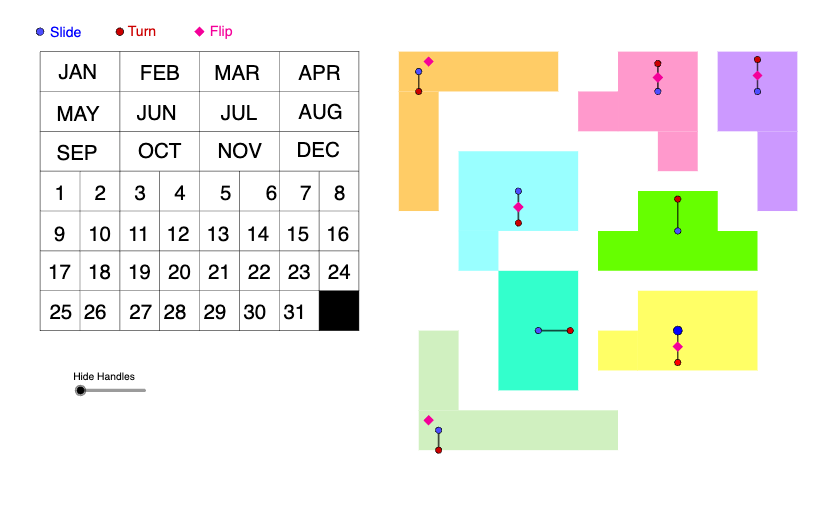
这个范例用几何图形把“日历谜题”中的计数规律可视化,展示在约束条件下日期分布与可预测结构之间的联系。核心数学概念包括:组合计数、同余(congruence)条件带来的周期性、以及在给定条件下进行条件概率的推理(conditional probability)。作图要点是先通过多点与线段构造几何骨架,再用相交与垂线/正交线确定关键位置,随后利用圆与多边形形成对称与约束结构;具体在 GeoGebra 中使用了 Point、Segment、Intersect、Circle、OrthogonalLine、Line、Polygon、Midpoint 等命令,并生成了多组几何对象(如 A、B、C、D 等点及线段、多边形、以及用于刻画约束的圆与中点相关元素)。适合中学高年级到大学入门阶段用于拓展:既可用于课堂探究“同余条件如何影响计数”,也可作为数学建模与可视化学习的练习。
GeoGebra 命令及参数
Point(yAxis) → KPoint(yAxis) → MSegment(J, H) → fSegment(K, M) → gSegment(L, N) → hSegment(G, O) → iSegment(D, C) → kSegment(E, I) → mSegment(F, P) → nSegment(A, B) → pSegment(C, A) → jSegment(D, B) → lPoint(p) → QPoint(p) → RPoint(p) → SIntersect(p, yAxis) → TPoint(p) → UPoint(p) → VPoint(p) → WPoint(i) → A_1Point(i) → B_1Point(i) → C_1Point(j) → D_1Point(j) → E_1Point(l) → G_1Segment(D_1, G_1) → qSegment(E_1, H_1) → rSegment(F_1, I_1) → sSegment(C_1, Q) → tSegment(H, R) → aSegment(B_1, S) → bSegment(M, T) → cSegment(A_1, U) → dSegment(N, V) → eSegment(Z, W) → f_1Circle(J_1, 0.8) → c_1Point(c_1) → K_1Segment(J_1, K_1) → g_1OrthogonalLine(J_1, g_1) → h_1Circle(J_1, 2) → d_1Intersect(d_1, h_1, 2) → L_1Intersect(d_1, h_1, 1) → M_1OrthogonalLine(L_1, h_1) → i_1OrthogonalLine(M_1, h_1) → j_1Circle(L_1, 1) → e_1Circle(M_1, 1) → k_1Intersect(e_1, i_1, 2) → N_1Intersect(e_1, i_1, 1) → O_1Intersect(k_1, j_1, 2) → P_1Intersect(k_1, h_1, 2) → Q_1OrthogonalLine(Q_1, h_1) → l_1Intersect(k_1, j_1, 1) → R_1Line(R_1, h_1) → m_1Line(P_1, h_1) → n_1Intersect(l_1, m_1) → S_1Intersect(l_1, n_1) → T_1Polygon(N_1, T_1, S_1, O_1) → q1, p_1, t_1, s_1, o_1Polygon(P_1, M_1, Q_1, T_1) → q2, q_1, r_1, a_1, b_1Polygon(S_1, R_1, M_1, Q_1) → q3, f_2, g_2, h_2, i_2Midpoint(J_1, K_1) → W_1Circle(U_1, 0.8) → c_2Point(c_2) → Z_1Segment(U_1, Z_1) → j_2OrthogonalLine(U_1, j_2) → k_2Circle(U_1, 1.5) → d_2Intersect(d_2, k_2, 2) → A_2Intersect(d_2, k_2, 1) → B_2Circle(A_2, 1) → e_2OrthogonalLine(A_2, k_2) → l_2Intersect(e_2, l_2, 2) → C_2Intersect(e_2, l_2, 1) → D_2Line(B_2, l_2) → m_2Line(C_2, k_2) → n_2Line(D_2, k_2) → p_2Intersect(m_2, n_2) → E_2Intersect(m_2, p_2) → F_2Polygon(C_2, E_2, F_2, D_2) → q4, q_2, r_2, s_2, t_2Circle(G_2, 0.8) → c_3Point(c_3) → H_2Segment(G_2, H_2) → a_2OrthogonalLine(G_2, a_2) → b_2Circle(G_2, 2) → d_3Intersect(d_3, b_2, 2) → I_2Intersect(d_3, b_2, 1) → J_2Circle(G_2, 1) → e_3Intersect(e_3, b_2, 2) → K_2Intersect(e_3, b_2, 1) → L_2Circle(I_2, 1) → f_3OrthogonalLine(I_2, b_2) → h_3Intersect(f_3, h_3, 2) → M_2Intersect(f_3, h_3, 1) → N_2OrthogonalLine(J_2, b_2) → g_3OrthogonalLine(N_2, h_3) → i_3OrthogonalLine(M_2, h_3) → j_3Intersect(g_3, j_3) → O_2Line(K_2, h_3) → k_3Line(L_2, g_3) → l_3Intersect(i_3, k_3) → P_2Intersect(i_3, l_3) → Q_2Polygon(M_2, I_2, K_2, P_2, Q_2, L_2, J_2, O_2) → poly1, m_3, n_3, p_3, q_3, r_3, s_3, t_3, o_2Circle(R_2, 0.8) → c_4Point(c_4) → S_2Segment(R_2, S_2) → a_3OrthogonalLine(R_2, a_3) → b_3Circle(R_2, 1.5) → d_4Intersect(d_4, b_3, 2) → T_2Intersect(d_4, b_3, 1) → U_2OrthogonalLine(T_2, b_3) → f_4Circle(T_2, 1) → e_4Intersect(e_4, f_4, 2) → V_2Intersect(e_4, f_4, 1) → W_2OrthogonalLine(U_2, b_3) → g_4OrthogonalLine(V_2, f_4) → h_4OrthogonalLine(W_2, f_4) → i_4Intersect(g_4, h_4) → Z_2Intersect(g_4, i_4) → A_3Circle(Z_2, 1) → k_4Intersect(k_4, h_4, 1) → B_3OrthogonalLine(B_3, h_4) → j_4Intersect(i_4, j_4) → C_3Circle(B_3, 1) → p_4Circle(C_3, 1) → q_4Intersect(p_4, j_4, 1) → D_3Intersect(q_4, j_4, 2) → E_3OrthogonalLine(D_3, j_4) → l_4OrthogonalLine(E_3, j_4) → m_4Intersect(g_4, l_4) → F_3Intersect(m_4, g_4) → G_3Polygon(V_2, Z_2, A_3, W_2) → q5, v_2, z_2, n_4, w_2Polygon(D_3, F_3, Z_2, B_3) → q6, r_4, s_4, t_4, a_4Polygon(C_3, A_3, G_3, E_3) → q7, b_4, f_5, g_5, h_5Midpoint(R_2, S_2) → H_3Circle(I_3, 0.8) → c_5Point(c_5) → J_3Segment(I_3, J_3) → i_5OrthogonalLine(I_3, i_5) → j_5Circle(I_3, 1) → d_5Intersect(d_5, j_5, 2) → K_3Intersect(d_5, j_5, 1) → L_3OrthogonalLine(I_3, j_5) → k_5Intersect(d_5, k_5, 2) → M_3Intersect(d_5, k_5, 1) → N_3Line(N_3, j_5) → l_5Line(L_3, k_5) → m_5Line(K_3, k_5) → n_5Line(M_3, j_5) → p_5Intersect(n_5, p_5) → O_3Intersect(l_5, n_5) → P_3Intersect(l_5, m_5) → Q_3Intersect(m_5, p_5) → R_3Circle(R_3, 2) → e_5Intersect(e_5, m_5, 2) → S_3Line(S_3, p_5) → q_5Intersect(k_5, q_5) → T_3Circle(Q_3, 2) → r_5Intersect(r_5, m_5, 1) → U_3Line(U_3, j_5) → s_5Intersect(k_5, s_5) → V_3Polygon(O_3, R_3, Q_3, P_3) → q8, o_3, t_5, a_5, b_5Polygon(N_3, V_3, U_3, Q_3) → q10, i_6, v_3, u_3, j_6Polygon(T_3, M_3, R_3, S_3) → q9, f_6, g_6, h_6, k_6Midpoint(I_3, J_3) → W_3Circle(Z_3, 0.5) → c_6Point(c_6) → A_4Segment(Z_3, A_4) → l_6OrthogonalLine(Z_3, l_6) → m_6Intersect(c_6, m_6, 1) → C_4OrthogonalLine(C_4, m_6) → n_6Circle(C_4, 0.5) → e_6Intersect(e_6, n_6, 2) → D_4Circle(D_4, 4) → d_6Intersect(d_6, n_6, 1) → B_4Line(D_4, m_6) → p_6Intersect(d_6, p_6, 2) → E_4Intersect(c_6, m_6, 2) → F_4Line(F_4, n_6) → q_6Intersect(e_6, n_6, 1) → G_4Line(G_4, m_6) → r_6Line(E_4, q_6) → s_6Intersect(r_6, s_6) → H_4Line(B_4, p_6) → t_6Intersect(q_6, t_6) → I_4Intersect(q_6, r_6) → J_4Polygon(E_4, D_4, G_4, H_4) → q11, a_6, b_6, f_7, g_7Polygon(J_4, G_4, B_4, I_4) → q12, h_7, i_7, j_7, k_7Circle(D_4, 3) → c_7Intersect(c_7, n_6, 2) → K_4Line(K_4, p_6) → l_7Intersect(q_6, l_7) → L_4Intersect(p_6, q_6) → M_4Polygon(L_4, K_4, D_4, M_4) → q13, m_7, n_7, p_7, q_7Midpoint(M_4, Z_3) → N_4Circle(O_4, 0.5) → d_7Point(d_7) → P_4Segment(O_4, P_4) → r_7OrthogonalLine(O_4, r_7) → s_7Intersect(d_7, s_7, 1) → Q_4OrthogonalLine(Q_4, s_7) → t_7Circle(Q_4, 0.5) → e_7Intersect(e_7, t_7, 2) → R_4OrthogonalLine(R_4, t_7) → a_7Circle(R_4, 5) → c_8Intersect(c_8, a_7, 1) → S_4Intersect(e_7, t_7, 1) → T_4Line(T_4, a_7) → b_7Line(S_4, t_7) → f_8Intersect(b_7, f_8) → U_4Circle(R_4, 1) → d_8Intersect(d_8, a_7, 1) → V_4Line(V_4, t_7) → g_8Circle(R_4, 3) → e_8Intersect(e_8, t_7, 1) → W_4Line(W_4, a_7) → h_8Intersect(g_8, h_8) → Z_4Intersect(b_7, g_8) → A_5Polygon(S_4, R_4, T_4, U_4) → q14, i_8, j_8, k_8, u_4Polygon(A_5, Z_4, W_4, T_4) → q15, l_8, z_4, w_4, m_8Circle(R_4, 2) → p_8Intersect(p_8, t_7, 2) → B_5Line(B_5, h_8) → n_8Intersect(g_8, n_8) → C_5Polygon(C_5, B_5, R_4, V_4) → q16, q_8, r_8, s_8, v_4Midpoint(R_4, O_4) → D_5Circle(E_5, 0.7) → t_8Circle(E_5, 1) → c_9Point(t_8) → F_5Segment(E_5, F_5) → a_8OrthogonalLine(E_5, a_8) → b_8Intersect(c_9, b_8, 1) → H_5Intersect(c_9, b_8, 2) → G_5OrthogonalLine(G_5, b_8) → f_9OrthogonalLine(H_5, b_8) → g_9Circle(G_5, 1) → d_9Intersect(d_9, f_9, 2) → I_5Intersect(d_9, f_9, 1) → J_5OrthogonalLine(I_5, f_9) → h_9OrthogonalLine(J_5, f_9) → i_9Intersect(g_9, h_9) → K_5Intersect(g_9, i_9) → L_5Circle(L_5, 1) → e_9Intersect(e_9, g_9, 1) → M_5Intersect(e_9, i_9) → N_5, O_5Intersect(e_9, i_9, 2) → P_5Line(N_5, g_9) → j_9Line(M_5, i_9) → k_9Intersect(k_9, j_9) → Q_5Circle(K_5, 1) → p_9Intersect(p_9, h_9, 2) → R_5Line(R_5, g_9) → l_9Intersect(b_8, l_9) → S_5Polygon(I_5, K_5, L_5, J_5) → q17, m_9, n_9, q_9, r_9Polygon(N_5, Q_5, M_5, L_5) → q18, s_9, t_9, a_9, b_9Polygon(K_5, R_5, S_5, H_5) → q19, f_{10}, g_{10}, h_{10}, i_{10}Intersect(d_9, b_8, 2) → T_5Line(T_5, f_9) → j_{10}Intersect(h_9, j_{10}) → U_5Polygon(U_5, I_5, G_5, T_5) → q20, u_5, k_{10}, l_{10}, m_{10}Intersect(p_9, g_9, 2) → V_5Line(V_5, h_9) → n_{10}Intersect(j_9, n_{10}) → W_5Intersect(h_9, j_9) → Z_5Polygon(W_5, V_5, K_5, Z_5) → q21, w_5, v_5, p_{10}, z_5Midpoint(E_5, F_5) → A_6Intersect(s, f_1) → B_6Polygon(B_6, W, B, I_1) → q22, q_{10}, w, b_{10}, r_{10}
AI 绘图提示语参考
画一个几何图形,展示一个日历谜题的数学解释。中心是两条垂直线相交于点,形成四个象限。在每条线上标记点,连接这些点形成多个线段和三角形。添加圆和正方形,使图形对称。用正交线找到关键点,并连接这些点形成新的几何形状。最终图形应展示出约束条件下的周期性规律和概率关系。
以上提示语为根据原始绘图命令整理而来,仅供参考。