
四边形内角和与外角和定理演示(V2)
几何画板及绘图内容加载中,请稍等……
所属专题
Polygons & Angles
Polygons & Angles
Polygons & Angles ( s n attar)
Polygons & Angles
Polygons & Angles
Polygons & Angles
Polygons & Angles
Geometry: Polygons & Angles
Geometry: Polygons & Angles
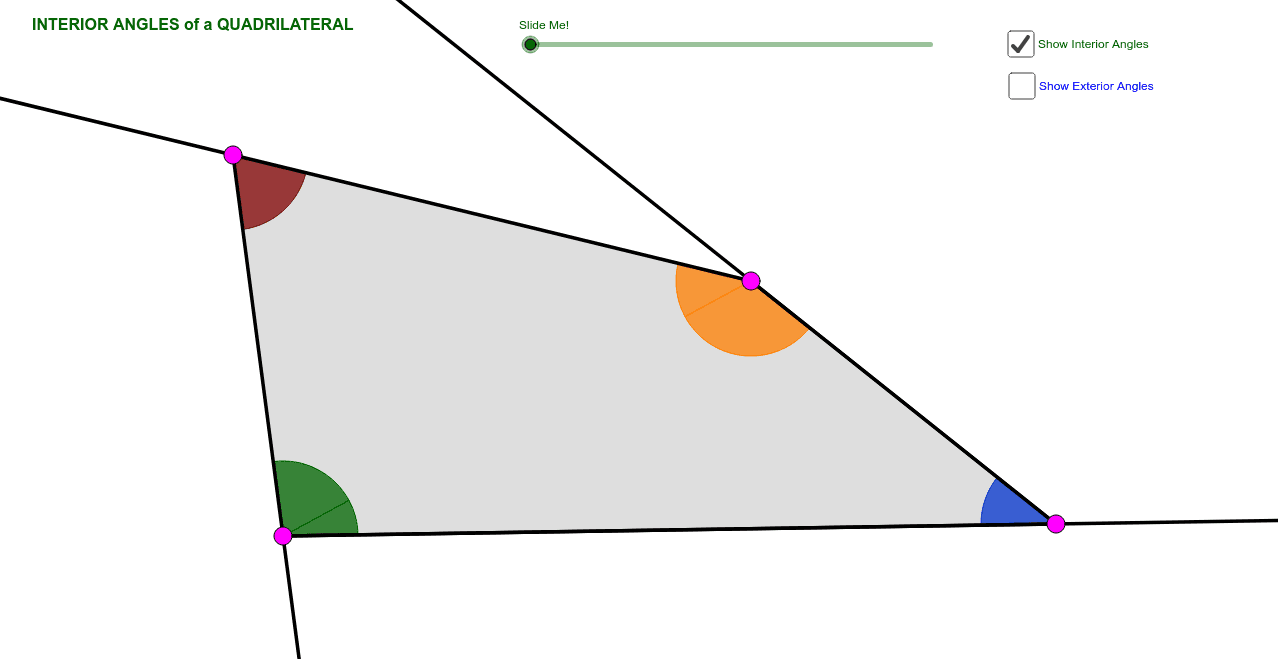
① 本范例动态演示任意四边形的内角和始终为 360°,以及外角和也为 360° 的几何事实。② 涉及核心数学概念:四边形、内角、外角、角度和定理、多边形角性质。③ 作图要点:使用 Ray、Point、Circle、Intersect、Segment、Angle、CircleSector、Vector、Translate、Dilate、If、Line、Polygon、Rotate、Mirror 等命令构建顶点、边、射线、圆弧、扇形、向量平移、缩放、条件判断、旋转与镜像,实现角度的动态测量与求和。④ 适用于初中几何(七至九年级)角度与多边形章节的教学演示、自主探究及考试复习。
GeoGebra 命令及参数
Ray(P, A) → h_1Point(h_1) → RRay(A, R) → j_1Ray(A, B) → aCircle(A, 1.5) → gIntersect(g, j_1) → I_1,Intersect(g, a, 1) → HSegment(P, A) → l_1Intersect(g, l_1, 1) → H_1Segment(P, C) → k_1Circle(C, 1.5) → kIntersect(k, k_1) → Z,Ray(B, C) → bIntersect(k, b) → M, NPoint(a) → D_1Point(b) → E_1Ray(B, D_1) → eRay(C, E_1) → fPoint(e) → DPoint(f) → EAngle(A, C, B) → γAngle(D, B, C) → εAngle(E, C, A) → ζCircle(B, 1.5) → hIntersect(h, b, 1) → JIntersect(h, a, 1) → KIntersect(h, a, 2) → LCircleSector(B, J, K) → qCircleSector(B, L, J) → tVector(B, C) → uCircleSector(A, I_1, H) → c_1Vector(A, C) → vTranslate(q, u) → q'Segment(B, C) → lDilate(C, If[0 < j ≤ 1, j, 0], B) → C'Vector(B, C') → wTranslate(q, w) → q'_1Dilate(A, If[1 < j ≤ 2, 2 - j, 0], C) → C'_1Vector(A, C'_1) → mDilate(C, If[0 < n ≤ 1, n, 0], B) → C'_2Dilate(A, If[1 < n ≤ 2, 2 - n, 0], C) → A'Vector(B, C'_2) → u_1Vector(A, A') → v_1If(0 < n ≤ 1, Translate[t, u_1], Translate[t, u]) → e_1If(1 < n ≤ 2, Translate[c_1, v_1], Translate[c_1, v]) → f_1Ray(C, P) → g_1Point(g_1) → QRay(P, Q) → i_1Point(i_1) → SPoint(j_1) → TCircle(P, 1.5) → p_1Intersect(p_1, l_1) → U,Intersect(p_1, i_1) → V,Intersect(p_1, k_1) → W,CircleSector(P, U, W) → q_1Intersect(k, b, 2) → A_1Line(P, b) → b_1Intersect(p_1, b_1) → C_1, G_1Angle(B, A, P) → αVector(P, C) → iDilate(P, If[2 < j ≤ 3, 3 - j, 0], C) → P'Vector(P, P') → w_1Translate(q_1, w_1) → r_1CircleSector(C, N, Z) → sCircleSector(P, V, U) → t_1Dilate(P, If[2 < n ≤ 3, 3 - n, 0], C) → P'_1Vector(P, P'_1) → m_1If(2 < n ≤ 3, Translate[t_1, m_1], Translate[t_1, w_1]) → e_2Angle(H, A, I_1) → δAngle(V, P, U) → ηAngle(U, P, W) → θPolygon(A, B, C, P) → poly1, a_2, b_2, c_2, p_2Segment(A, C) → n_1Intersect(g, n_1) → F,Intersect(k, n_1) → G,Line(P, n_1) → cLine(B, n_1) → dCircleSector(C, Z, G) → d_1CircleSector(C, G, M) → s_1CircleSector(A, H, F) → d_2If(0 < j ≤ 1, Dilate[C, 1 - j, B]) → IIf(1 < j ≤ 2, Dilate[A, 2 - j, P]) → OIf(1 < j ≤ 2, Dilate[C, 2 - j, P]) → B_1Vector(C, I) → rVector(A, O) → u_2Translate(s_1, r) → h_2Dilate(A, If[0 < j ≤ 1, 1 - j, Distance[A, B]], B) → A'_1Vector(A, A'_1) → pTranslate(d_2, p) → g_2Rotate(d_2, 180*°, A) → k_2Vector(A, B) → v_2Translate(k_2, v_2) → q_2Rotate(g_2, ((j * 180))°, A'_1) → r_2Vector(C, B) → w_2Translate(s_1, w_2) → s_2Mirror(s_2, B) → t_2Rotate(h_2, ((j * 180))°, I) → c_3Vector(A, P) → i_2Vector(C, P) → j_2CircleSector(A, F, H_1) → f_2Translate(f_2, i_2) → d_3Mirror(d_3, P) → e_3Vector(C, B_1) → l_2Translate(d_1, j_2) → f_3Mirror(f_3, P) → g_3Translate(f_2, u_2) → h_3Translate(d_1, l_2) → k_3Rotate(h_3, (((j - 1) * 180))°, O) → p_3Rotate(k_3, (((j - 1) * 180))°, B_1) → q_3Segment(A, B) → m_2Polygon(A, B, C) → poly2, c_4, a_3, b_3Polygon(A, C, P) → poly3, p_4, a_4, c_5
AI 绘图提示语参考
绘制一个四边形,包括点A、B、C、D和E,以及它们之间的边。首先画出点A和B,然后通过点A画一条射线,与圆相交得到点C。接着画出点B和C之间的射线,与圆相交得到点D。再画出点C和D之间的射线,与圆相交得到点E。最后连接点A、B、C、D和E,形成四边形,并测量其内角和外角,确保内角和为360度,外角和也为360度。
以上提示语为根据原始绘图命令整理而来,仅供参考。