
立方差的无言证明
几何画板及绘图内容加载中,请稍等……
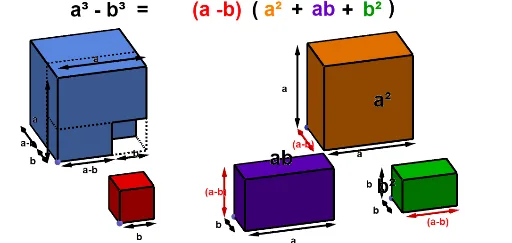
这个范例通过几何图形展示了立方差公式a^3 - b^3的证明过程。核心数学概念包括立方差、几何作图和解析几何。通过使用GeoGebra中的PointIn、Cube、Polygon、Vector等命令,构建了一个立体几何模型,直观地展示了立方差的几何意义。适合初中及以上学生学习立方差公式及其几何解释。
GeoGebra 命令及参数
PointIn(f) → APoint(Circle[B, Distance[C, B], Segment[C, B]]) → LCube(C, B, L) → c, M, faceLMQP, faceNOPQ, arêteCM_1, arêteBC, arêteBL, arêteLM, arêteCN, arêteMQ, arêteNQ, arêteNO, N, arêteBO, arêteOP_1, arêteLP, arêtePQ, O, P, Q, faceBCML, faceCMQN, faceBCNO, faceBLPOPolygon(E, L, M, C, A, D) → poly1, e, l, m, c_1, a_1, dPolygon(T, U, O, N, C, A) → poly2, t, u, o_3, n, c_2, a_2Polygon(U, R, E, L, P, O) → poly3, u_1, r, e_1, l_1, p, o_1Polygon(P, O, N, Q) → q1, p_1, o_2, n_1, qPolygon(Q, N, C, M) → q2, q_1, n_2, c_3, m_1Polygon(R, S, D, E) → q3, r_1, s, d_1, e_2Polygon(S, T, A, D) → q4, s_1, t_1, a_3, d_2Polygon(U, T, S, R) → q5, u_2, t_2, s_2, r_2PointIn(f) → VVector(C, V) → vTranslate(c, Vector[(If[Animation ≤ 10, Animation / 10, 1] * v)]) → c'Polygon(Q, P, L, M) → q6, q_2, p_2, l_2, m_2Segment(W, C_1) → gSegment(C_1, A_1) → hSegment(B_1, Z) → iSegment(Z, O) → jSegment(W, L) → kPrism(L, A_1, D, E, W) → w, D_1, arête4, arête1, arêteDE, arêteEL, arêteLW, arête7, arête2, arête3, arête5, arête8, E_1, arête9, arête6, F_1, face1, face5, face3, face2, face4, face6Prism(B_1, Z, O, P, D_1) → b_1, G_1, arête13, arêteOZ, arêteOP, arête11, arête15, arête14, arête10, arête12, arête16, arête18, H_1, arête19, arête17, I_1, face7, face11, face9, face8, face10, face12Prism(A_1, A, C, M, B_1) → f_1, J_1, arête20, arêteAC, arêteCM, arête23, arête25, arête21, arête22, arête24, arête26, arête28, K_1, arête29, arête27, L_1, face13, face15, face14, face16, face17, face18PointIn(f) → M_1Vector(D, M_1) → v_1PointIn(f) → N_1PointIn(f) → O_1Vector(B_1, N_1) → w_1Translate(b_1, Vector[((Animation - 10) / 10 * w_1)]) → g_1Vector(A_1, O_1) → h_1Translate(f_1, Vector[((Animation - 10) / 10 * h_1)]) → i_1Translate(c, Vector[(If[Animation ≤ 10, Animation / 10, 1] * v)]) → c'_1Translate(b_1, Vector[((Animation - 10) / 10 * w_1)]) → j_1Translate(w, Vector[((Animation - 10) / 10 * v_1)]) → w'_1Translate(f_1, Vector[((Animation - 10) / 10 * h_1)]) → k_1Translate(w, Vector[((Animation - 10) / 10 * v_1)]) → w'Midpoint(R_1, S_1) → Z_1Vector(Z_1, S_1) → v_2Vector(Z_1, R_1) → w_2Midpoint(T_1, U_1) → A_2Vector(A_2, U_1) → b_2Vector(A_2, T_1) → f_2Midpoint(B_2, Q_1) → C_2Vector(C_2, Q_1) → g_2Vector(C_2, B_2) → h_2Midpoint(D_2, B_2) → E_2Vector(E_2, B_2) → i_2Vector(E_2, D_2) → j_2Midpoint(P_1, Q_1) → F_2Vector(F_2, P_1) → k_2Vector(F_2, Q_1) → u_3Midpoint(W_1, V_1) → G_2Vector(G_2, W_1) → v_3Vector(G_2, V_1) → w_3Segment(C, B) → f_3Segment(L, B) → g_3Segment(O, B) → h_3Midpoint(M_2, N_2) → W_2Vector(W_2, N_2) → b_3Vector(W_2, M_2) → d_3Midpoint(P_2, Q_2) → Z_2Midpoint(U_2, V_2) → A_3Midpoint(K_2, J_2) → B_3Vector(B_3, K_2) → e_3Vector(B_3, J_2) → i_3Vector(Z_2, Q_2) → j_3Vector(Z_2, P_2) → k_3Midpoint(R_2, S_2) → C_3Midpoint(T_2, R_2) → D_3Midpoint(H_2, I_2) → E_3Vector(E_3, I_2) → l_3Vector(E_3, H_2) → m_3Vector(D_3, T_2) → n_3Vector(D_3, R_2) → p_3Vector(C_3, S_2) → q_3Vector(C_3, R_2) → r_3Vector(A_3, V_2) → s_3Vector(A_3, U_2) → t_3Midpoint(J_2, L_2) → F_3Vector(F_3, L_2) → u_4Vector(F_3, J_2) → v_4Midpoint(O_2, H_2) → G_3Vector(G_3, O_2) → w_4Vector(G_3, H_2) → a_4Midpoint(U_1, H_3) → I_3Vector(I_3, H_3) → b_4Vector(I_3, U_1) → c_4PointIn(w') → J_3PointIn(k_1) → K_3PointIn(j_1) → L_3
AI 绘图提示语参考
绘制一个立方体差公式 a^3 - b^3 的几何证明,展示两个立方体的差值。首先构建一个立方体,然后通过几何构造和坐标几何,将立方体差值分解为多个几何形状,并用不同颜色的多边形和线段表示。最终图形应包含多个几何体和向量,清晰展示立方体差值的几何意义,适合初中及以上学生理解。
以上提示语为根据原始绘图命令整理而来,仅供参考。