
棱柱体积与底面积关系演示
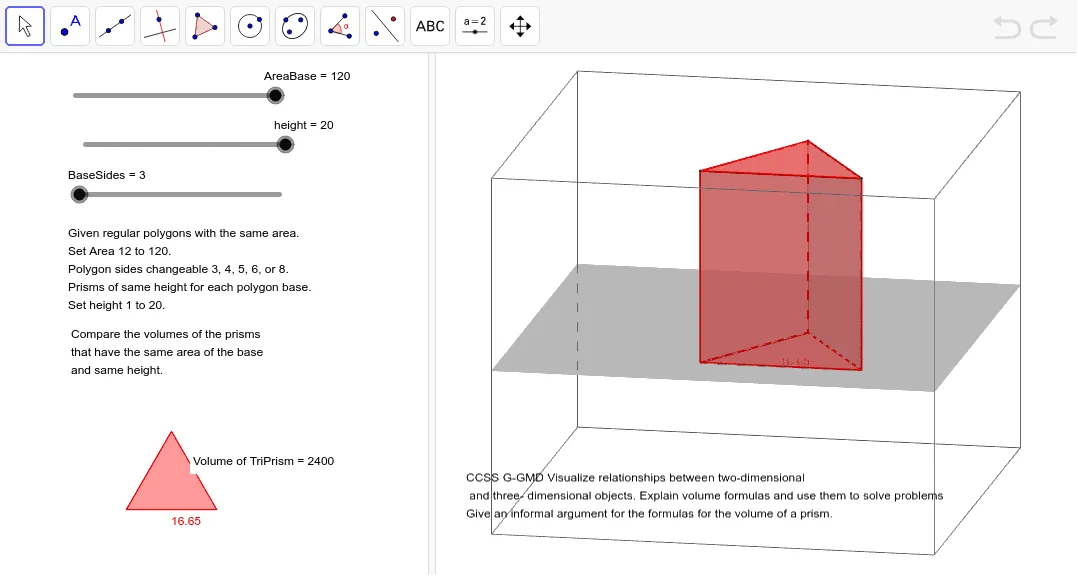
几何画板及绘图内容加载中,请稍等……
①本范例演示固定底面积时不同棱柱体积的变化规律;②涉及核心概念:棱柱体积公式、底面积恒定、立体几何;③作图要点:使用Point、Segment、Polygon、Prism、Volume等命令构建棱柱模型,通过Slider动态调整参数;④适合高中立体几何教学,用于理解体积与底面积的关系。
GeoGebra 命令及参数
Point(Circle[A, sqrt((4 * AreaBase / tan(60°)))]) → BSegment(A, B) → fPolygon(A, B, 3) → reg3, g, h, i, CPoint(Circle[A, AreaBase / sqrt(AreaBase)]) → DSegment(A, D) → jPolygon(A, D, 4) → reg4, k, l, m, n, E, FPoint(Circle[A, sqrt((4 * AreaBase / sqrt(25 + (10 * sqrt(5)))))]) → GSegment(A, G) → pPolygon(A, G, 5) → reg5, q, r, s, t, a, H, I, JPoint(Circle[A, sqrt(((2 * AreaBase)) / ((3 * sqrt(3))))]) → KSegment(A, K) → bPolygon(A, K, 6) → reg6, c, O, d, e, f_1, g_1, h_1, L, M, NPoint(Circle[A, sqrt(AreaBase / (2 + (2 * sqrt(2))))]) → PSegment(A, P) → i_1Polygon(A, P, 8) → reg8, j_1, R, S, T, U, V, k_1, l_1, m_1, n_1, p_1, q_1, r_1, QPrism(reg3, top) → TriPrism, W, edgetopW, edgeWZ, edgetopZ, Z, faceABWtop, faceBCZW, faceACZtop, facetopWZ, edgeAtop_1, edgeBW, edgeCZPrism(reg4, top) → SqPrism, A_1, edge1, edge2, edge3, edge4, edge6, edge7, edge5, B_1, C_1, face1, face3, face4, face2, face5, edgeAtop_2Prism(reg5, top) → PentPrism, D_1, face11, edgeAtop_3, edge8, edge9, edge10, edge11, edge12, edge14, edge15, edge16, E_1, edge13, F_1, G_1, face6, face8, face9, face10, face7Prism(reg6, top) → HexPrism, H_1, face17, face13, face18, edgeAtop_4, edge17, edge18, edge19, edge20, edge21, edge22, I_1, edge24, edge25, edge26, edge27, edge23, J_1, K_1, L_1, face12, face14, face15, face16Prism(reg8, top) → OctPrism, M_1, face22, face23, face24, face25, face26, face20, face27, edgeAtop, edge28, edge29, N_1, edge30, edge31, edge32, edge33, edge34, edge35, edge37, edge38, edge39, edge40, O_1, edge41, edge42, edge36, P_1, Q_1, R_1, S_1, face19, face21Volume(OctPrism) → volumeOctPrismPoint(OctPrism) → PointOctPrism_1Volume(HexPrism) → volumeHexPrismPoint(HexPrism) → PointHexPrism_1Volume(TriPrism) → volumeTriPrismPoint(TriPrism) → PointTriPrismVolume(SqPrism) → volumeSqPrismPoint(SqPrism) → PointSqPrismVolume(HexPrism) → oPoint(HexPrism) → PointHexPrismVolume(OctPrism) → uPoint(OctPrism) → PointOctPrismVolume(PentPrism) → volumePentPrismPoint(PentPrism) → PointPentPrism_1Volume(PentPrism) → vPoint(PentPrism) → PointPentPrism