
多项式乘法演示 by Walch Education
几何画板及绘图内容加载中,请稍等……
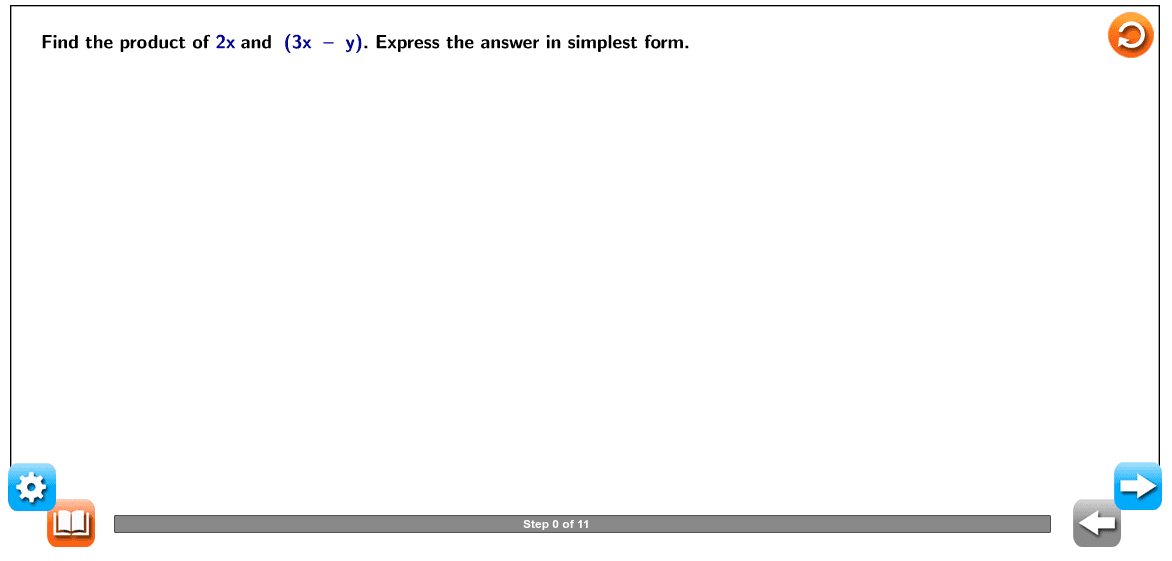
本范例演示了如何使用 GeoGebra 计算 [math]2x[/math] 和 [math](3x – y)[/math] 的乘积并化简。涉及的核心数学概念为多项式乘法与化简。作图要点包括使用 Segment、Sequence、LaTeX、Vector 等命令,以及 Calc、Hint、Next、Grey_Prev、Grey_next、Prev、steps、Progressbar、A_0、stepmax、B_0、Scaleline、list1、list2、list3、Scalevalue0、Scalevalue1、p、q、Scalevalue2、Scalevalue3、Scalevalue4、Scalevalue5、Scalevalue6、Scalevalue7、Scalevalue8、Scalevalue9、Scalevalue10、Multiplier、C_0、D_0、j、u、Random、Original、DummyDatakit、Words、Datakit_Close、Hint_Close、Border 等对象。适合初中及以上学生学习多项式运算和 GeoGebra 操作。
GeoGebra 命令及参数
Segment(A_0, B_0) → ScalelineSequence(Segment[A_0 + (i, 0), A_0 + (i, (-0.5))], i, 0, 10) → list1Sequence(Segment[A_0 + (i - 0.5, 0), A_0 + (i - 0.5, (-0.4))], i, 1, 10) → list2Sequence(Sequence[Segment[A_0 + ((0.5 * i) + (0.1 * j), 0), A_0 + ((0.5 * i) + (0.1 * j), (-0.3))], j, 1, 4], i, 0, 19) → list3LaTeX("\text{0}") → Scalevalue0LaTeX("\text{1}") → Scalevalue1LaTeX("\text{2}") → Scalevalue2LaTeX("\text{3}") → Scalevalue3LaTeX("\text{4}") → Scalevalue4LaTeX("\text{5}") → Scalevalue5LaTeX("\text{6}") → Scalevalue6LaTeX("\text{7}") → Scalevalue7LaTeX("\text{8}") → Scalevalue8LaTeX("\text{9}") → Scalevalue9LaTeX("\text{10}") → Scalevalue10Segment(D_0, (x(D_0), 0)) → jVector(C_0, D_0) → uLaTeX("\text{Use the Distributive Property to find the product of the two expressions.}") → text2LaTeX("\text{by each term in the second expression.}") → text5LaTeX("\text{Apply the Distributive Property.}") → text9LaTeX("\text{Simplify the multiplication.}") → text12LaTeX("\text{Simplify.}") → text13LaTeX("\text{Combine the like terms.}") → text15LaTeX((("\text{Thus, to apply the Distributive Property in order to multiply the expressions, multiply the first expression, \textcolor{#000099}{" * Multiplier) * "x},}")) → text4LaTeX((("\text{Multiply \textcolor{#000099}{" * Multiplier) * "x} by each term in the second expression.}")) → text7Segment((0, 0), (0, 1.6)) → iSegment(F_0, (x(F_0), 0)) → kVector(E_0, F_0) → vLaTeX("\text{where \textcolor{#000099}{a ≠ 0}. The graph of any quadratic function is a parabola.}") → text21LaTeX((((("\text{the same power. In this case, although both terms contain the variable \textcolor{#000099}{x}, the first term, \textcolor{#000099}{" * mul1) * "x²}, has an exponent of \textcolor{#000099}{") * Multiplier) * "}.}")) → text17LaTeX((((((("\text{The expression to be multiplied is \textcolor{#000099}{(" * Multiplier) * "x)(") * Multiplicand) * "x -y)}. Notice that the first expression, \textcolor{#000099}{") * Multiplier) * "x}, only has one term.}")) → text3LaTeX((((("\text{\textcolor{#000099}{(" * Multiplier) * "x)(") * Multiplicand) * "x -y)}}")) → text6LaTeX((((((("\text{\textcolor{#000099}{= " * Multiplier) * "x\; •\; ") * Multiplicand) * "x + ") * Multiplier) * "x\; • -y}}")) → text8LaTeX((((("\text{\textcolor{#000099}{= " * mul1) * "x² + (-") * Multiplier) * "xy)}}")) → text10LaTeX((((("\text{\textcolor{#000099}{= " * mul1) * "x²-") * Multiplier) * "xy}}")) → text11LaTeX((((((((("\text{The result of applying the Distributive Property to \textcolor{#000099}{(" * Multiplier) * "x)(") * Multiplicand) * "x-y)} is \textcolor{#000099}{") * mul1) * "x² -") * Multiplier) * "xy}.}")) → text14LaTeX((((((((("\text{The result of multiplying \textcolor{#000099}{" * Multiplier) * "x} and \textcolor{#000099}{(") * Multiplicand) * "x-y)} is \textcolor{#000099}{ ") * mul1) * "x²-") * Multiplier) * "xy}. Recall that like terms must have the same variables raised to}")) → text16LaTeX((("\text{In the second term, \textcolor{#000099}{-" * Multiplier) * "xy}, the variable \textcolor{#000099}{x} has an understood exponent of \textcolor{#000099}{1}. Therefore, these terms are not like terms.}")) → text18LaTeX((((((((("\text{Thus, when \textcolor{#000099}{" * Multiplier) * "x} and \textcolor{#000099}{(") * Multiplicand) * "x-y)} are multiplied, the simplified result is \textcolor{#000099}{") * mul1) * "x² -") * Multiplier) * "xy}.}")) → text19LaTeX((((("\text{Find the product of \textcolor{#000099}{" * Multiplier) * "x\;}and\textcolor{#000099}{ \;(") * Multiplicand) * "x\; –\; y)}. Express the answer in simplest form.}")) → text1LaTeX("\text{\mathbf{quadratic \;function}}\text{ a function that can be written in the form \textcolor{#000099}{f(x) = ax² + bx + c},}") → text20LaTeX((("\text{Multiplier=" * Multiplier) * "x}")) → Datakit_Value1LaTeX((("\text{Multiplicand=(" * Multiplicand) * "x \textendash y)}")) → Datakit_Value2